Is Polypropylene Food Safe? Why PP Resin Is Not the Same as a Food Grade Bag
FDA lets polypropylene be used in contact with food, but that covers the resin only. See what 21 CFR 177.1520 sets and what a food grade bulk bag also needs.
PackTonne Sourcing Desk · · 7 min read
Polypropylene is a plastic US regulation allows in contact with food, but that covers the resin, not the bag. A food grade bulk bag also depends on what else goes into it and how the factory makes it. “PP is food safe” answers one question out of three.
What the FDA Says About Polypropylene
FDA regulation lists polypropylene among the plastics that may be used in contact with food. 21 CFR 177.1520 says the olefin polymers it lists may be safely used as articles or components of articles that contact food, subject to the provisions of that section. Polypropylene, made by catalytic polymerization of propylene, is one of them. So is polyethylene.
The section sets specifications for the resin. For polypropylene as defined in the regulation, they are:
| Property | Limit in 21 CFR 177.1520 |
|---|---|
| Density | 0.880 to 0.913 |
| Melting point | 160 to 180 °C |
| n-hexane extractable fraction | 6.4% maximum by weight, at reflux temperature |
| Xylene soluble fraction | 9.8% maximum by weight, at 25 °C |
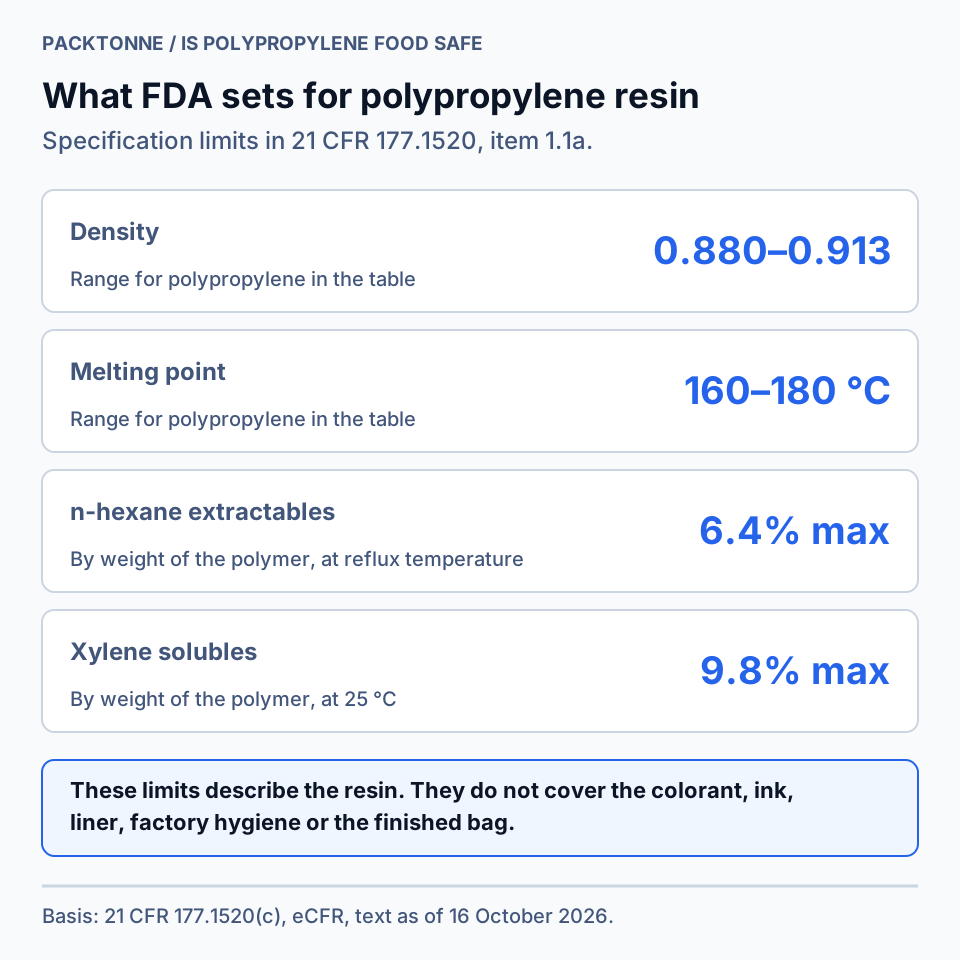
The resin may also contain optional adjuvant substances needed to make it, such as those permitted under other FDA food-contact regulations. That is a long list of conditions, and the regulation is the place to check them. The table is a summary, not a compliance test.
Is Polypropylene Toxic?
This guide does not give health advice. It looks at what regulation and published research show, and what that means for a buyer.
FDA permits polypropylene for food contact under defined conditions, and those conditions include limits on how much of the resin can be extracted or dissolved in the test solvents. Research adds a caution about products rather than the resin. A 2019 laboratory study tested 34 plastic consumer products across eight polymer types. It found that the toxicities of polypropylene, LDPE and polystyrene products varied, and that products which caused no toxicity in its tests were already on the market. The tests were in vitro, so they show the products differ, not that any one causes harm.
A review of plastic additives makes a related point: additives in plastic products can potentially migrate into food from packaging. Additives are separate from the resin, which is why this guide keeps asking about the whole product. Research on microplastics is outside its scope.
For a buyer the practical question is narrow: is this particular product, with its colorants, additives and liner, declared compliant for the way you will use it? The resin name does not answer that. For the material’s other properties, see our guide to what polypropylene is.
Is Polypropylene BPA Free?
Yes in the sense that matters for the polymer itself. FDA explains that BPA is an industrial chemical used to make polycarbonate, and that it is also found in epoxy resins used as can linings. 21 CFR 177.1520 defines polypropylene as basic polymers made by catalytic polymerization of propylene, so BPA is not a building block of it.
That statement covers the polymer only. A bag also contains colorant, other additives, ink and usually a liner, so “BPA free” for the resin does not replace a declaration for the finished bag.
Permitted Does Not Mean Unrestricted
The regulation attaches conditions to some materials in the same section. Certain olefin copolymers in 21 CFR 177.1520 are permitted only for stated conditions of use, and paragraph (f) says the polymers must also meet any specifications that apply to the finished article. So a resin listed as permitted can still be limited by the way the finished article is used.
For polypropylene bags that makes the use case part of the question. What the product is, how hot it is when filled and how long it stays in the bag all matter, and our polypropylene melting point guide covers the heat limits of a bag. Give your supplier the product, the temperature and the time, not just “food”.
Why a PP Bag Is Not Automatically Food Grade
A woven bulk bag is not just resin. It is fabric, thread, colorant, UV stabilizer, sometimes print, and usually a liner. Each is a separate material with its own compliance question.
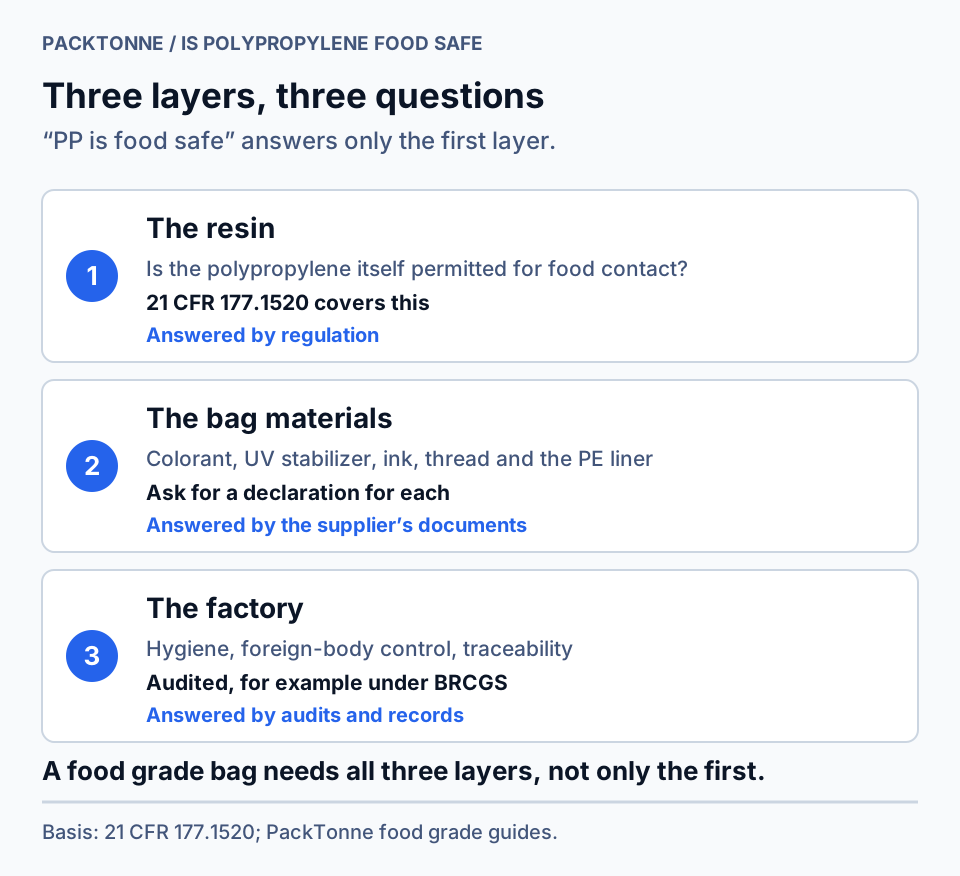
| Layer | What to ask | What answers it |
|---|---|---|
| Resin | Is the polypropylene permitted for food contact? | 21 CFR 177.1520 and the resin supplier |
| Bag materials | Are colorant, UV stabilizer, ink, thread and liner declared for food use? | A declaration of conformity |
| Factory | Is the bag made under hygiene, foreign-body and traceability controls? | Audits and batch records |
The liner deserves its own question. The woven body is polypropylene, while the liner is usually polyethylene, as covered in polypropylene versus polyethylene. The same regulation covers polyethylene, but the liner still needs its own declaration. Our guide to FIBC liners covers the types.
What “Food Grade Polypropylene” Means in Practice
There is no single legal label called food grade polypropylene. A supplier using the phrase usually means that the resin and the other materials are permitted for food contact, and that the product is made in controlled conditions. The phrase is only as good as the documents behind it.
For bulk bags, that means a declaration of conformity that names the materials, batch traceability and, if your customer requires it, a current factory certificate. Our guide to FDA requirements for food grade bulk bags explains the documents, and food grade versus feed grade explains when a customer requires them.
What a Factory Certificate Adds and What It Does Not
A site certificate such as BRCGS shows that a factory runs hygiene and traceability systems. It does not prove that a given bag’s liner meets food-contact rules. Our guide to what a BRC certificate proves covers what it does and does not cover, and the BRC, FDA and EU comparison shows which document each market expects.
Your Food Safety Checklist for PP Bags
- If a supplier says “the bag is polypropylene, so it is food safe”, you should ask for the declaration of conformity instead.
- If the bag has a liner, you should ask for the liner’s film type and its own declaration.
- If your customer requires a factory certificate, you should confirm the certified site is the one making your bags and that the scope covers your product.
- If you plan to reuse a bag from non-food use, you should assume it has no food-contact documents until shown otherwise.
- If your product is hot, fatty or acidic when filled, you should give the supplier the product, temperature and time and ask if the declaration covers them.
- If you are unsure which grade you need, you should settle your customer’s requirement first.
Final Thoughts
Polypropylene can be used in contact with food under FDA regulation, and that is where “food safe” stops being a property of the plastic and becomes a property of the product. A food grade bulk bag is the resin, the other materials and the factory together, each with its own proof. Ask for the documents, not the phrase.
Before You Request a Quote
If your bags will touch food, send us these details and we will ask the partner factory for the documents:
- The product and whether it is for direct human food contact
- Whether you need a liner, and its type
- Any certificate your customer requires, and your destination market
- Filled weight and monthly volume
We will check them against our food grade bulk bags and tell you what to confirm.
Common Questions
Is polypropylene food safe?
Polypropylene is one of the plastics US regulation allows in contact with food. 21 CFR 177.1520 says the olefin polymers it lists, polypropylene among them, may be safely used in articles or components of articles that touch food, subject to the provisions of that section. That covers the resin. A finished product still depends on its other materials and how it is made.
Is polypropylene toxic?
This guide covers regulation and packaging, not health advice. FDA permits polypropylene for food contact under stated conditions, including limits on extractable and soluble fractions of the resin. A 2019 laboratory study found that the toxicity of polypropylene consumer products varied from product to product. So check the maker's declaration for the specific product, not the resin name alone.
Is polypropylene BPA free?
BPA is a building block of polycarbonate and of some epoxy resins, according to FDA. Polypropylene is defined in 21 CFR 177.1520 as a polymer of propylene, so BPA is not part of the polymer. Additives and other bag materials are separate, which is why a declaration for the finished product still matters.
What does food grade polypropylene mean?
There is no single legal label. In practice it means the polypropylene and the other materials in the article are permitted for food contact, and the product is made under controls that keep contamination out. A supplier using the phrase should be able to give a declaration of conformity and describe its production controls.
Is a woven polypropylene bag automatically food safe?
No. Woven polypropylene fabric is made from a resin that can be used for food contact, but a standard bag may be made in an uncontrolled area, with colorant, additives or a liner nobody has declared for food use. A bag sold for food needs documents and production controls on top of the resin.
Is the PE liner in a bulk bag food safe?
It can be, if it is made from resin permitted for food contact and declared that way. 21 CFR 177.1520 covers polyethylene as well as polypropylene. The liner is a separate material from the woven body, so ask for its own declaration and the film type, not just the bag's.
What documents show that a PP bag is food safe?
Ask for a declaration of conformity that names the materials in the bag, including the liner, and for batch traceability. If your customer requires it, ask for the factory's current audit certificate and confirm its scope covers your product. A certificate describes the site, so it does not replace the material declaration.
Can I use any polypropylene bag for food?
Not safely by default. Match the bag to your customer's requirement and your own food safety plan. Bags for food contact should come with material declarations and production controls. A bag for non-food goods may have none, so reusing it for food puts the risk on you.
More in Construction & Materials
All Construction & Materials guides- What Is Polypropylene? 7 Properties That Explain Where It Is UsedPolypropylene is a lightweight, chemical-resistant thermoplastic that floats and melts near 160 °C. Seven properties explain its uses, from caps to bulk bags.
- Polypropylene Recycling: Why #5 Plastic Is Recyclable but Rarely RecycledPolypropylene is recyclable, yet most of it is not captured. See why access, sorting and degraded resin hold it back, and where your PP can actually go.
- Polypropylene Melting Point: Why 160 °C Is Not the Temperature a Bulk Bag Can TakePolypropylene melts at about 160–165 °C, but a bulk bag has lower limits: softening, shrinking tape and a PE liner. See the numbers and what to ask suppliers.
- Polypropylene vs Polyethylene: 10 Differences That Decide Which to UsePP is stiffer, lighter and handles heat to about 160 °C; PE stays tough in the cold and heat-seals easily. Ten differences, the grades of each, and how to choose.