Polypropylene Melting Point: Why 160 °C Is Not the Temperature a Bulk Bag Can Take
Polypropylene melts at about 160–165 °C, but a bulk bag has lower limits: softening, shrinking tape and a PE liner. See the numbers and what to ask suppliers.
PackTonne Sourcing Desk · · 8 min read
Polypropylene melts at about 160–165 °C, but the temperatures that matter for a bulk bag sit much lower. The resin softens under load, drawn tape can shrink, and the polyethylene liner inside gives way sooner than the fabric. Use the melting point to identify the material and the lower limits to decide what you can hot-fill.
What Is the Melting Point of Polypropylene?
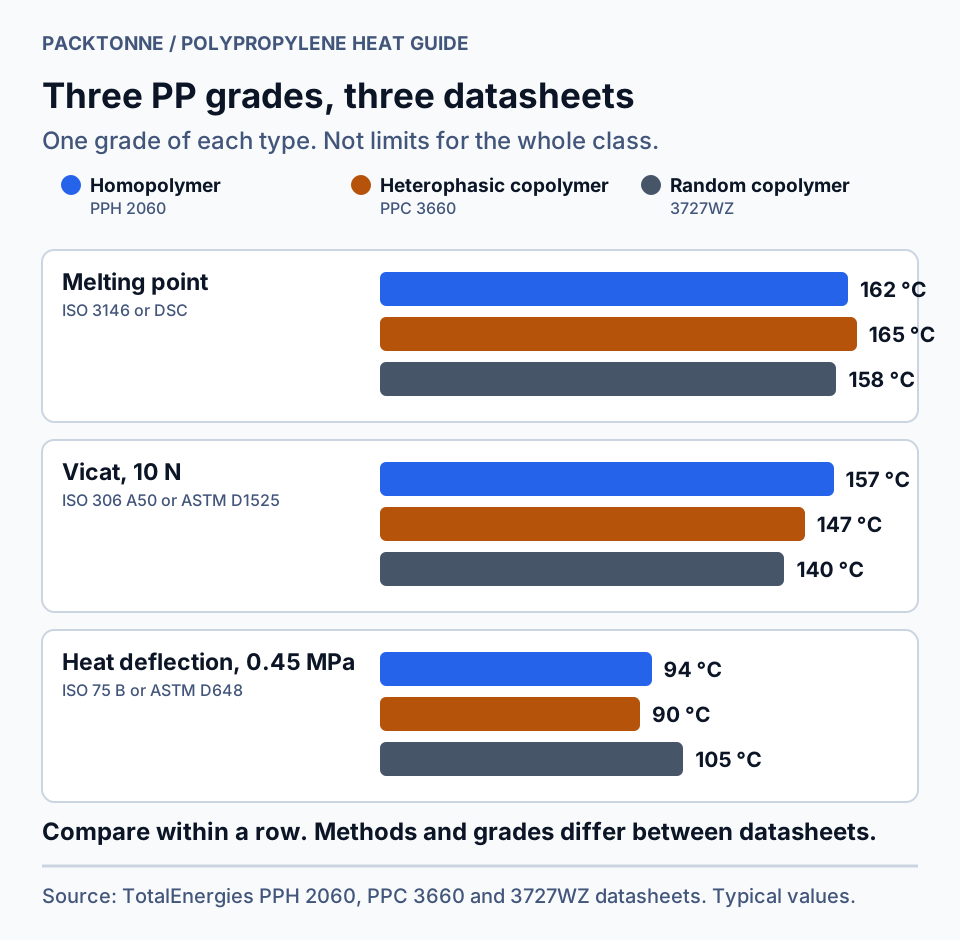
Common polypropylene grades melt at roughly 160–165 °C, with random copolymers a few degrees lower. Three manufacturer datasheets show the pattern.
| Grade type | Datasheet example | Melting point | Vicat, 10 N | Heat deflection, 0.45 MPa |
|---|---|---|---|---|
| Homopolymer | TotalEnergies PPH 2060 | 162 °C (ISO 3146) | 157 °C | 94 °C |
| Heterophasic (impact) copolymer | TotalEnergies PPC 3660 | 165 °C (ISO 3146) | 147 °C | 90 °C |
| Random copolymer | TotalEnergies 3727WZ | 158 °C (DSC) | 140 °C (ASTM) | 105 °C (ASTM) |
These come from the PPH 2060, PPC 3660 and 3727WZ datasheets. TotalEnergies labels the values typical, not specification limits. Each row is one grade, so it describes that grade rather than its whole class, and the methods differ. For the material’s other properties and uses, see what polypropylene is.
Why the Melting Point Is a Range, Not One Number
The melting point depends on the grade, the polymer chain and how it was measured. Polypropylene is partly crystalline, and the crystals melt over a band of temperatures. Ethylene units in a copolymer chain disrupt crystal formation and generally lower the figure, as the 158 °C random copolymer shows. The test method also moves the number: a sheet maker quotes 162–167 °C by ISO 11357-3 in its APSOplast PP datasheet. When you compare two sources, compare the method as well as the value.
Our polypropylene versus polyethylene guide puts the melting point alongside nine other differences.
Five Temperatures That Matter More Than 160 °C
A bag meets heat as softening, deflection and fill limits long before it melts.
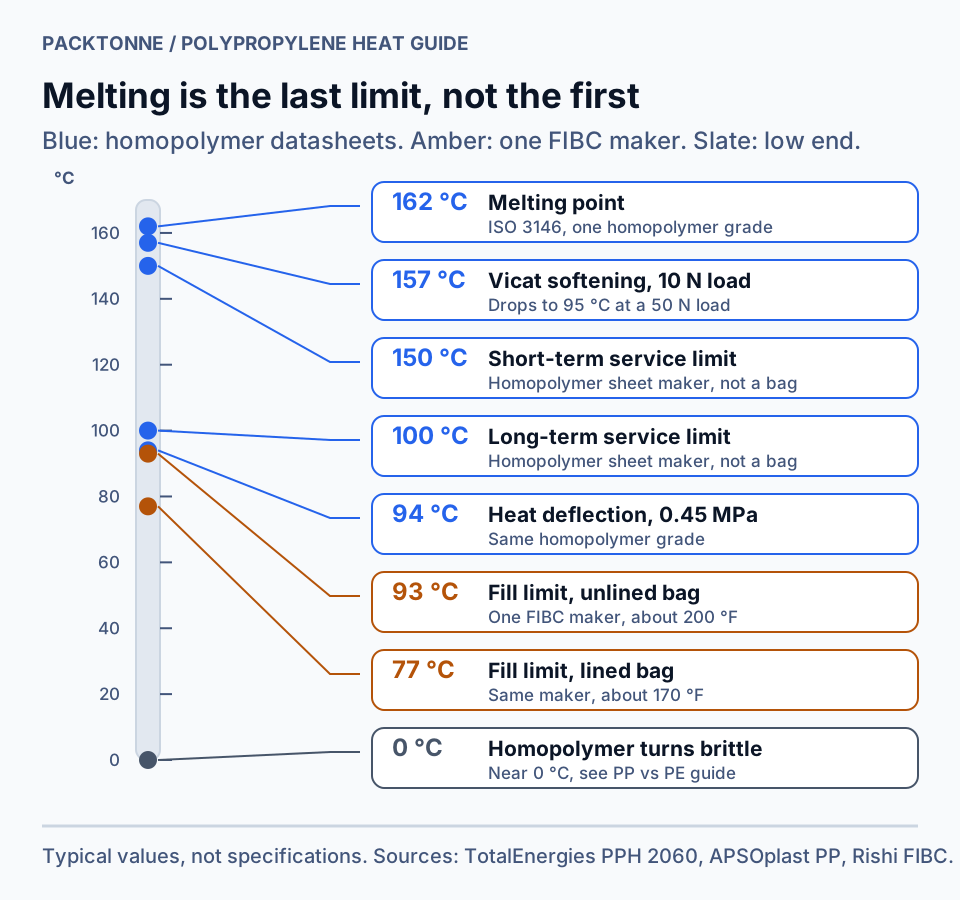
Vicat softening point is the temperature at which a loaded needle sinks a set depth. The same homopolymer reads 157 °C at 10 N and 95 °C at 50 N, so the load changes the answer by more than 60 °C.
Heat deflection temperature is where a loaded bar bends a set amount. For PPH 2060 it is 94 °C at 0.45 MPa, and the heavier 1.80 MPa test for the heterophasic grade drops it to 50 °C.
Service temperature is the sheet maker’s own guidance. APSOplast lists a long-term limit of 100 °C and a short-term limit of 150 °C for its homopolymer sheet. That is solid material, not woven bag fabric holding a tonne.
A filled bag carries far more stress than a test specimen, so it behaves closer to the heavier tests than to the headline figure.
What Heat Does to a Woven Bag
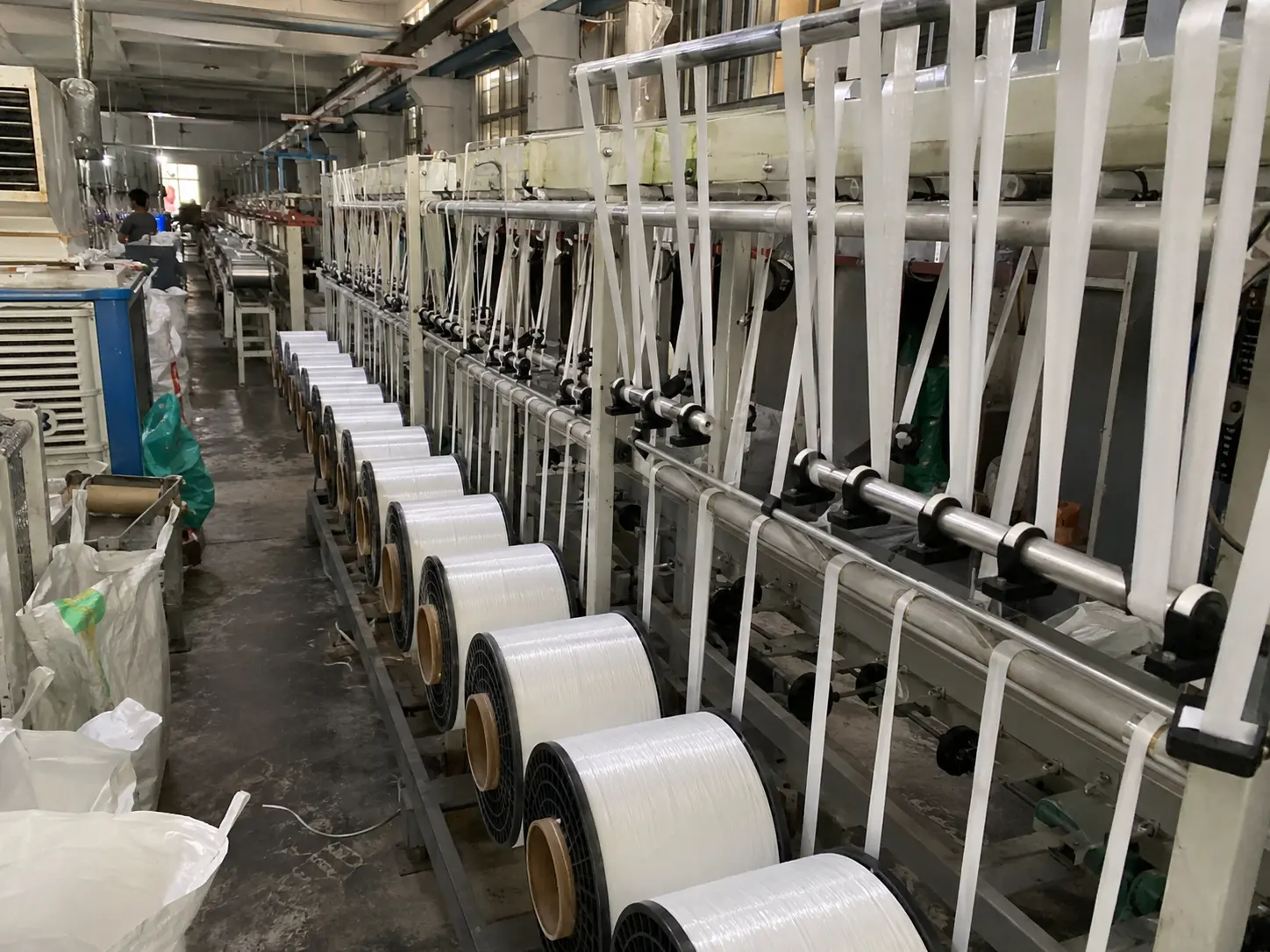
A bulk bag is more than polypropylene resin. It is drawn tape, a liner, thread and seams, and each reacts to heat differently.
The fabric can shrink. Bag fabric is woven from stretched tape (see what woven polypropylene is). A patent on low-shrink tape fibres reports tape-based materials shrinking by a few percent in hot air around 130–150 °C and describes high-shrink tapes as dimensionally unstable. A bag is sewn to fixed dimensions, so shrinkage is worth asking about. Ask whether the fabric is heat-set or low-shrink if your product goes in hot.
The liner often sets the lower limit. One FIBC manufacturer, Rishi FIBC, says polyethylene liners start softening at 195–210 °F (about 91–99 °C) and can melt at 260–295 °F (about 127–146 °C). It advises against filling above 200 °F (about 93 °C), and against filling lined bags above 170 °F (about 77 °C), and recommends testing if the product is hotter. That is one maker’s guidance, not a standard. Our liner guide covers the types.
Duration counts as much as peak temperature. The same guidance tells users to weigh how long a bag stays hot, and not to lift or stack a bag that has been over its limit until the fabric surface cools to around 100 °F (about 38 °C).
The Cold End: Brittle Near 0 °C
Homopolymer polypropylene also has a cold limit. It turns brittle at around 0 °C and can crack on impact in a cold yard, covered in the polypropylene versus polyethylene guide. Heat and cold are separate problems, and a bag specified for one does not cover the other.
Five Questions to Settle Before a Hot Fill
Give the supplier a temperature, a duration and a liner choice, not the word “hot”.
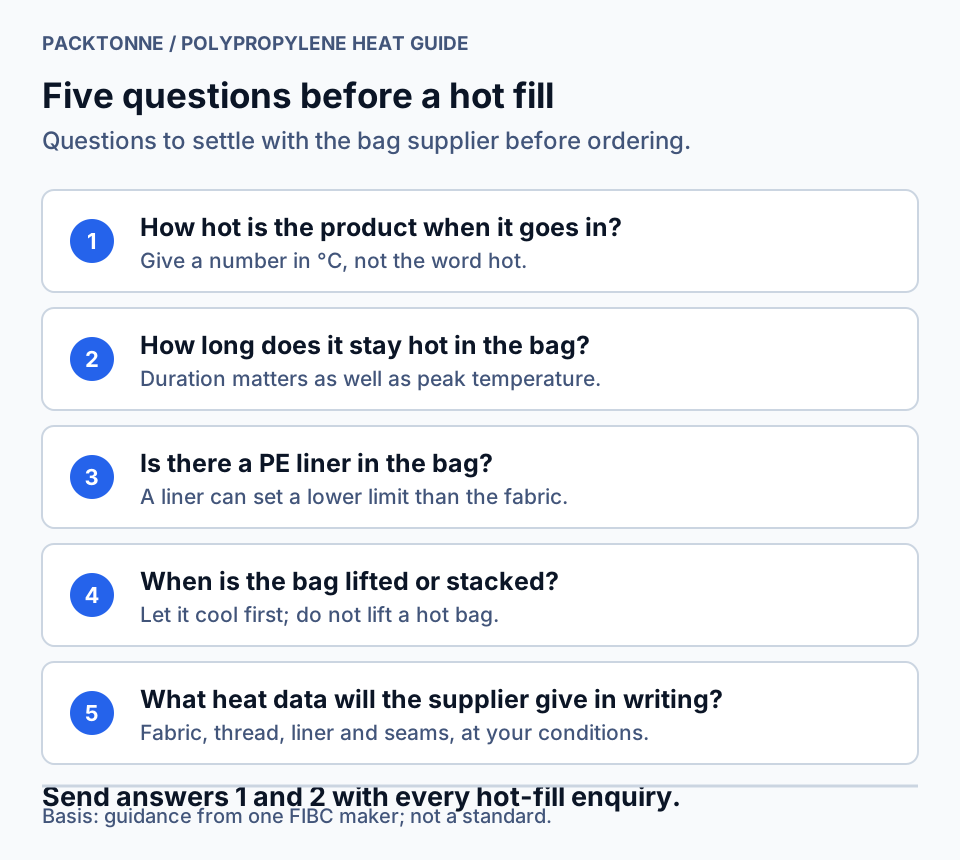
If the product may exceed the supplier’s recommended fill temperature, the Rishi guidance suggests testing the bag at your conditions, and a safety ratio of at least 5:1 is desirable. Our guide to 5:1 versus 6:1 safety factors explains what that means. For sun exposure, a different problem, see UV resistance in FIBC bags.
Your Hot-Fill Checklist
- If you cannot give a product temperature in °C, you cannot get a reliable answer from any supplier.
- If the bag has a PE liner, you should expect the liner, not the fabric, to set your limit.
- If the product stays hot for hours, you should ask for test data at that time and temperature, not just the peak.
- If you plan to stack or lift soon after filling, you should let the bag cool first.
- If a supplier will only say “it is polypropylene, it melts at 160 °C”, you should ask for written heat data instead.
Final Thoughts
The melting point is a property of the resin. A bulk bag is a system of tape, liner, thread and seams, and it is limited by its weakest part under your conditions. Give your supplier the temperature, the time and the liner, and ask for written data. That is more useful than any figure from a datasheet for a different material.
Before You Request a Quote
If you are hot-filling bulk bags, send us these details and we will ask the factory for written heat data on the construction:
- Product and filling temperature in °C
- How long the product stays hot in the bag
- Liner requirement
- Filled weight and how the bag will be lifted or stacked
- Delivery destination and storage conditions
We will check them against a Type A construction and tell you what to confirm.
Common Questions
What is the melting point of polypropylene?
Polypropylene melts at about 160–165 °C for common grades. Manufacturer datasheets list 162 °C for a homopolymer and 165 °C for a heterophasic copolymer, with a random copolymer at 158 °C by a different test method. Treat these as typical values for one grade each, and check the datasheet of the grade you actually use.
Is the melting point the maximum temperature polypropylene can take?
No. Polypropylene softens, loses stiffness and deforms well below its melting point. One homopolymer datasheet lists a Vicat softening point of 157 °C at a light load but 95 °C at a heavier load, and a heat deflection temperature of 94 °C. A sheet maker quotes 100 °C for long-term use. Real limits depend on load and time.
What temperature can a polypropylene bulk bag be filled at?
No standard sets one figure. One FIBC manufacturer advises against filling above 200 °F (about 93 °C), and against filling lined bags above 170 °F (about 77 °C), and recommends testing if the product is hotter. Ask your supplier for written heat data on the exact fabric, liner and seams, and give the product temperature and time.
At what temperature does polypropylene soften?
It depends on how the test is loaded. One homopolymer grade shows a Vicat softening point of 157 °C under a light 10 N load and 95 °C under a 50 N load. Its heat deflection temperature is 94 °C at 0.45 MPa. A loaded bag is closer to the heavier tests than the lighter one, so do not use the headline figure.
Does polypropylene fabric shrink when heated?
It can. Woven bag fabric is made from drawn polypropylene tape, and patent literature on tape fibres reports shrinkage of a few percent in hot air at temperatures around 130–150 °C, noting that high-shrink tapes are dimensionally unstable. Ask your supplier whether the fabric is heat-set or low-shrink if your product goes in hot.
Which melts at a higher temperature, polypropylene or polyethylene?
Polypropylene. Homopolymer polypropylene melts at about 160–165 °C, while LDPE melts at roughly 105–115 °C and HDPE at 120–135 °C. This is why a polypropylene bag body can hold a hotter product than the polyethylene liner inside it. Our polypropylene versus polyethylene guide compares the two in full.
Can a bulk bag sit in a hot container or warehouse?
No datasheet gives a safe ambient temperature for a bag, because heat, load and time all matter. A hot product plus a hot environment adds up. Do not lift or stack a bag that is still hot, and ask your supplier about your worst-case conditions, including how long the bag will sit and what it will carry.
More in Construction & Materials
All Construction & Materials guides- FIBC Fabric Weight Explained: Why a Higher GSM Is Not Always a Stronger BagGSM is the weight of a square metre of fabric, not the strength of the bag. See how FIBCA defines fabric weight, how to convert units and what else to ask.
- Is Polypropylene Food Safe? Why PP Resin Is Not the Same as a Food Grade BagFDA lets polypropylene be used in contact with food, but that covers the resin only. See what 21 CFR 177.1520 sets and what a food grade bulk bag also needs.
- What Is Polypropylene? 7 Properties That Explain Where It Is UsedPolypropylene is a lightweight, chemical-resistant thermoplastic that floats and melts near 160 °C. Seven properties explain its uses, from caps to bulk bags.
- Polypropylene Recycling: Why #5 Plastic Is Recyclable but Rarely RecycledPolypropylene is recyclable, yet most of it is not captured. See why access, sorting and degraded resin hold it back, and where your PP can actually go.