FIBC Fabric Weight Explained: Why a Higher GSM Is Not Always a Stronger Bag
GSM is the weight of a square metre of fabric, not the strength of the bag. See how FIBCA defines fabric weight, how to convert units and what else to ask.
PackTonne Sourcing Desk · · 7 min read
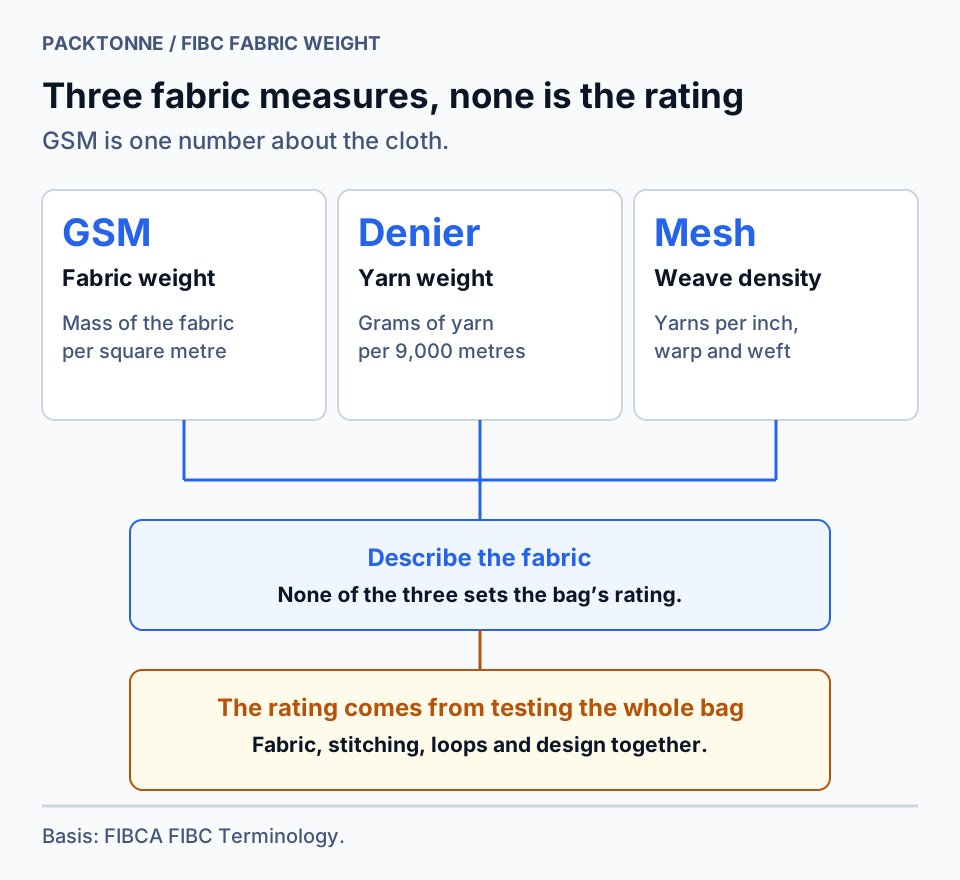
GSM is the weight of one square metre of the fabric. It is not the strength of the bag. A higher GSM means more polypropylene in the cloth, but a bulk bag’s rating comes from testing the whole design. Use GSM to describe the fabric, and use the tested rating to judge the bag.
What GSM Means in a Bulk Bag
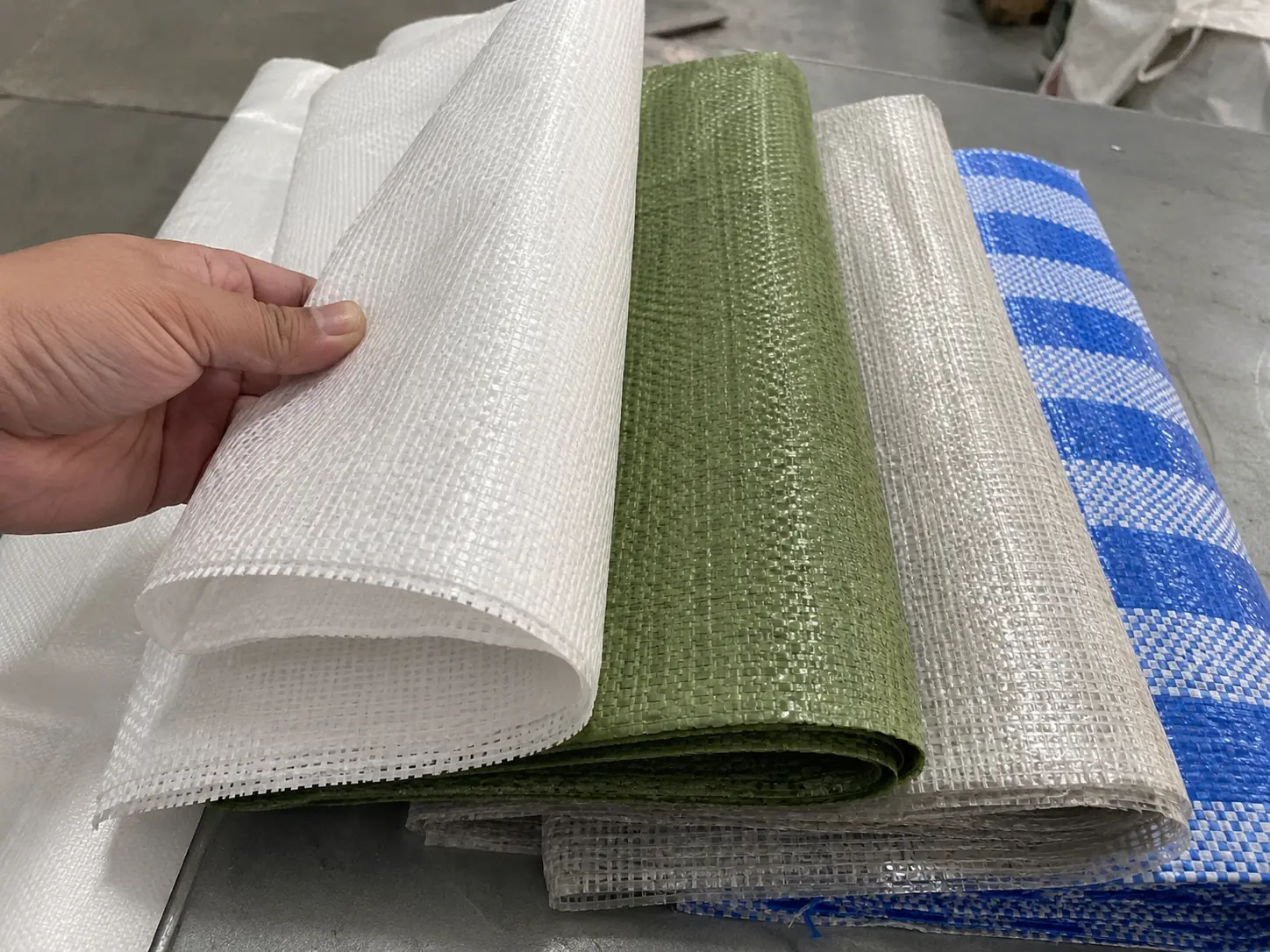
GSM stands for grams per square metre. It is the mass of a square metre of woven fabric, so a 180 GSM fabric contains more polymer per unit area than a 140 GSM fabric when both are measured the same way. Our guide to what woven polypropylene is explains how the tape is made and woven into that fabric.
The Three Measures FIBCA Uses for Fabric
The Flexible Intermediate Bulk Container Association defines the terms in its FIBC terminology page. Three of them describe the fabric.
| Measure | FIBCA definition | What it tells you |
|---|---|---|
| Fabric weight | Ounces per square yard or grams per 100 square centimetres; for example 6.5 oz per sq yd | How heavy the cloth is |
| Denier | The weight of yarn in grams per 9,000 metres | How heavy the yarn is |
| Fabric mesh | Yarns per inch in the warp and weft directions; a typical construction is 12 × 12 | How dense the weave is |
FIBCA also defines warp as the yarn running top to bottom in the body fabric and weft as the yarn across it.
Converting Ounces per Square Yard to GSM
Quotes can use either unit. One ounce per square yard equals 33.906 grams per square metre, so multiply ounces by 33.906.
| oz per square yard | GSM |
|---|---|
| 5.0 | 169.5 |
| 5.5 | 186.5 |
| 6.0 | 203.4 |
| 6.5 | 220.4 |
| 7.0 | 237.3 |
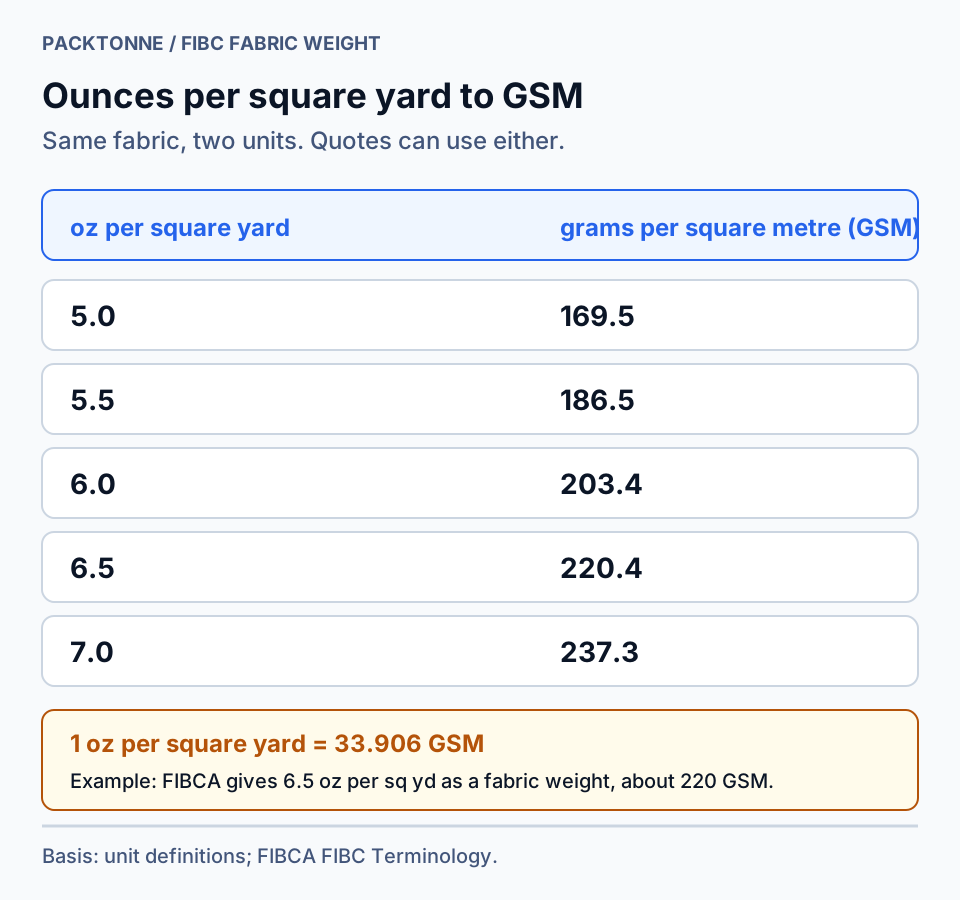
FIBCA’s example of 6.5 oz per square yard is about 220 GSM. FIBCA also gives grams per 100 square centimetres as a unit. A hundred square centimetres is one hundredth of a square metre, so 2.2 grams per 100 square centimetres is 220 GSM. Check the unit on any quote before comparing numbers.
Why a Higher GSM Is Not Always a Stronger Bag
Fabric weight describes the cloth. Strength depends on more than weight.
- Yarn and weave are separate. FIBCA lists denier and mesh as their own measures. Two fabrics with the same GSM can be built from different yarn weights and weave densities.
- The rating is tested on the bag. Safe working load and safety factor come from testing the whole design, as our guide to FIBC testing standards and 5:1 versus 6:1 safety factors explain. Stitching, loops and construction are part of what is tested.
- Compare tested ratings, not fabric weights. The rating is the number that describes what the bag was tested to carry.
No source read for this guide maps a load to a single GSM figure, and this guide does not give one. Published supplier tables that pair a load with a fabric weight are one maker’s practice, not a standard, and the tables checked for this guide were not consistent with each other.
Does the GSM Include the Coating?
A coated fabric has a coating layer on the cloth, as covered in our coated versus uncoated guide. One supplier tells buyers to confirm the coating weight separately from the fabric weight. That is one maker’s advice, but the question is worth asking. A combined figure for coated fabric is not directly comparable to a base fabric figure.
What GSM Does Tell You
GSM tells you how much polypropylene sits in each square metre of cloth, which is one of the factors in price. It is not the only one: safety factor, static class, liner, certification, printing and quantity all add cost, as our FIBC price guide explains. A price gap between two quotes with the same GSM is not a sign of bad value until the full specifications are compared.
What to Ask Besides GSM
When you compare quotes, ask for these on every one.
- Fabric weight, with its unit
- Yarn denier
- Weave density, such as 12 × 12
- Whether the fabric is coated, and whether the weight includes the coating
- Safe working load and safety factor
- A test report for the exact bag design
Our guide to reading a bulk bag spec sheet lists the other fields a complete sheet should have, and our 1 ton bag guide explains capacity and rating.
Your Fabric Weight Checklist
- If a quote gives fabric weight, you should confirm the unit and convert before comparing.
- If two bags have the same GSM, you should compare denier and mesh before assuming they are equal.
- If the fabric is coated, you should ask whether the weight includes the coating.
- If you need a rating, you should ask for the test report for the exact design, not a fabric weight.
- If a supplier says “heavier means stronger”, you should ask for the tested safe working load and safety factor.
Final Thoughts
GSM is a useful detail and a poor shortcut. It tells you how heavy the cloth is, and nothing about the stitching, the loops or the tested rating. Convert the units, ask for denier, mesh and coating, and judge the bag by its test report.
Before You Request a Quote
If you are comparing quotes, send us these details and we will ask the partner factory for the full fabric specification:
- Product, bulk density and filled weight per bag
- Safe working load and safety factor you need
- Coated or uncoated, and liner requirement
- Quantity and destination
We will check them against a Type A or 1 ton bulk bag construction and tell you what to confirm.
Common Questions
What does GSM mean in FIBC fabric?
GSM means grams per square metre. It measures the mass of one square metre of the woven fabric, so a 180 GSM fabric holds more polypropylene per unit area than a 140 GSM fabric if both are measured the same way. It describes the cloth. It does not state the strength of the finished bag.
Is a higher GSM bulk bag always stronger?
Not necessarily. FIBCA lists fabric weight, denier and mesh as separate measures of the fabric: weight of the cloth, weight of the yarn and density of the weave. A bag's rating comes from testing the whole design, including stitching, loops and construction, so compare the tested rating, not GSM alone.
How do I convert ounces per square yard to GSM?
Multiply ounces per square yard by 33.906. For example, 6.5 oz per square yard is about 220 GSM, and 5 oz is about 170 GSM. FIBCA's terminology gives fabric weight in ounces per square yard or grams per 100 square centimetres, so check the unit on any quote before comparing.
What GSM do I need for a 1 ton bulk bag?
There is no standard that maps a load to one GSM figure. A bag's safe working load and safety factor come from testing the design. Ask the supplier for the rated safe working load, the safety factor and the test report for the exact bag, and treat GSM as one of the details on the spec sheet.
Does the GSM figure include the coating?
Ask. One supplier advises confirming the coating weight separately from the fabric weight. A combined figure can make a coated fabric look heavier than an uncoated one of the same cloth. Get in writing whether the quoted GSM is the base fabric or the coated fabric.
What should I ask besides GSM when comparing bulk bag quotes?
Ask for the fabric weight and its unit, the yarn denier, the weave density, whether the fabric is coated, the safe working load and safety factor, and a test report for the full bag design. Two quotes that match on GSM can still differ on every other line.
Why do two bulk bag quotes with the same GSM have different prices?
GSM is one price factor among several. Safety factor, static class, liner, certification, printing and quantity all add to the cost. Compare the full specification line by line, as our price guide explains, before reading a price difference as a quality difference.
More in Construction & Materials
All Construction & Materials guides- Is Polypropylene Food Safe? Why PP Resin Is Not the Same as a Food Grade BagFDA lets polypropylene be used in contact with food, but that covers the resin only. See what 21 CFR 177.1520 sets and what a food grade bulk bag also needs.
- What Is Polypropylene? 7 Properties That Explain Where It Is UsedPolypropylene is a lightweight, chemical-resistant thermoplastic that floats and melts near 160 °C. Seven properties explain its uses, from caps to bulk bags.
- Polypropylene Recycling: Why #5 Plastic Is Recyclable but Rarely RecycledPolypropylene is recyclable, yet most of it is not captured. See why access, sorting and degraded resin hold it back, and where your PP can actually go.
- Polypropylene Melting Point: Why 160 °C Is Not the Temperature a Bulk Bag Can TakePolypropylene melts at about 160–165 °C, but a bulk bag has lower limits: softening, shrinking tape and a PE liner. See the numbers and what to ask suppliers.