ISO 21898 FIBC Testing: Six Tests, Not One Pass/Fail
ISO 21898 is a suite — lift, drop, stacking, righting, tear and UV aging — each catching a failure mode the others miss. Here's what it checks.
PackTonne Sourcing Desk · · 6 min read
ISO 21898 isn’t a single pass/fail test — it’s a suite covering cyclic top lift, drop, stacking, righting, tear propagation, and UV weathering, each one simulating a different real-world stress a bag faces in actual handling and storage. A bag that passes one of these tests hasn’t necessarily passed them all. Which matters, because a supplier citing the standard rarely says which of those tests they actually ran.
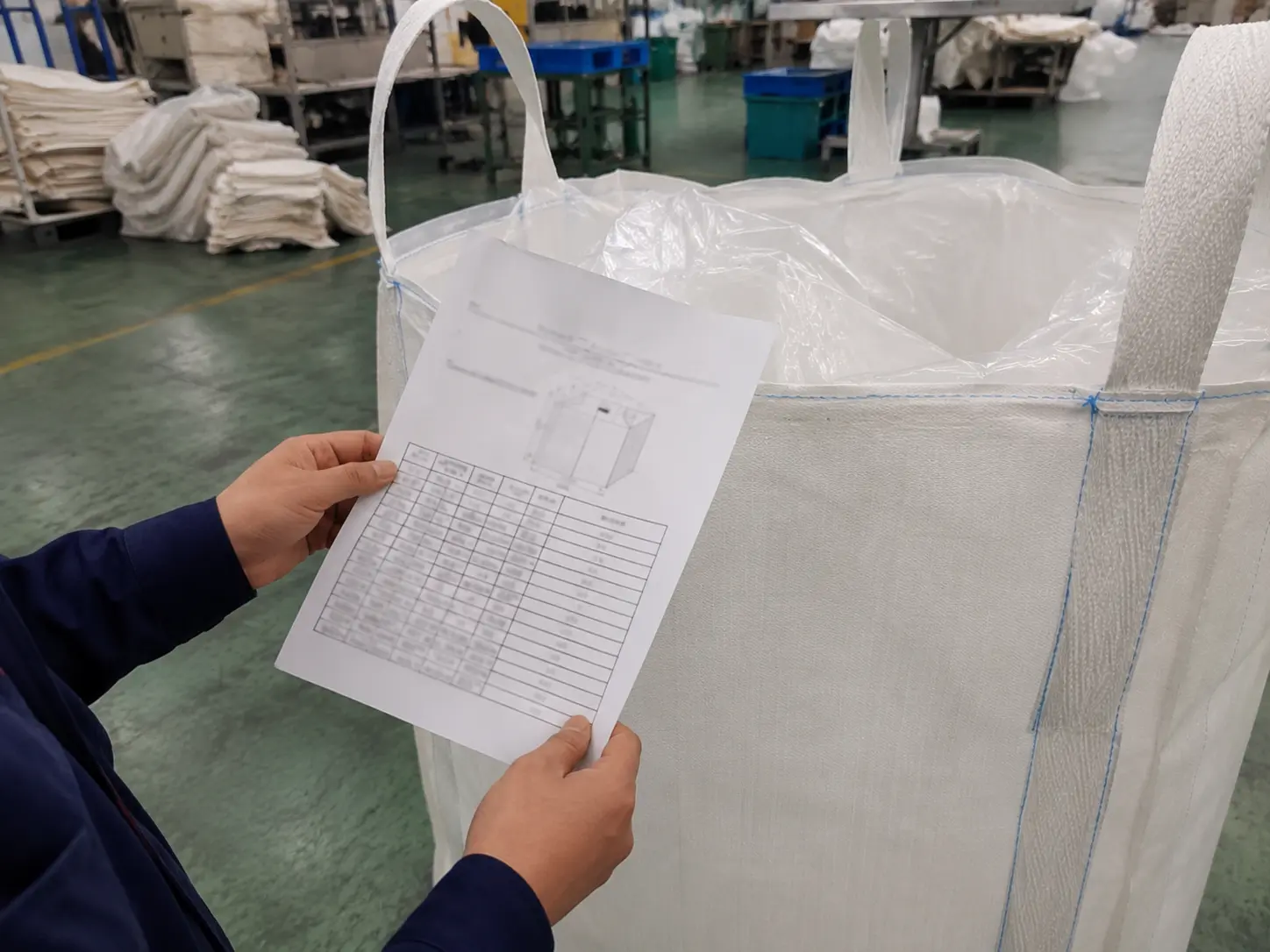
The Full ISO 21898 Test Suite
| Test | What it simulates | Why it matters |
|---|---|---|
| Cyclic top lift | Repeated crane/forklift lifting cycles | Verifies safety factor holds across multiple load cycles, not just one |
| Drop test | Bag dropped from a specified height during handling | Checks seam and base integrity under impact stress |
| Stacking test | Extended storage with bags stacked on top | Verifies the bag resists deformation under sustained compressive load |
| Righting test | Bag tipped over, then uprighted | Confirms no structural damage from a realistic handling mishap |
| Tear propagation | Small fabric damage spreading under stress | Checks whether minor damage stays contained or spreads catastrophically |
| UV/weathering | Extended outdoor sun exposure | Verifies fabric and stitching don’t degrade prematurely from UV exposure |
Cyclic Top Lift Test: The Core Safety Factor Verification
The cyclic top lift test — 30 lift cycles at twice the safe working load, then a final cycle at five times SWL for multi-trip bags — is the test most closely tied to a bag’s rated safety factor. See our safety factor guide for the full breakdown of how this test connects to 5:1 versus 6:1 ratings; this article covers where it fits among the other tests in the full standard rather than repeating that detail here.
Drop Test: Impact During Handling
A drop test simulates a bag being dropped from a specified height during forklift handling, loading, or transfer — a genuinely common real-world scenario that a static or cyclic lift test doesn’t capture, since dropping introduces sudden impact stress concentrated at the base and lower seams rather than distributed lifting stress at the loops. A bag that passes cyclic lift testing can still fail a drop test if base construction is weaker relative to the corner reinforcement.
Stacking Test: Sustained Compressive Load
The stacking test verifies a bag can support the weight of bags stacked above it for an extended period without deforming or failing — directly relevant to warehouse storage and container loading, where bags commonly sit stacked for days or weeks rather than being lifted once and immediately used. This test catches a different failure mode than lifting tests: slow deformation and creep under sustained load rather than sudden failure under peak stress.
Righting Test: A Realistic Handling Mishap
A bag that tips onto its side during forklift handling — a common enough occurrence in real warehouse operations — needs to be uprightable again without structural damage, which is what the righting test verifies. This is a scenario a lift test or drop test alone doesn’t address, since it tests a different kind of stress: sideways loading and the transition back to upright, rather than vertical lift or impact.
Tear Propagation and Vibration
Tear propagation testing checks whether a small cut or puncture in the fabric stays contained or spreads catastrophically under normal handling stress — relevant because minor fabric damage is common in real handling and the question is whether it stays a minor issue or becomes a bag failure. Vibration testing, relevant for extended truck or rail transit, checks whether repeated low-level vibration loosens stitching or causes fatigue distinct from the higher-stress lift and drop scenarios.
UV and Weathering Resistance
Extended outdoor exposure before use — common when bags sit in yard storage or travel on open transport — degrades untreated fabric and stitching over time, which UV testing verifies against. ISO 21898:2024’s updated guidance strengthened this testing area specifically, reflecting how much outdoor exposure duration varies across real supply chains and how inconsistent coating formulations can be on UV stabilization, a point also covered in our coated vs uncoated fabric guide.
What Compliance Documentation Should Actually Include
A supplier’s ISO 21898 compliance claim should reference which specific tests were performed, not just cite the standard number generically — ask for documentation covering the cyclic lift result, and ideally drop, stacking, and UV results relevant to your actual use case (outdoor storage duration, transit method, handling equipment). A general “ISO 21898 compliant” statement without specifying which tests were actually run and passed isn’t a complete compliance claim.
Why No Single Test Tells the Whole Story
Each test in the suite exists because it catches a failure mode the others don’t — a bag can pass cyclic lift testing and still fail a drop test if base construction lags behind corner reinforcement, or pass every mechanical test and still degrade prematurely from unaddressed UV exposure. Treating any one test result as proof of overall bag quality misses this design intent; the standard is built as a suite precisely because real-world handling exposes bags to multiple, different stresses across their working life, not one repeated stress in isolation.
Common Mistakes When Evaluating Test Compliance
- Accepting a generic “ISO 21898 compliant” claim without specifics. Ask which tests were performed and request the actual results, not just a standard reference.
- Assuming a passed lift test covers drop and stacking scenarios too. Each test addresses a distinct failure mode — one passing result doesn’t imply the others passed.
- Ignoring UV testing for bags that will sit outdoors. This is one of the more commonly skipped verifications, and coating formulations vary meaningfully on this point.
- Treating ISO 21898 and UN certification as the same thing. They’re separate standards with separate scopes — general durability versus specific hazardous goods compliance.
- Not matching test relevance to your actual handling conditions. A bag tested for scenarios your operation never encounters isn’t more valuable than one tested for the scenarios you actually face.
Decision Checklist
- Will your bags face repeated lift cycles? Confirm cyclic top lift test results specifically, not just a general safety factor number.
- How will bags be handled — forklift, crane, manual? Drop and righting test relevance depends on your actual handling method.
- Will bags be stacked for extended storage? Confirm stacking test results if warehouse dwell time is significant.
- Will bags face outdoor exposure before use? Ask specifically about UV testing and coating formulation.
- Is your supplier’s compliance claim specific or generic? Push for which tests were actually performed, not just a standard number cited without detail.
Final Thoughts
A claim of ISO 21898 testing is only as meaningful as the specific results behind it. The standard exists as a suite precisely because a bag can survive one kind of stress and fail another — passing a lift test says nothing about how it handles being dropped or stacked for six weeks. Tell us how your bags get handled and stored, and we’ll confirm which test results actually matter for your order.
Before You Request a Quote
Tell us your handling and storage conditions and we’ll confirm which tests are relevant:
- Handling equipment — forklift, crane, or manual
- Expected storage duration and stacking height
- Outdoor exposure before use, if any
- Transit method and distance
Request a quote and we’ll confirm the testing documentation relevant to your actual use case.
Common Questions
What tests does ISO 21898 require for FIBC bags?
The standard covers a suite of tests including the cyclic top lift test, drop test, stacking test, righting test, tear propagation, and UV weathering resistance — each one simulates a different real-world stress the bag will face in actual use, not a single pass/fail check.
What's the difference between the top lift test and the drop test?
The top lift test simulates repeated crane or forklift lifting cycles under load; the drop test simulates a bag being dropped from a specified height during handling, checking that seams and the base don't fail on impact. They test different failure modes and both matter for real-world handling.
What does the stacking test actually verify?
It verifies a bag can support the weight of other bags stacked on top of it for an extended simulated storage period without deforming or failing — relevant for warehouse storage and container loading where bags sit stacked for days or weeks.
What is a righting test for FIBC bags?
It checks that a bag which has fallen onto its side during handling can be uprighted again without structural damage — a realistic scenario in warehouse and forklift handling that a static lift test alone doesn't cover.
Does passing ISO 21898 mean a bag is certified for hazardous goods?
Not automatically — ISO 21898 covers general FIBC performance and durability testing, while UN certification for hazardous goods is a separate certification with its own specific requirements. A bag can pass ISO 21898 testing without being UN certified, and vice versa in terms of scope.
Do I need every ISO 21898 test result for my order?
Not usually — request the results relevant to how your bags will actually be handled. Cyclic lift matters for any load-bearing use; stacking matters if bags sit in warehouse storage; UV matters for outdoor exposure. Asking for everything indiscriminately gets slower answers than asking precisely.
Is ISO 21898 testing done on every batch or once per design?
Primarily once per design, as type qualification. Routine production relies on faster in-house QC checks confirming consistency with that qualified design. When a supplier cites the standard, clarify whether they mean original type testing, ongoing batch QC, or both.
More in Standards & Compliance
All Standards & Compliance guides- Food Grade vs Feed Grade FIBC: 5 Checks Before You Pay for the Higher GradeFeed grade is not a tested bulk bag grade. Check your customer's rules, the liner, the production area and the documents before deciding to pay for food grade.
- Packing Group I, II, III: What They Mean and What Your Bulk Bag Must MatchPacking group I means great danger, II medium, III minor. See what each shows on shipping papers, decode X/Y/Z marks and check whether a tested FIBC fits.
- BRC Meaning: What BRCGS Stands For and What a BRC Certificate ProvesBRC means British Retail Consortium; BRCGS is BRC Global Standards. See what a BRC packaging certificate covers, how grades work and how to check one.
- Pharma-Grade FIBC: Why Food Grade Isn't Close EnoughCleanroom classification, a full GMP documentation chain and often two-way containment — pharma grade is a different category, not food grade with extras.