Packing Group I, II, III: What They Mean and What Your Bulk Bag Must Match
Packing group I means great danger, II medium, III minor. See what each shows on shipping papers, decode X/Y/Z marks and check whether a tested FIBC fits.
PackTonne Sourcing Desk · · 12 min read
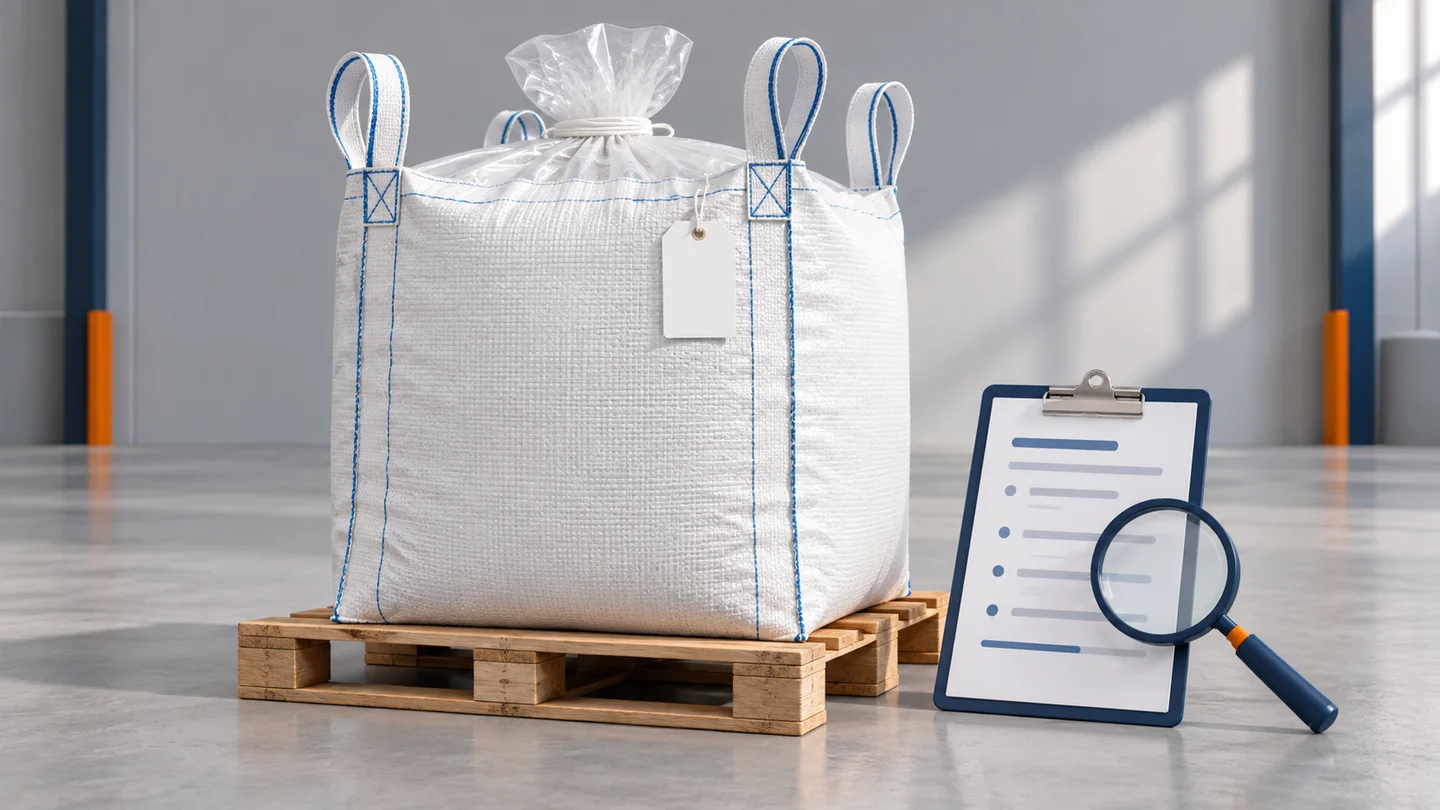
A packing group describes the degree of danger a material presents during transport: I is great danger, II medium danger and III minor danger. It does not identify a bag’s construction or authorize a shipment by itself. For a bulk bag, three things must agree: the material’s classification, the packaging types permitted for it, and the exact tested FIBC design. A matching letter on a label is only one part of that check.
Packing Group I, II and III at a Glance
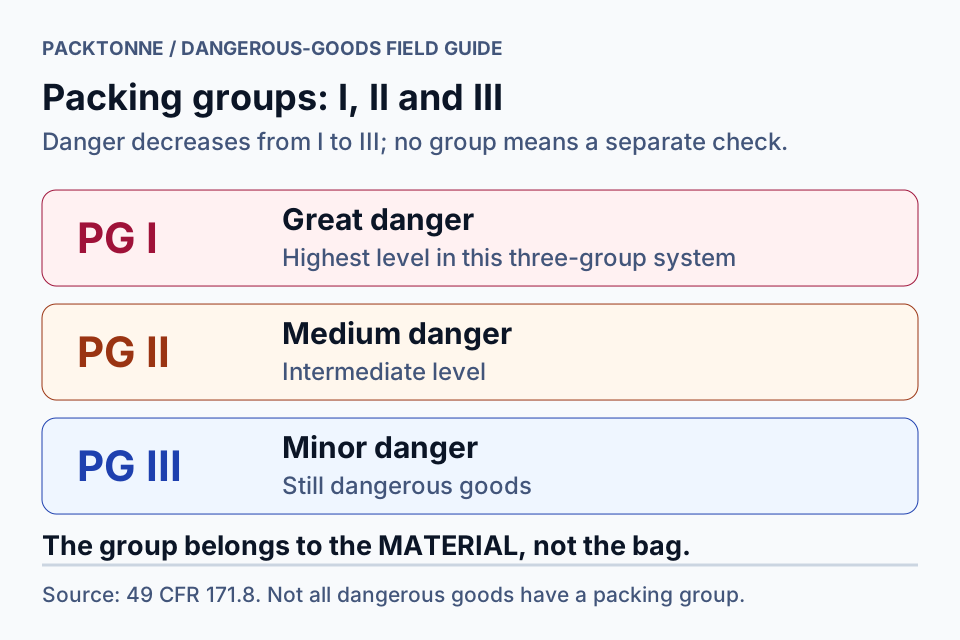
Packing groups rank transport danger in descending order, with Group I at the highest level.
| Material’s packing group | Degree of danger | Purchasing implication |
|---|---|---|
| I — PG I | Great danger | Check the specific authorization before proposing an FIBC; a Y or Z rating does not cover this level |
| II — PG II | Medium danger | Where UN performance packaging is required, check an appropriate X or Y design and the permitted packaging type |
| III — PG III | Minor danger | A suitable Z, Y or X performance level may meet the requirement; other restrictions still apply |
The definitions are set out in 49 CFR 171.8. Searches for “packing group 1,” “packing group 2” and “packing group 3” normally refer to the same categories; transport documents use Roman numerals.
A quote request that says only “PG II bag” is incomplete. The bag supplier also needs the material’s identity, physical form and shipping route. Two PG II products can need different containment, closures or packaging types. Start with the material, then narrow the packaging specification.
What a Packing Group Indicates on a Package or Shipment
On a shipment, the packing group is part of the shipping description. For US shipments, 49 CFR 172.202(a)(4) requires the packing group in Roman numerals, as designated for the material in the hazardous materials table, and allows it to be written with the prefix “PG”, for example “PG II”. Class 1 explosives, self-reactive substances, Division 5.2 materials and entries with no packing group are excepted.
So “Packing Group II” on a package or shipping paper tells you the material’s degree of danger is medium. It says nothing about what the bag is made of or whether the bag is authorized. The same definitions apply to Packing Group I, great danger, and Packing Group III, minor danger.
Hazard Class, Packing Group and Packaging Code Are Different
Hazard class identifies the kind of transport hazard, while packing group indicates its degree where a group is assigned.
| Term | What it describes | Example of how to read it |
|---|---|---|
| UN number and proper shipping name | The transport entry for the material | Identify the entry before selecting packaging |
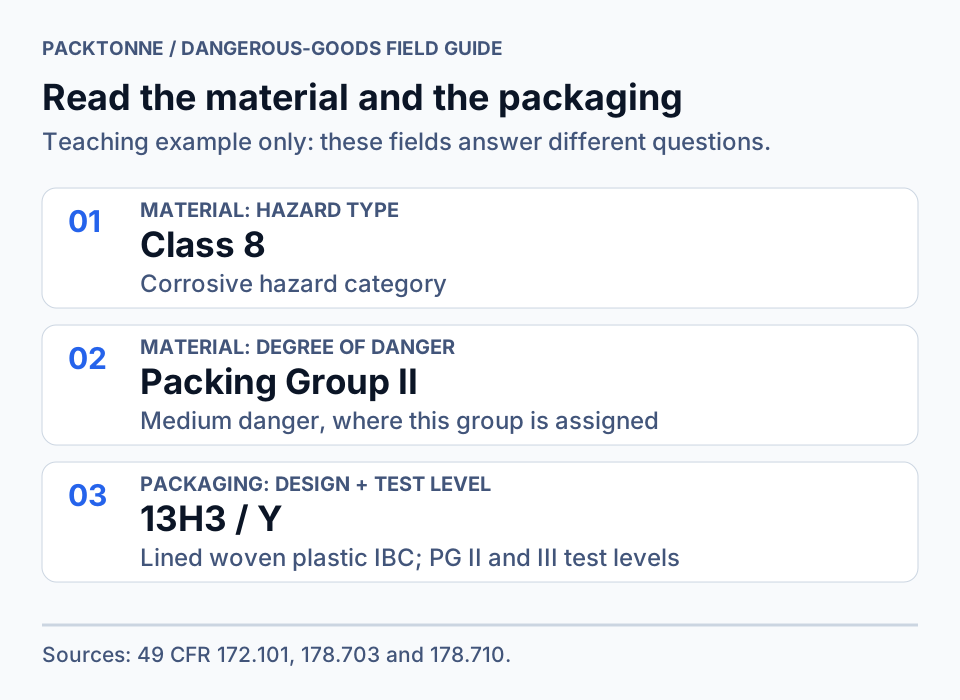
| Hazard class or division | The hazard category | Class 8 means corrosive |
| Packing group | The material’s degree of danger | II means medium danger |
| IBC construction code | The packaging’s construction | 13H3 identifies woven plastic with a liner |
| X, Y or Z | The packaging’s tested performance level | Y covers the PG II and III test levels |
Static-protection Type A, B, C or D is another specification. It concerns electrostatic behavior during handling; it does not replace dangerous-goods packaging approval. A liner, conductive thread or higher fabric weight cannot assign a packing group to the contents.
The 13H1–13H4 marking codes guide explains construction differences. This guide addresses the classification and authorization checks that come before choosing that construction.
How a Packing Group Is Assigned
Packing group is determined by the transport classification and relevant hazard criteria, rather than by a buyer’s preferred bag specification.
For US shipments, the shipper is responsible for classifying and describing the material and selecting authorized packaging under 49 CFR 173.22. A packaging quotation is not a substitute for that classification.
Class 3: flash point and initial boiling point
Flammable-liquid grouping illustrates why a hazard class alone is insufficient. When the US table gives more than one group for an entry, the basic criteria in 49 CFR 173.121(a) are:
| Packing group | Closed-cup flash point | Initial boiling point |
|---|---|---|
| I | No separate threshold in this table | ≤35 °C |
| II | <23 °C | >35 °C |
| III | ≥23 °C and ≤60 °C | >35 °C |
The section also contains provisions for viscous materials. This table explains the principle; it is not a complete classification calculator. It also does not authorize a liquid in a flexible bulk bag.
Class 8: corrosivity, not the liquid table
Corrosives use different criteria. 49 CFR 173.137 addresses skin-corrosion tests, exposure and observation periods, and metal-corrosion criteria. A Class 8 solid cannot be assigned a packing group by applying the Class 3 flash-point thresholds.
For purchasing, record the final classification and its basis. If a formulation or concentration changes, send the updated information for classification review before repeating the previous bag order.
Which Hazard Classes Have Packing Groups?
Packing groups are used for many hazardous substances, but they are not assigned to every dangerous-goods entry.
They commonly appear for substances in Class 3; Divisions 4.1, 4.2, 4.3 and 5.1; Division 6.1; Class 8; and some Class 9 entries. Exceptions matter: self-reactive substances and organic peroxides follow their own approaches, for example.
Under 49 CFR 172.101(f), Class 2, Division 6.2 and Class 7 have no packing groups, and articles in classes other than Class 1 are not assigned one. A blank packing-group field therefore does not prove a material is unregulated. Check the entry and its packaging instructions rather than filling the blank with “III.”
What X, Y and Z Mean on Packaging
X, Y and Z describe packaging test performance; they are not additional packing groups for the material.
The IBC marking system in 49 CFR 178.703(a)(1)(iii) uses these letters:
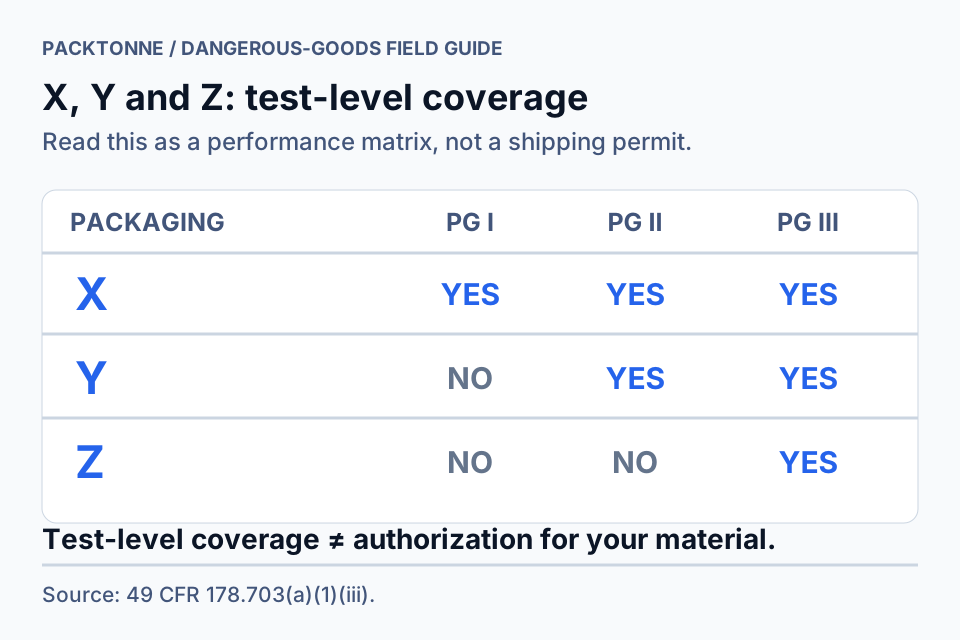
For packing group II packaging, a Y performance letter is relevant. But “Y-rated” leaves several questions unanswered: does the entry permit this IBC type, does the lining suit the contents, and does the proposed load match the approved configuration?
A useful procurement distinction is performance coverage versus use authorization. The matrix answers the first question. The transport entry and packaging provisions answer the second. Neither replaces the manufacturer’s design documents.
Can a Bulk Bag Carry Packing Group I, II or III?
A flexible IBC is suitable only when its type is authorized for the specific material and its tested configuration fits the shipment.
49 CFR 178.710 covers flexible IBCs for solid hazardous materials. Adding a PE liner does not turn a woven bag into an authorized liquid IBC.
For a US order, check the entry’s bulk-packaging reference and special provisions. The IB-code table in 49 CFR 172.102(c)(4) makes the distinction visible: IB8 lists flexible IBC types; IB6’s general list does not. Read the applicable exceptions and additional provisions as well. “IBC permitted” does not necessarily mean “flexible IBC permitted.”
The PG I question needs a conditional answer
US 49 CFR 173.35(j) sets a 1.5 m³ ceiling for flexible IBCs transporting PG I solids. It does not create blanket authorization. A common Y- or Z-rated FIBC also lacks the PG I performance coverage shown above. Do not approve a PG I order from the bag’s size or appearance.
For PG II or III, permission is still conditional. A compatible liner, suitable closure, correct loading and the authorized design matter. Ask for the specific UN certified bulk bag documentation rather than accepting a generic factory certificate.
International orders add a route check. The UN Model Regulations provide the framework, but the rules applicable to the actual sea, road or air movement must be checked. A US provision alone does not settle every leg of an export shipment.
What the Packing Group Changes in Testing
Packing group affects the severity of relevant packaging tests, although a drop test alone does not qualify an FIBC.
For an IBC solid-content drop test, 49 CFR 178.810 specifies heights of 1.8 m for PG I, 1.2 m for PG II and 0.8 m for PG III. Flexible IBC test samples are loaded to their maximum permissible gross mass with evenly distributed contents.
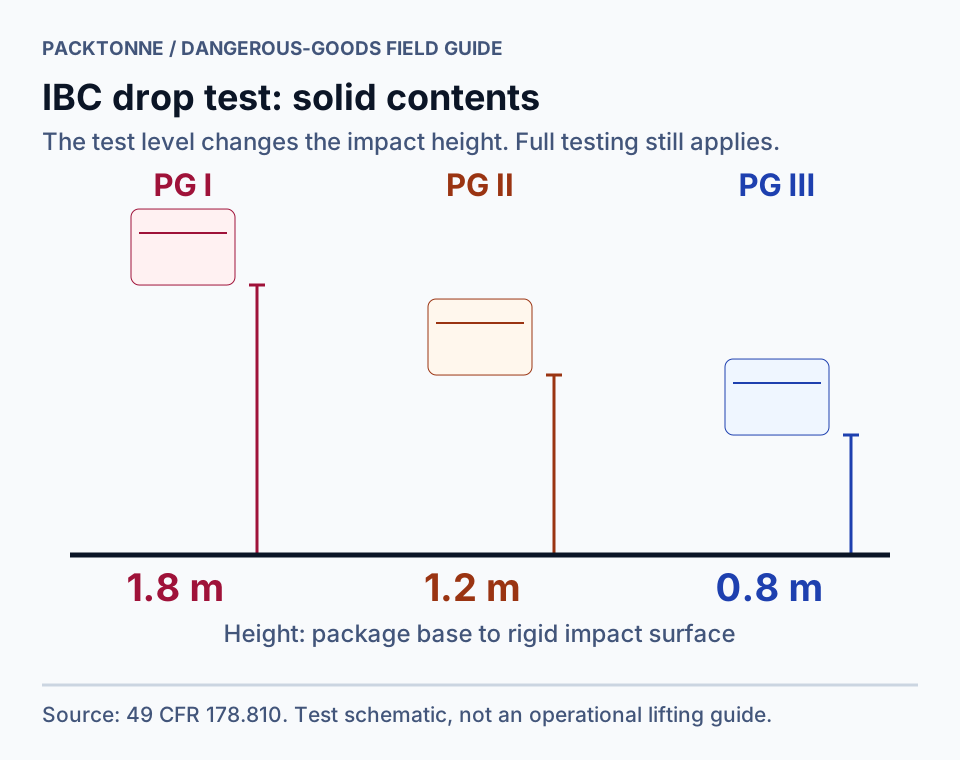
When reviewing a report, check which design, load and performance level were tested. A document headed “drop test passed” without those details gives little help in comparing it with the order specification. The supplier’s report and production specification should describe the same bag.
Read the FIBC Mark and Documents Together
The performance letter must be read alongside the construction, manufacture and loading information in the IBC mark.
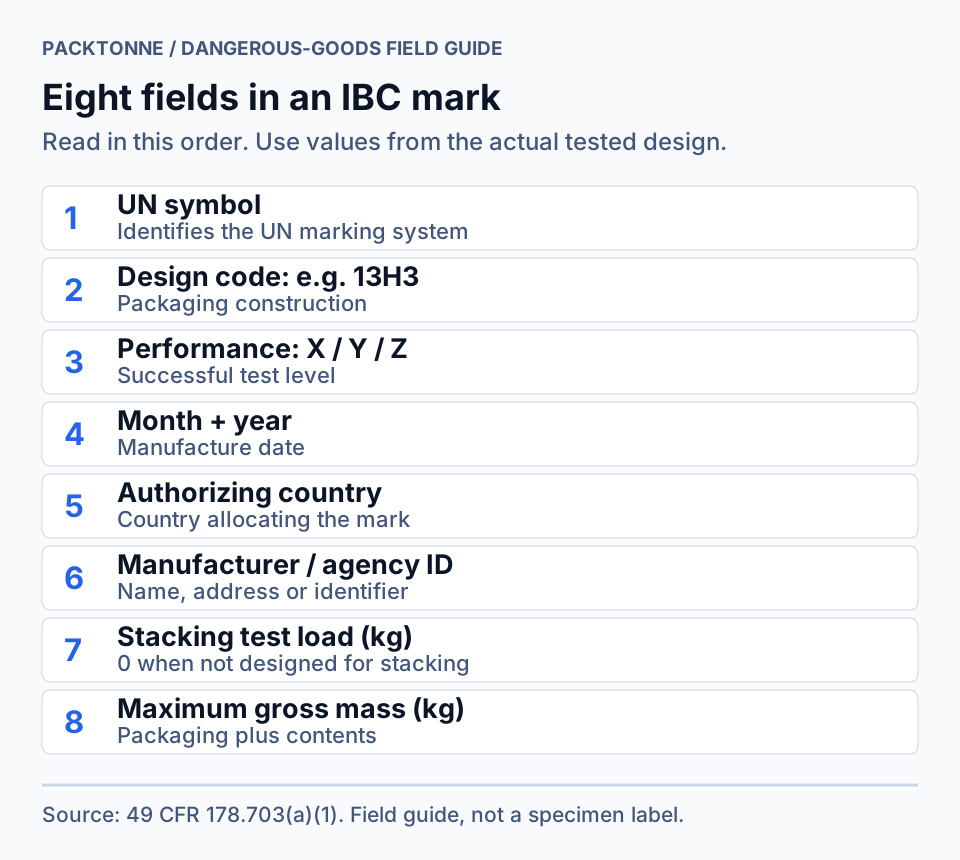
For an IBC, the mass field is maximum permissible gross mass, including packaging. As a purchasing example, a 1,000 kg gross limit and 5 kg tare leave 995 kg for contents before any other restriction is considered. A “1,000 kg SWL” sales description is not enough to resolve that calculation. Record tare and intended filled mass separately in the bulk bag specification sheet.
Ask for the design test report or applicable approval, the matching drawing/specification, a readable marking sample, and filling/closure instructions. Record the fabric, liner, seams, top and bottom closures used in that design. A change advertised as “stronger” still needs to be checked against the tested configuration and permitted variations.
Five Checks Before You Order
A reliable order follows the classification through to the approved bag and the filling procedure.
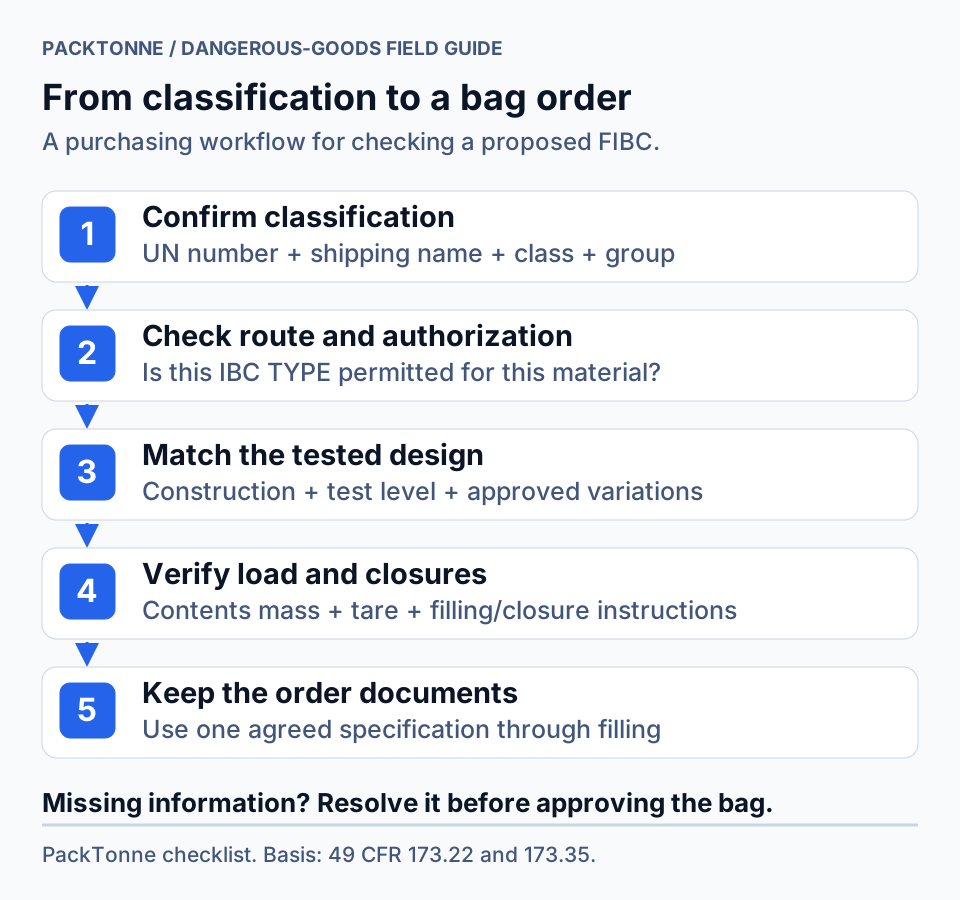
- Confirm your material. Start with the current SDS, including Section 14 transport information. Have the responsible classifier resolve incomplete or conflicting entries; keep the UN number, proper shipping name, class and group together.
- Check your route and permitted packaging. Identify the rules for each transport leg. Confirm the allowed IBC type and any additional provisions, not just a generic reference to bulk packaging.
- Match the tested bag. Compare the proposed construction and performance letter with its report and specification. Get written confirmation of any variation before substituting a liner, closure or fabric.
- Verify your filled load. Provide bulk density, net fill mass and tare. Confirm the relevant mass limit, filling method, closure procedure and any electrostatic-control requirements for the actual operation.
- Keep the documents with the order. Record the agreed design, marking and instructions so the supplier, receiving team and filling operator use the same specification. Check delivered bags against it before filling.
Final Thoughts
Packing group is a starting point for choosing dangerous-goods packaging. You still need the authorized packaging type and a tested design that matches the contents, load and closures. Keep those decisions together in one order specification. For a PackTonne quotation, provide the classification and shipping route first, so the proposed bag and supporting documents can be checked against a defined requirement rather than a general “UN certified” request.
Request a Bag and Document Review
Send the current SDS, UN number, proper shipping name, hazard class, packing group, destination and transport modes. Add the material’s physical form, bulk density, intended fill weight and filling/discharge arrangement. If you already have an approved specification, include its drawing and marking sample.
Request a quote for a bag proposal and the documents needed to evaluate it. Confirm the exact design’s availability and approval scope before placing the order.
Common Questions
Which packing group represents the greatest hazard, and what do II and III indicate?
Packing Group I represents the greatest degree of transport danger within this three-group system; II indicates medium danger and III indicates minor danger. These groups apply only where the transport classification assigns one. You cannot compare all dangerous goods by packing group alone: gases, infectious substances and radioactive materials, for example, use other classification rules and do not have packing groups.
Where do I find the packing group for my product?
Start with the transport information in Section 14 of the current safety data sheet, then verify it against the applicable dangerous-goods entry and classification criteria for your route. Keep the UN number, proper shipping name, hazard class and packing group together. If the product formulation, concentration or physical state has changed, ask the responsible classifier to confirm that the old shipping description still applies.
Which hazard classes have packing groups?
Packing groups are used for many substances in Class 3, Divisions 4.1, 4.2, 4.3 and 5.1, Division 6.1, Class 8 and some Class 9 entries. That does not mean every entry in those classes receives one. Always check the specific shipping entry; self-reactive substances, organic peroxides and many articles follow other approaches rather than a simple I, II or III assignment.
Can a UN bulk bag carry Packing Group I material?
A Y- or Z-rated bulk bag cannot be selected for Packing Group I on its performance rating. For a proposed PG I solid shipment, check the exact packaging authorization and tested design rather than assuming every flexible IBC is prohibited or permitted. US rules specify a 1.5 cubic meter capacity ceiling for flexible IBCs carrying PG I solids, but that ceiling does not itself authorize a particular shipment.
Can I use Y-rated packing group II packaging for a PG III solid?
A Y mark covers the PG II and PG III test levels, so its performance rating can meet a PG III requirement. You still need authorization for that packaging type and compatibility with the contents, plus the correct closure and loading conditions. Ask for confirmation of the exact design and intended filled mass; a stronger test rating does not make a different liner or an unlisted packaging type acceptable.
What does packing group X mean on a bag?
X is a packaging performance letter, not a fourth packing group. In the IBC marking system, X denotes testing at the level covering PG I, II and III; Y covers II and III; Z covers III. The letter describes the packaging's tested performance. Your material's packing group remains a Roman numeral, and the applicable transport rules must still authorize the packaging type for that material.
Is Packing Group III material safe to ship in a standard bulk bag?
Packing Group III still describes dangerous goods, so the numeral alone does not justify a standard non-UN bulk bag. Check the entry's packaging requirements and any applicable exception before ordering. Where UN performance packaging is required, verify the design and marking rather than relying on the bag's fabric weight or one-ton lifting label. Minor danger is a relative category, not a release from transport controls.
Can I add a thicker liner to a UN-rated FIBC?
A different liner must be checked against the tested design and its authorized variations before use. Thickness alone does not prove an upgrade: resin, dimensions, sealing and closure can affect the package's performance. Ask the manufacturer to confirm in writing whether the change is covered or requires further evaluation or testing. Keep the approved specification with the order so production and filling use the same configuration.
More in Standards & Compliance
All Standards & Compliance guides- Food Grade vs Feed Grade FIBC: 5 Checks Before You Pay for the Higher GradeFeed grade is not a tested bulk bag grade. Check your customer's rules, the liner, the production area and the documents before deciding to pay for food grade.
- BRC Meaning: What BRCGS Stands For and What a BRC Certificate ProvesBRC means British Retail Consortium; BRCGS is BRC Global Standards. See what a BRC packaging certificate covers, how grades work and how to check one.
- Pharma-Grade FIBC: Why Food Grade Isn't Close EnoughCleanroom classification, a full GMP documentation chain and often two-way containment — pharma grade is a different category, not food grade with extras.
- FIBC Safety Labels: An Unreadable Tag Means Stop WorkA bag whose label you can't read is a bag with unknown specifications. Here's what has to be on it, and why a faded tag stops the job.