FIBC Safety Labels: An Unreadable Tag Means Stop Work
A bag whose label you can't read is a bag with unknown specifications. Here's what has to be on it, and why a faded tag stops the job.
PackTonne Sourcing Desk · · 6 min read
Every FIBC needs a legible label showing its safe working load (SWL), safety factor rating, and classification — and if that label is missing or unreadable, the bag shouldn’t go into service. This isn’t a minor paperwork detail; a bag without a verifiable label is functionally a bag with unknown specifications, regardless of how it looks. Operators can only respect a rating they can actually read.
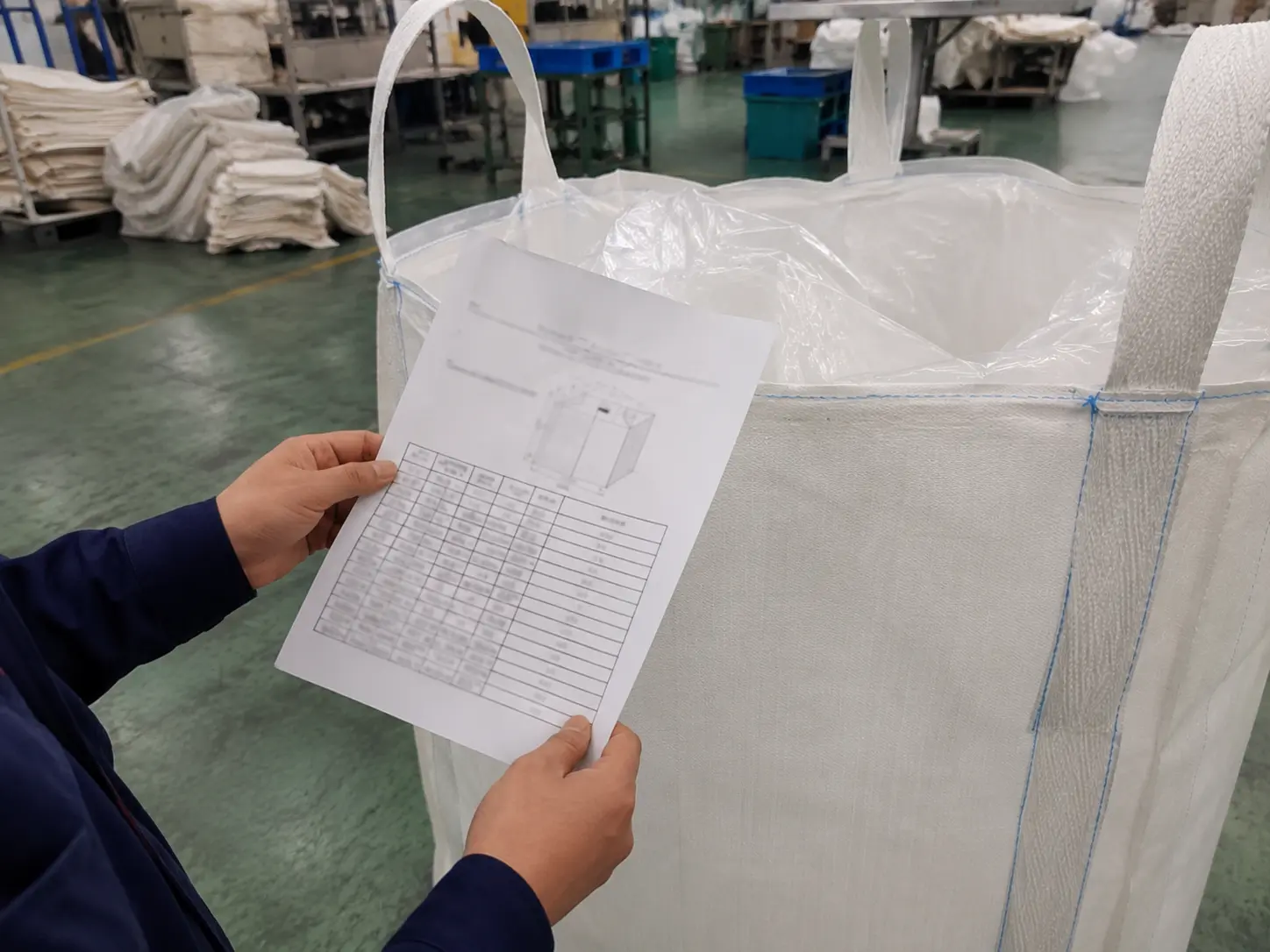
Core Label Elements Every Bag Needs
| Element | What it tells you | Why it matters |
|---|---|---|
| Safe working load (SWL) | The bag’s rated operating capacity | The number you load the bag to — see our SWL and safety factor guide |
| Safety factor | 5:1 single-trip or 6:1 multi-trip | Determines whether the bag is safe to reuse |
| Static protection class | Type A/B/C/D | Confirms the bag matches your product’s ignition risk |
| Manufacturer/batch reference | Traceability to production run | Needed if a quality question arises later |
Additional Elements for UN Certified Bags
UN certified bags carry a more extensive marking string beyond the core elements above — the UN packaging symbol, the specific 13H construction code, packing group, and additional identifying information. See our UN marking codes guide for the full breakdown of what each part of that string means; the key point for labeling purposes is that hazardous goods bags require more information, more prominently and durably marked, than a standard bag does — reflecting their regulatory role in transport safety.
Why a Missing or Unreadable Label Is a Stop-Work Issue
A bag’s label is the only reliable way to confirm what you’re actually handling — its rated capacity, whether it’s safe for reuse, and its static protection class. Without a legible label, none of that is verifiable, which means using the bag anyway means operating on assumptions rather than confirmed specifications. Treat a bag with a missing, faded, or otherwise unreadable label the same way you’d treat a bag with genuinely unknown specifications: not safe to put into service until the information can be confirmed some other way, such as matching it to a specific, documented order.
Label Durability: Surviving the Bag’s Actual Handling Life
A label that’s legible when the bag arrives but fades or wears off partway through its handling life defeats its own purpose — anyone handling the bag later, including during a multi-trip bag’s later reuse cycles, needs to be able to read it. This matters more for bags facing extended outdoor storage, since UV exposure and weathering that degrade fabric can also degrade printed markings — see our storage guide for related considerations. Ask your supplier specifically about label durability for your expected storage and handling conditions rather than assuming any printed label holds up equally well.
Handling Practices Tied to Labeling
General safe handling practice extends beyond just reading a label correctly — it includes confirming a bag’s rated specifications actually match its intended use before filling or lifting, not assuming based on general appearance or a supplier’s verbal description. A widely recognized handling principle is that no one should be positioned underneath a bulk bag that isn’t solidly supported, a practice that depends on operators actually knowing and respecting a bag’s rated capacity and condition, which starts with a legible, accurate label.
Common Mistakes With Labels and Markings
- Assuming any printed text on a bag counts as a compliant label. Confirm SWL, safety factor, and classification are all specifically and clearly present, not just some general product description.
- Not checking label legibility after storage or partial use. A label that was readable on delivery can degrade before the bag’s actual use, particularly after outdoor exposure.
- Using a bag with a partially readable label because “it’s probably fine.” If any core element — SWL, safety factor, classification — can’t be confirmed, treat the bag as unverified.
- Confusing general safety labeling with full UN marking requirements. Hazardous goods bags need the complete marking string, not just the basic SWL/safety factor information sufficient for a standard bag.
- Not training handling staff to actually read and act on label information. A compliant label only helps if operators know what it means and check it before use.
Labels Are the Practical Link Between Spec and Handling
A bag’s spec sheet and its physical label serve different purposes at different points — the spec sheet is what you use to order and compare quotes, while the label is what handling staff actually see and rely on once the bag is in use. See our spec sheet guide for the ordering-stage checklist; the label is the field-level version of that same information, and it needs to survive from delivery through actual use for the ordering-stage accuracy to translate into safe handling in practice.
Decision Checklist
- Does every bag in your inventory have a legible SWL and safety factor label? Confirm on arrival, not just at the point of use.
- Do you know how to read your bag’s full classification from its label? SWL, safety factor, and static class should all be identifiable.
- For hazardous goods, is the full UN marking string present and legible? This carries more regulatory weight than standard labeling.
- Have you asked about label durability for your storage and handling conditions? Extended outdoor exposure is a real risk factor for label legibility.
- Do your handling procedures include verifying label information before use, not just visual inspection? Confirming specs against actual intended use is a distinct step from a general condition check.
Final Thoughts
A label is the only place a bag’s rating meets the person actually lifting it. Everything upstream — the spec sheet, the test report, the certification — becomes operationally useless the moment that tag is unreadable. Specify durable marking for the conditions your bags will actually face, and treat an illegible one as a stop, not an inconvenience. Tell us your storage conditions and we’ll spec labelling that survives them.
Before You Request a Quote
Tell us your product and handling conditions and we’ll confirm the right labeling for your order:
- Target capacity, safety factor, and static protection needs
- Whether UN certification or other regulatory marking applies
- Expected storage duration and conditions
- Order volume, for batch traceability planning
Request a quote and we’ll confirm labeling that stays legible and accurate for your bag’s actual handling life.
Common Questions
What information must be on an FIBC's safety label?
At minimum, the safe working load (SWL), the safety factor rating, and the bag's classification (static protection type, single-trip or multi-trip). UN certified bags carry additional required elements — see our UN marking codes guide for the full breakdown of that specific string.
What should I do if a bag's label is missing or unreadable?
Don't put it into service. A bag without a legible label can't be verified against its intended use, and that's a stop-work issue, not a minor paperwork gap — treat it the same as a bag with unknown specifications.
Does the label need to survive the bag's entire handling life?
Yes — a label that fades or becomes illegible partway through a bag's use defeats its purpose, since anyone handling the bag later needs to be able to read it. Ask your supplier about label durability, particularly for bags facing extended outdoor storage or rough handling.
Is a printed label enough, or does it need to be a specific type of marking?
Requirements vary by what's on the label — general SWL and safety factor information is typically printed directly on the fabric, while UN certified markings have more specific durability and legibility requirements given their regulatory role. Confirm with your supplier what marking method they use for each element.
Are there handling practices tied to labeling beyond just reading the label?
Yes — general safe handling practice includes not positioning anyone underneath a bulk bag that isn't solidly supported, and confirming a bag's label matches its actual intended use before filling or lifting, not assuming based on appearance alone.
Can I add my own labels to supplier-marked bags?
Yes, for internal tracking, batch codes or handling instructions — as long as your labels don't obscure the supplier's required markings, particularly on UN certified bags where the marking string is a regulatory element. Place additional labels on a clear panel rather than over existing information.
Should labels be in the language of the destination country?
Where operators need to act on them, yes — a warning nobody on the floor can read isn't a control. Technical markings like SWL figures and UN codes are largely numeric and international, but handling instructions benefit from being in the working language of the site using them.
More in Standards & Compliance
All Standards & Compliance guides- Pharma-Grade FIBC: Why Food Grade Isn't Close EnoughCleanroom classification, a full GMP documentation chain and often two-way containment — pharma grade is a different category, not food grade with extras.
- GB/T 10454-2025: What Changed in China's FIBC StandardEffective March 2026, GB/T 10454-2025 replaces two older standards and is the first to formally separate single-trip from multi-trip requirements.
- ISO 21898 FIBC Testing: Six Tests, Not One Pass/FailISO 21898 is a suite — lift, drop, stacking, righting, tear and UV aging — each catching a failure mode the others miss. Here's what it checks.
- BRC, FDA or EU? Match Food Certification to Your MarketBRCGS for UK/EU retail, FDA for the US, EU 1935/2004 for direct EU sale. They aren't interchangeable — here's which one your buyer actually needs.