What Is Polypropylene? 7 Properties That Explain Where It Is Used
Polypropylene is a lightweight, chemical-resistant thermoplastic that floats and melts near 160 °C. Seven properties explain its uses, from caps to bulk bags.
PackTonne Sourcing Desk · · 8 min read
Polypropylene (PP) is a lightweight thermoplastic made by polymerizing propylene, and it is the second most widely produced commodity plastic after polyethylene. It carries resin code 5, floats on water, melts at about 160–165 °C and is cheap to process. Those properties explain why the same material turns up in bottle caps, car bumpers, carpets and woven bulk bags.
What Is Polypropylene?
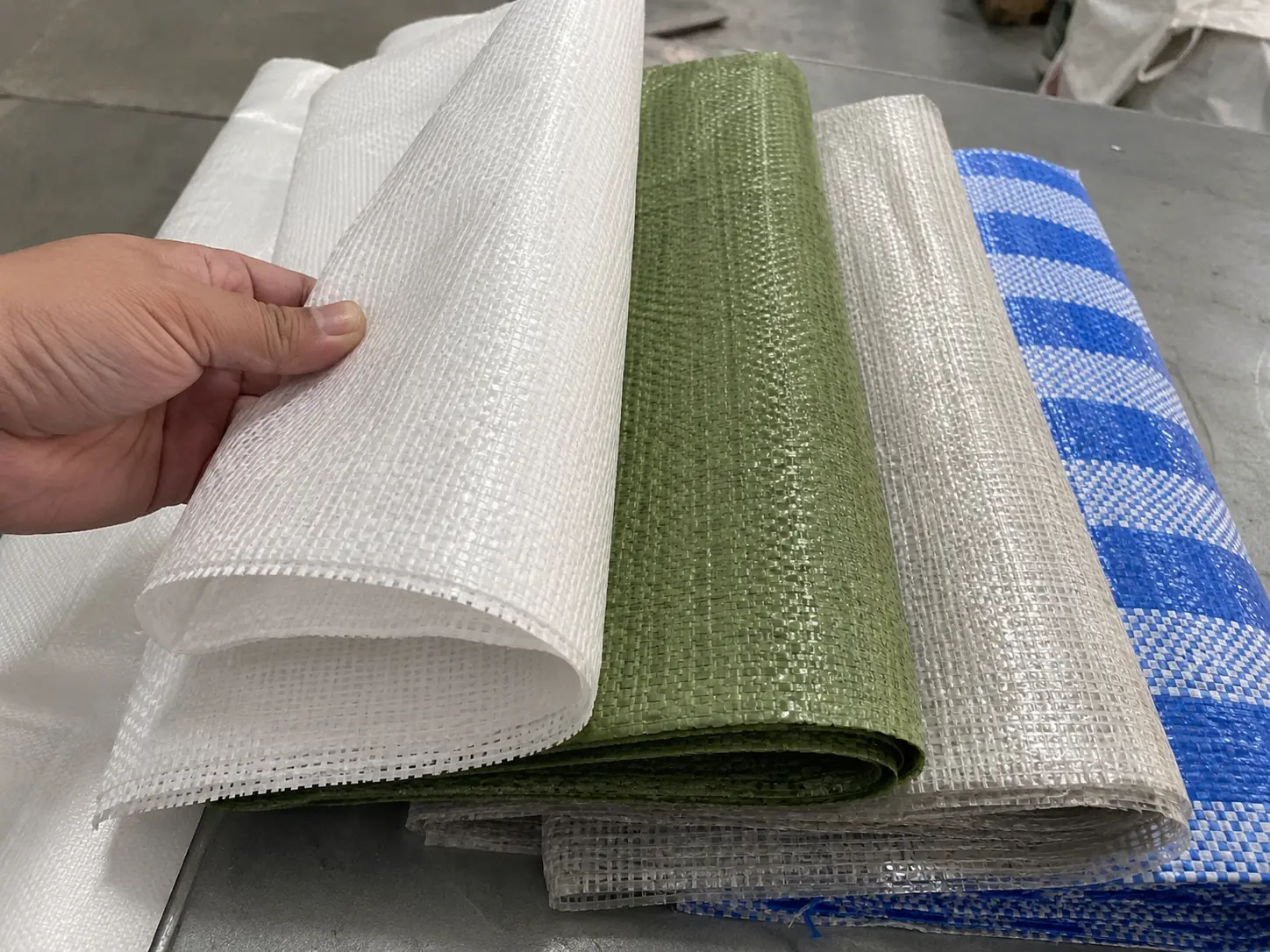
Polypropylene is a partially crystalline, non-polar thermoplastic in the polyolefin family. It is made by chain-growth polymerization of propylene, according to Wikipedia’s polypropylene entry, which also lists it as the second most widely produced commodity plastic after polyethylene. “Thermoplastic” means it can be melted and shaped again, which is why it can be extruded into tape, molded into parts and recycled.
It looks much like polyethylene and is often confused with it, so our polypropylene versus polyethylene guide lists ten differences.
7 Properties That Explain Where Polypropylene Is Used
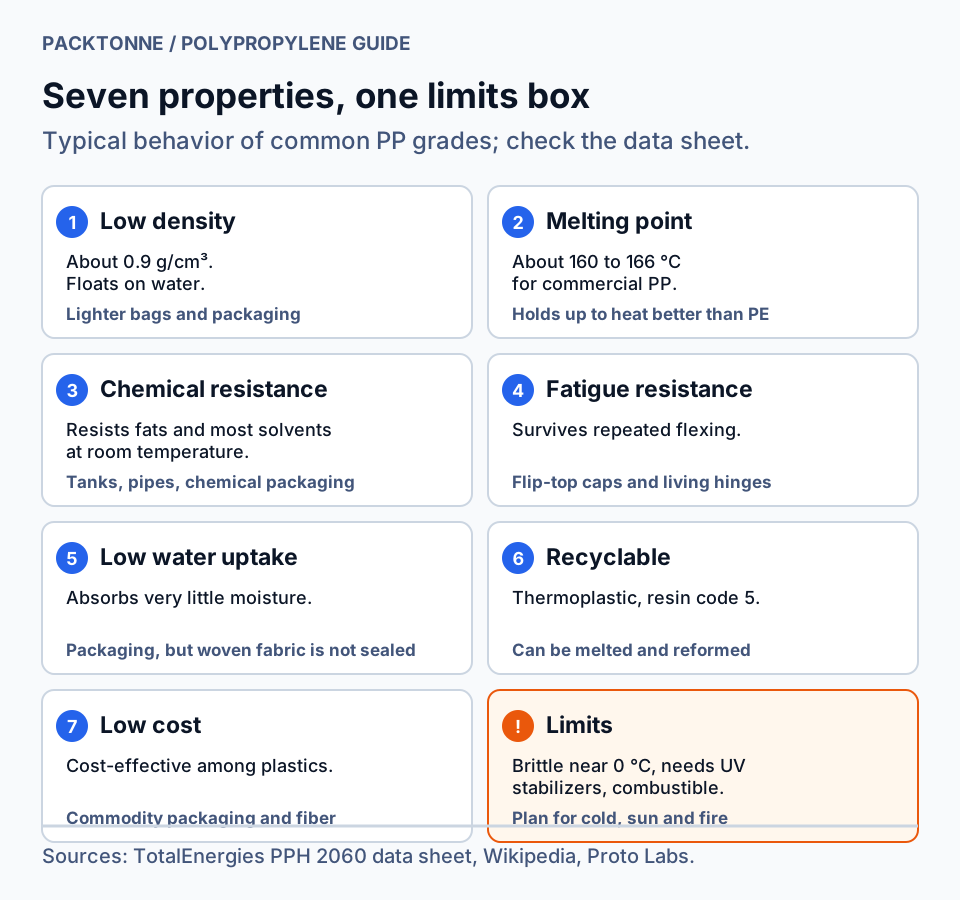
Seven properties account for most of its uses, and one set of limits shapes how it is specified.
| # | Property | Typical value or behavior | Why it matters |
|---|---|---|---|
| 1 | Low density | 0.905 g/cm³ for one homopolymer grade; floats on water | Lighter bags and packaging |
| 2 | Melting point | About 160–166 °C for commercial isotactic PP | Handles heat better than polyethylene; see the melting point guide |
| 3 | Chemical resistance | Resists fats and most organic solvents at room temperature; non-oxidizing acids and bases can be stored in PP | Tanks, pipes, chemical packaging |
| 4 | Fatigue resistance | Good; used for living hinges such as flip-top caps | Parts that flex repeatedly |
| 5 | Low water uptake | Absorbs very little moisture | Packaging, though a woven bag is not sealed |
| 6 | Recyclable | Thermoplastic, resin code 5 | Can be melted and reformed |
| 7 | Low cost | Cost-effective among plastics | Commodity packaging and fiber |
The density comes from the TotalEnergies PPH 2060 data sheet, which labels its values typical rather than specification limits. The other behaviors come from Wikipedia and from Proto Labs, a manufacturer whose page is educational but promotes its own services.
Three Grades of Polypropylene
Polypropylene is sold in three main grades, and they do not behave identically. Homopolymer is the stiffest. Random copolymers include a little ethylene, which lowers the melting point. Impact copolymers add a rubbery phase for toughness in the cold.
| Grade type | Datasheet example | Melting point | Typical role |
|---|---|---|---|
| Homopolymer | TotalEnergies PPH 2060 | 162 °C (ISO 3146) | Stiff parts, woven tape |
| Heterophasic (impact) copolymer | TotalEnergies PPC 3660 | 165 °C (ISO 3146) | Parts that must resist impact |
| Random copolymer | TotalEnergies 3727WZ | 158 °C (DSC) | Clearer, lower-melting parts |
Each row is one grade, not a limit for its class, and the test methods differ. Our melting point guide shows the full numbers and why they do not set a service limit.
Where Polypropylene Is Used
Packaging, textiles, vehicles, medical items and industrial parts are the main uses. Proto Labs lists packaging, automotive parts such as bumpers, interior trim and battery cases, carpets and nonwoven fabrics, medical items such as syringes and lab equipment, household goods, and pipes, fittings and tanks. Wikipedia adds films and bags, filters, ropes and fibers.
Woven bags are one example of the packaging use. Our guide to what woven polypropylene is explains how the tape is made and woven.
Polypropylene in a Bulk Bag
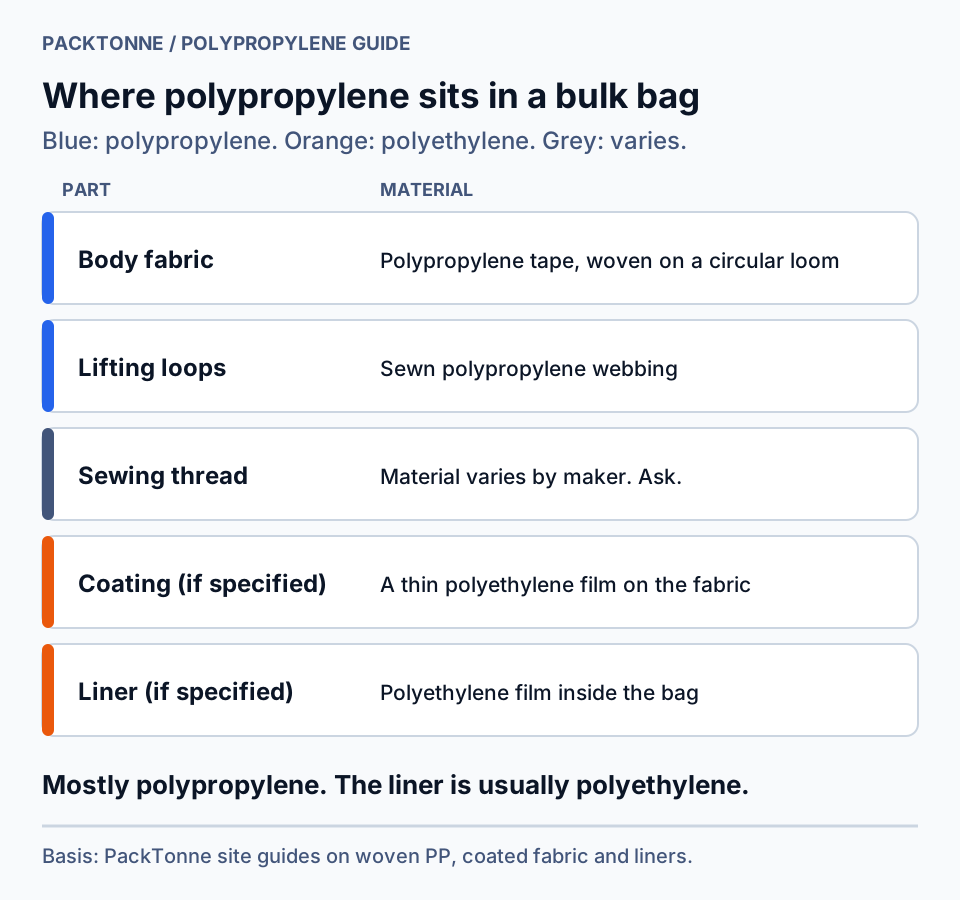
A bulk bag is mostly polypropylene, with a polyethylene liner or coating where the product needs one. The body is woven from polypropylene tape, and the lifting loops are sewn polypropylene webbing. A liner or coating, where specified, is usually polyethylene, which is why the two plastics appear together.
For standard construction, see our Type A standard bulk bags.
What Polypropylene Does Not Do Well
Four limits matter most. They are why a bag’s spec needs more than the word “polypropylene.”
- Cold. Polypropylene becomes brittle below about 0 °C, and adding ethylene-propylene rubber raises low-temperature impact strength, according to Wikipedia.
- Sunlight. Outdoors, oxidation breaks the polymer chains and shows up as cracks and crazing unless stabilizers are added. See our UV resistance guide.
- Fire. It is combustible. Wikipedia lists a flash point of about 260 °C and an autoignition temperature of about 388 °C.
- Bonding. Low surface energy means adhesives and paints stick poorly without surface treatment, per Proto Labs.
Water is a related point. The material takes up very little, but that does not make a woven bag waterproof, as covered in is polypropylene waterproof.
Your Polypropylene Checklist
- If the product will sit outdoors, you should ask which UV stabilizer package it has.
- If it will see temperatures near or below 0 °C, you should ask whether the grade is an impact copolymer.
- If it will see heat, you should ask for the temperature and time, not just the melting point.
- If water protection matters, you should ask about coating and liner, not only the fabric.
- If recycling matters, you should ask whether the product is mono-material, and read our polypropylene recycling guide.
Final Thoughts
Polypropylene is everywhere because seven plain properties add up: light, chemical resistant, fatigue resistant, heat tolerant for a commodity plastic, low in water uptake, recyclable and cheap. Its limits are just as plain, and they are managed by choosing the right grade and spec. If you are buying products made from it, ask for the grade and the data sheet.
Before You Request a Quote
If you are specifying bags and want to check how the polypropylene suits your conditions, send us these details:
- The product and filling temperature
- Storage: indoors or outdoors, and the climate
- Liner or coating requirement
- Filled weight and monthly volume
We will check them against a Type A construction and tell you what to confirm.
Common Questions
What is polypropylene used for?
Polypropylene is used in packaging, textiles, automotive parts, medical items, pipes and household goods. Typical examples are films, bags and food containers; carpets, filters and nonwovens; bumpers, trim and battery cases; syringes and lab ware. Its light weight, chemical resistance and low cost explain the spread.
What is the difference between polypropylene and polyethylene?
Polypropylene is stiffer and melts higher, at about 160–165 °C for common grades, while polyethylene is softer and tougher in the cold. Both are polyolefin thermoplastics and both float on water. Bulk bags use polypropylene for the body and usually polyethylene for the liner. Our polypropylene versus polyethylene guide compares them in full.
Is polypropylene waterproof?
The material absorbs very little water, but a woven polypropylene bag is not sealed. Moisture can still enter through gaps in the weave and at the seams and spout. Whether a given product keeps water out depends on its construction, including coating and liner. Our guide on whether polypropylene is waterproof covers the entry paths.
What is the melting point of polypropylene?
Commercial isotactic polypropylene melts at about 160–166 °C, and datasheets for individual grades list values around 158–165 °C. The melting point is not the temperature a product can safely take, because polypropylene softens under load well below it. Our guide to the polypropylene melting point explains the lower limits.
Can polypropylene be recycled?
Yes. Polypropylene is a thermoplastic with resin identification code 5, so it can be melted and reformed. Whether a particular item is recycled depends on local collection, sorting and markets. Check your local program's accepted list. Our polypropylene recycling guide explains why so little of it is recycled.
Is polypropylene UV resistant?
Only with help. Untreated polypropylene degrades in sunlight and can crack or craze outdoors, so outdoor products use UV stabilizers and antioxidants. How long a product lasts depends on the stabilizer package and the exposure. Our UV resistance guide for bulk bags explains how to specify it.
Why is polypropylene used for bulk bags?
It combines strength for its weight, resistance to many chemicals, low moisture uptake and low cost. Drawn into tape and woven, it forms fabric that carries a tonne of dry product at low weight. Its limits, cold brittleness and UV degradation, are managed by specification. See what woven polypropylene is for the fabric.
More in Construction & Materials
All Construction & Materials guides- Is Polypropylene Food Safe? Why PP Resin Is Not the Same as a Food Grade BagFDA lets polypropylene be used in contact with food, but that covers the resin only. See what 21 CFR 177.1520 sets and what a food grade bulk bag also needs.
- Polypropylene Recycling: Why #5 Plastic Is Recyclable but Rarely RecycledPolypropylene is recyclable, yet most of it is not captured. See why access, sorting and degraded resin hold it back, and where your PP can actually go.
- Polypropylene Melting Point: Why 160 °C Is Not the Temperature a Bulk Bag Can TakePolypropylene melts at about 160–165 °C, but a bulk bag has lower limits: softening, shrinking tape and a PE liner. See the numbers and what to ask suppliers.
- Polypropylene vs Polyethylene: 10 Differences That Decide Which to UsePP is stiffer, lighter and handles heat to about 160 °C; PE stays tough in the cold and heat-seals easily. Ten differences, the grades of each, and how to choose.