Polypropylene vs Polyethylene: 10 Differences That Decide Which to Use
PP is stiffer, lighter and handles heat to about 160 °C; PE stays tough in the cold and heat-seals easily. Ten differences, the grades of each, and how to choose.
PackTonne Sourcing Desk · · 12 min read
Polypropylene (PP) and polyethylene (PE) are the two most produced plastics in the world, and they look almost identical. They behave differently. PP is stiffer, slightly lighter and melts at about 160 °C, so it suits rigid, load-bearing and hot-use parts. PE is softer, stays tough below freezing and heat-seals easily, so it suits film, bags, liners, bottles and pipes. Both resist water and most chemicals, both have food-contact grades, and both recycle — under different codes. For a general introduction to the material, see what polypropylene is.
PP vs PE at a Glance
| Property | Polypropylene (PP) | Polyethylene (PE) |
|---|---|---|
| Density | 0.90–0.91 g/cm³ — the lightest common plastic | 0.91–0.97 g/cm³ (LDPE to HDPE) |
| Melting point | About 160–165 °C (homopolymer) | About 105–115 °C (LDPE), 120–135 °C (HDPE) |
| Stiffness | Higher | Lower — LDPE is soft, HDPE is firm |
| Tensile strength | Higher | Lower for LDPE; HDPE closer to PP |
| Toughness in the cold | Brittle near 0 °C (homopolymer) | Tough well below freezing |
| Repeated flexing | Excellent — forms living hinges | Poor for hinges |
| Chemical resistance | Excellent to acids, bases, alcohols | Excellent to acids, bases, alcohols |
| UV resistance | Needs stabilizer; degrades faster | Needs stabilizer; somewhat more resistant |
| Heat sealing | Seals, but in a narrower window | Seals easily at lower temperatures |
| Water absorption | Almost none | Almost none |
| Microwave and dishwasher use | Common | Not suitable for hot use |
| Resin code | 5 | 2 (HDPE), 4 (LDPE) |
| Typical uses | Woven bags, caps, tubs, fibers, auto parts | Film, bags, liners, bottles, pipes, tanks |
Values are typical for common grades. Individual grades — and the additives in them — move every figure, so a resin data sheet always overrides a general table.
What PP and PE Have in Common
Polypropylene and polyethylene are both polyolefins: long chains of carbon and hydrogen made by linking small hydrocarbon molecules — propylene for PP, ethylene for PE — usually derived from natural gas or crude oil. That shared chemistry gives them a shared set of traits.
- They repel water. Neither absorbs more than a trace of moisture, so neither rots, swells or loses strength when wet.
- They resist chemicals. Both shrug off most acids, alkalis, salts and alcohols at room temperature.
- They float. Both are less dense than water, which is useful for recycling separation from heavier plastics but useless for telling PP from PE.
- They are thermoplastics. Both melt and re-form, so they can be extruded, injection-molded, blow-molded and recycled.
- They are cheap and widely available, which is why they turn up everywhere from food packaging to industrial bulk bags.
The Chemical Difference: One Methyl Group
The whole difference between PP and PE starts with one small group of atoms. A polyethylene chain is a plain run of carbon atoms, each carrying only hydrogen. A polypropylene chain carries a methyl group (CH₃) on every second carbon.
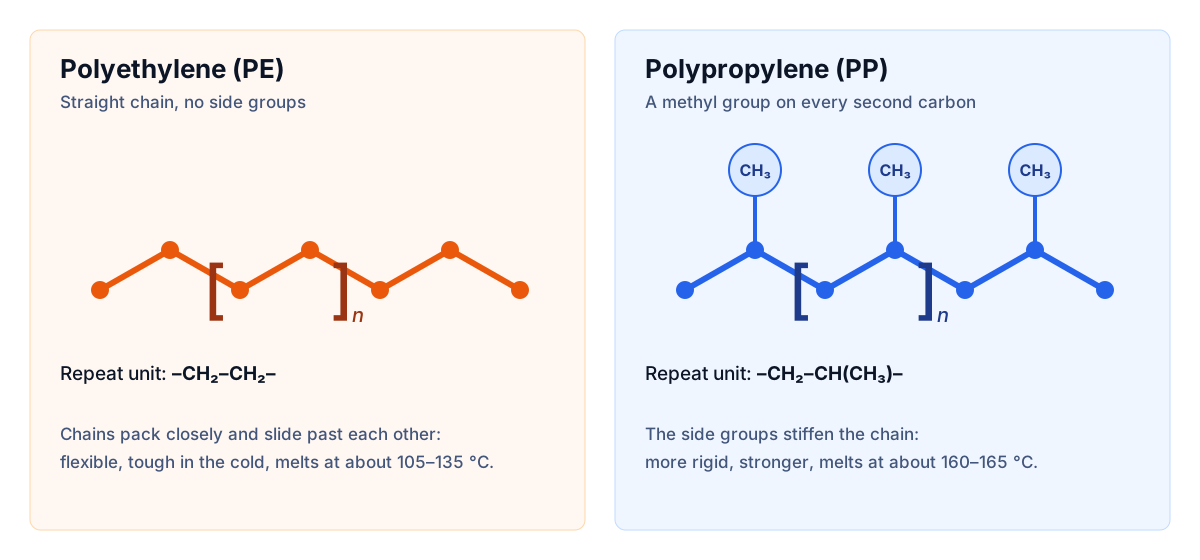
In commercial polypropylene, those methyl groups sit on the same side of the chain — an arrangement called isotactic — which lets the chains pack into an orderly, crystalline structure. The side groups also make the chain stiffer and harder to pull out of position. Result: PP is more rigid and needs more heat to melt. Polyethylene chains, with nothing hanging off them, slide past each other more easily. Result: PE is more flexible and keeps that flexibility at much lower temperatures.
The Main Grades of Each
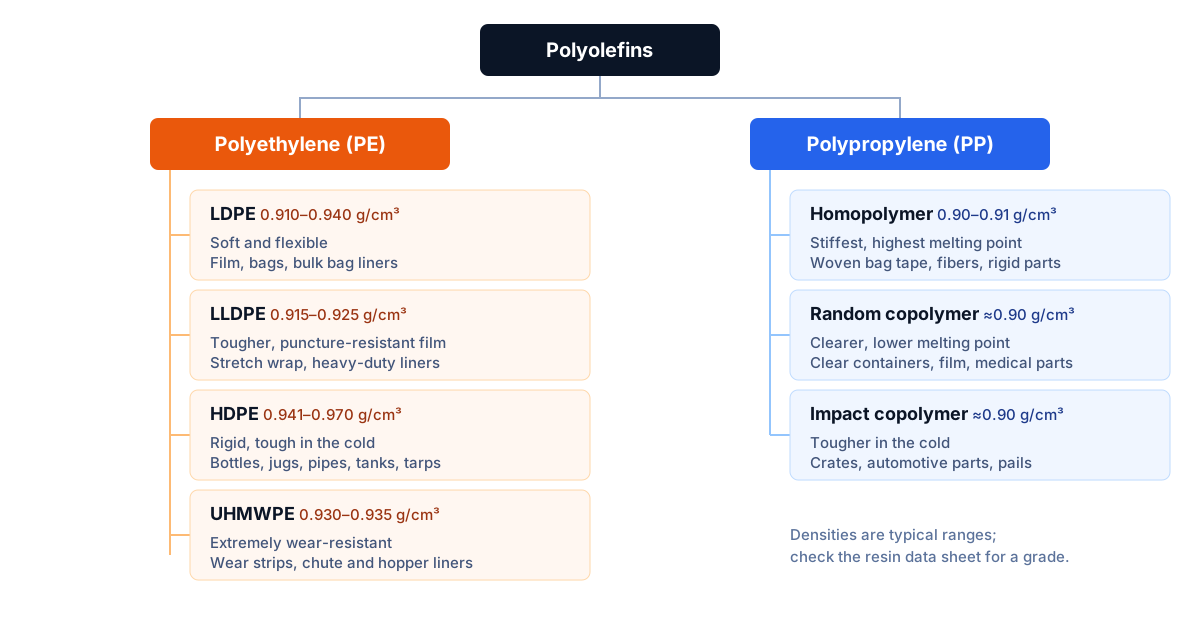
Neither PP nor PE is a single material. Each comes in grades that shift its properties a long way.
| Grade | What changes | Typical uses |
|---|---|---|
| LDPE (low-density PE) | Branched chains: soft, flexible, clear film | Bags, film, squeeze bottles, bulk bag liners |
| LLDPE (linear low-density PE) | Short, regular branches: tougher, more puncture-resistant film | Stretch wrap, heavy-duty liners and sacks |
| HDPE (high-density PE) | Few branches, dense packing: rigid and tough | Milk jugs, detergent bottles, pipes, tanks, tarps |
| UHMWPE | Extremely long chains: outstanding wear resistance | Wear strips, chute and hopper liners |
| PP homopolymer | Propylene only: stiffest, highest melting point | Woven bag tape, fibers, rigid parts |
| PP random copolymer | A little ethylene built in: clearer, lower melting point | Clear containers, film, medical parts |
| PP impact copolymer | Rubbery ethylene phase: much tougher in the cold | Crates, pails, automotive parts |
This is why “HDPE vs polypropylene” and “LDPE vs polypropylene” are different comparisons. HDPE sits close to PP in stiffness and beats it in the cold; LDPE is soft film material and competes with PP only in packaging.
10 Differences That Decide Which to Use
1. Density and weight
Polypropylene, at 0.90–0.91 g/cm³, is the lightest of the common plastics. Polyethylene runs from about 0.91 g/cm³ for LDPE to 0.97 g/cm³ for HDPE. The gap looks small, but a part or a fabric made from PP gives slightly more volume per kilogram of resin, which adds up at production scale.
2. Stiffness and tensile strength
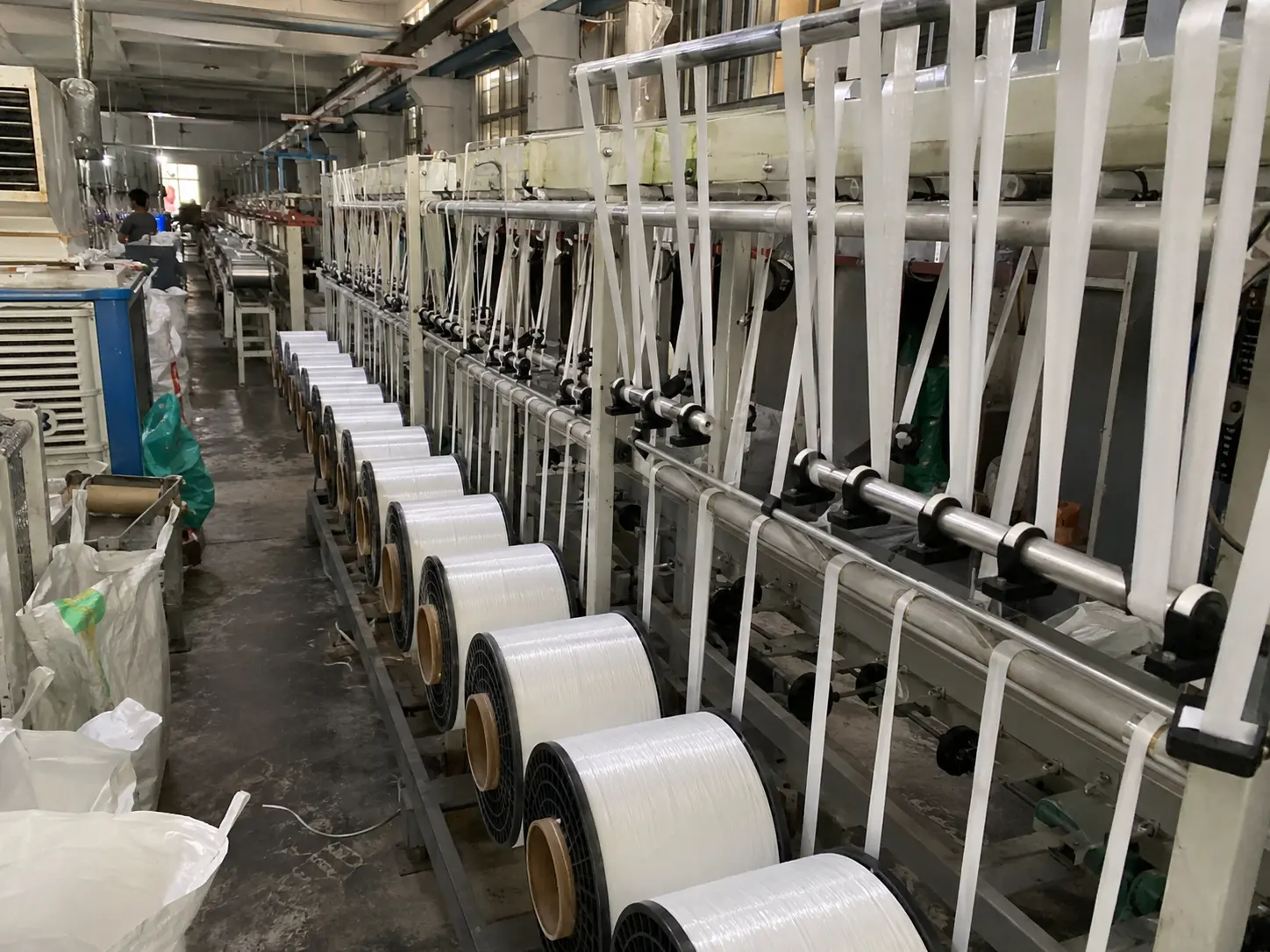
Polypropylene is stiffer and has higher tensile strength than LDPE, and is generally stiffer and somewhat stronger than HDPE. When PP is stretched into tape or fiber, its chains line up and its strength rises sharply — the reason woven polypropylene can carry a tonne of product in a bag that weighs a few kilograms. If the job is carrying a load without stretching or sagging, PP usually wins.
3. Toughness in the cold
Polyethylene stays tough well below freezing; standard polypropylene does not. PP homopolymer turns brittle at around 0 °C and can crack on impact in a cold warehouse or a winter yard. Impact-copolymer PP extends the useful range to roughly −20 °C, but freezer packaging, cold-climate outdoor parts and cold-chain containers are still usually polyethylene.
4. Melting point and heat resistance
Polypropylene melts at about 160–165 °C, well above LDPE at about 105–115 °C and HDPE at about 120–135 °C. In practice PP keeps its shape at temperatures that would soften PE, which is why PP is used for dishwasher-safe containers, microwave tubs and parts that meet hot filling.
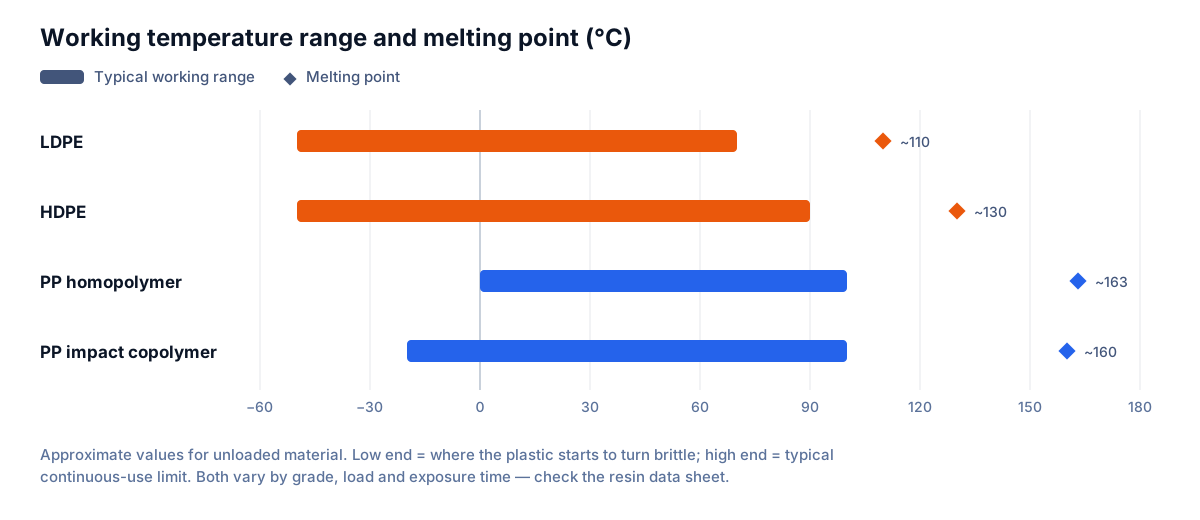
Read the chart as two limits: PP gives you more headroom at the hot end, PE gives you more at the cold end. The right plastic is the one whose range covers the temperatures your part actually sees.
5. Fatigue resistance
Polypropylene survives being bent back and forth thousands of times. A thin section of PP molded as a “living hinge” — the flip lid on a shampoo bottle or a storage box — can flex for years without breaking. Polyethylene fatigues and cracks much sooner under repeated bending, so hinges are almost always PP.
6. Chemical resistance
Both plastics resist acids, alkalis, salts and alcohols very well, and for most everyday chemicals the choice between them rarely comes down to chemistry. The differences appear at the edges: both can swell in hydrocarbons and aromatic or chlorinated solvents, especially when hot, and both are attacked by strong oxidizers. For anything aggressive, check the resin supplier’s chemical-resistance chart at your concentration and temperature rather than relying on a general rating.
7. UV resistance
Both degrade in sunlight without stabilizers, and polypropylene degrades faster. The tertiary carbon that carries PP’s methyl group is a weak point for oxidation, so unstabilized PP left outdoors chalks, loses strength and eventually crumbles. Outdoor PP products — woven bulk bags stored in open yards, for example — use UV-stabilized resin; the UV resistance guide explains how that is specified.
8. Heat sealing and film behavior
Polyethylene heat-seals at lower temperatures and over a wider temperature window than polypropylene, and it stays flexible and tear-resistant as a thin film. That makes PE the default for bags, pouches, stretch wrap and liners. PP film is used too — often as stiffer, clearer BOPP film for labels and snack packs — but where a package has to be sealed quickly and reliably on a production line, PE is the easier material.
9. Food contact and microwave use
Both are widely used for food: PP for yogurt tubs, bottle caps and microwave containers, PE for milk jugs, cling film and bread bags. In the US both fall under the FDA’s olefin polymer regulation, 21 CFR 177.1520, and both have food-contact grades under EU rules. For hot food and microwaves, PP is the one to use, because PE softens at those temperatures. Either way, food safety belongs to a specific grade and its additives, so ask for a declaration of conformity for the exact material.
10. Recycling codes and recyclability
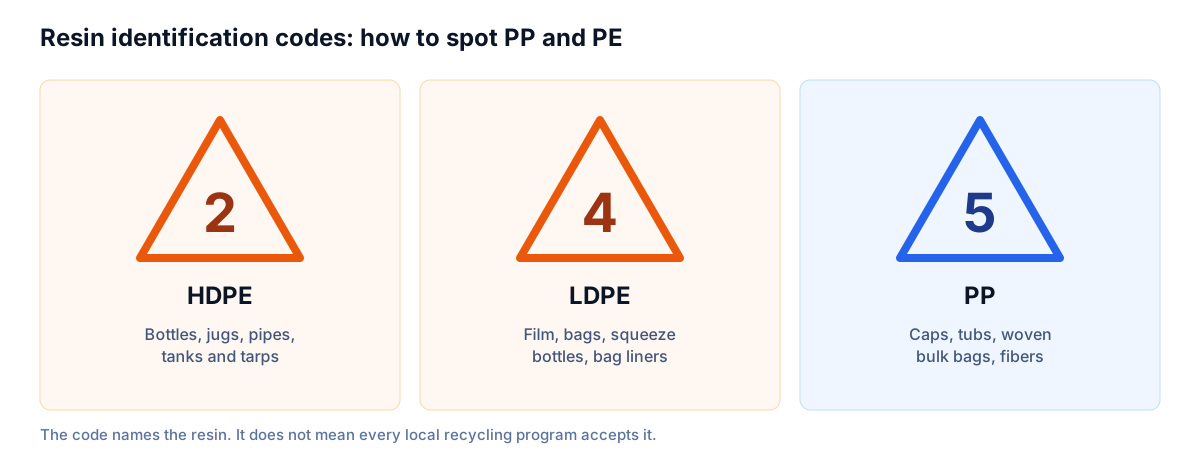
Polypropylene carries resin identification code 5; polyethylene carries 2 for HDPE and 4 for LDPE. Both are recyclable, and HDPE bottles are among the most widely recycled plastics. They are sorted apart because a mixed PP/PE melt forms a blend weaker than either plastic on its own. For why a recyclable plastic like PP is so rarely recycled, see polypropylene recycling.
Where Each One Is Used
| Application | Usually PP | Usually PE |
|---|---|---|
| Heavy-duty packaging | Woven bulk bags, woven sacks, strapping | Bag liners, stretch wrap, shrink film |
| Food packaging | Yogurt tubs, caps, microwave containers | Milk jugs, cling film, bread and produce bags |
| Household | Storage boxes, hinged lids, kettles | Bin liners, squeeze bottles, cutting boards |
| Industrial | Tanks for hot chemicals, fibers, auto parts | Water and gas pipes, fuel tanks, chute liners |
| Textiles | Carpet fibers, nonwoven fabrics, ropes | Tarpaulins, geomembranes |
How to Tell PP and PE Apart
Start with the resin code molded into the part: 5 is PP, 2 or 4 is PE. Without a code, a few practical checks help.
- Feel and flex. PP feels harder and springs back when bent; PE feels softer, slightly waxy, and bends more easily.
- Scratch. A fingernail marks LDPE easily; PP resists.
- Float test — no help. Both float in water, so this only separates them from heavier plastics such as PET or PVC.
- Lab confirmation. A melting-point test (DSC) shows PP near 160 °C and PE well below; infrared spectroscopy (FTIR) identifies each directly.
Burn tests are sometimes suggested, but they give off fumes, are unreliable with filled or blended grades, and are no substitute for a lab test.
Case Study: Why a Bulk Bag Uses Both
A lined bulk bag is a good example of choosing each plastic for what it does best — and of why “PP vs PE” is rarely an either-or decision.
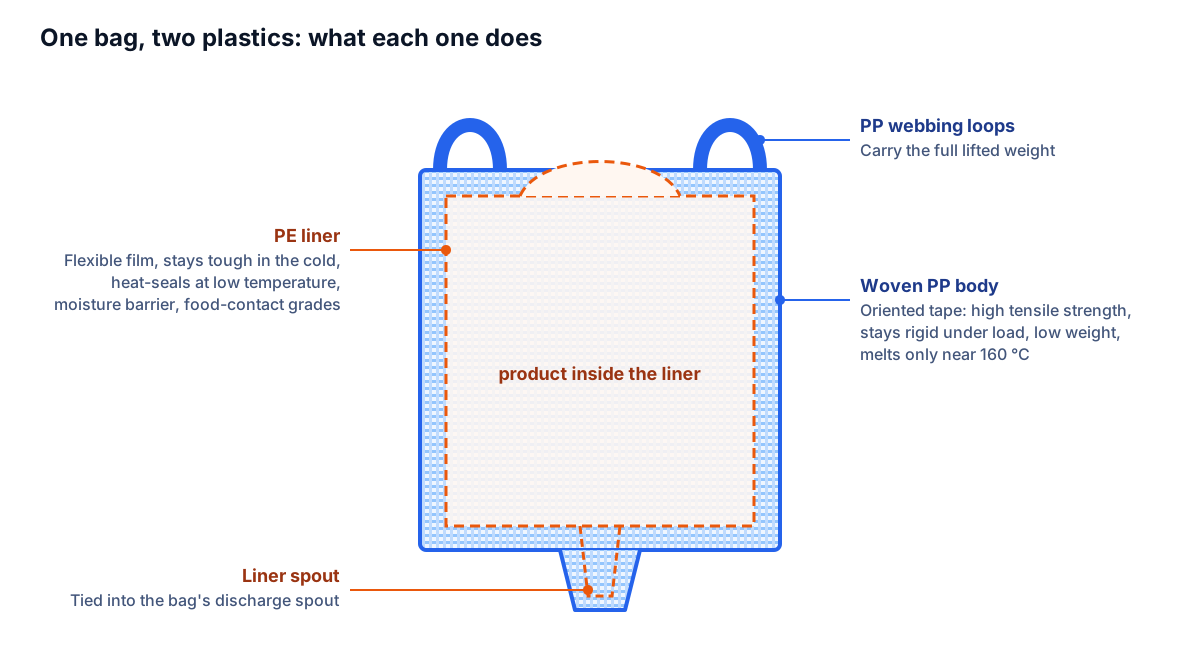
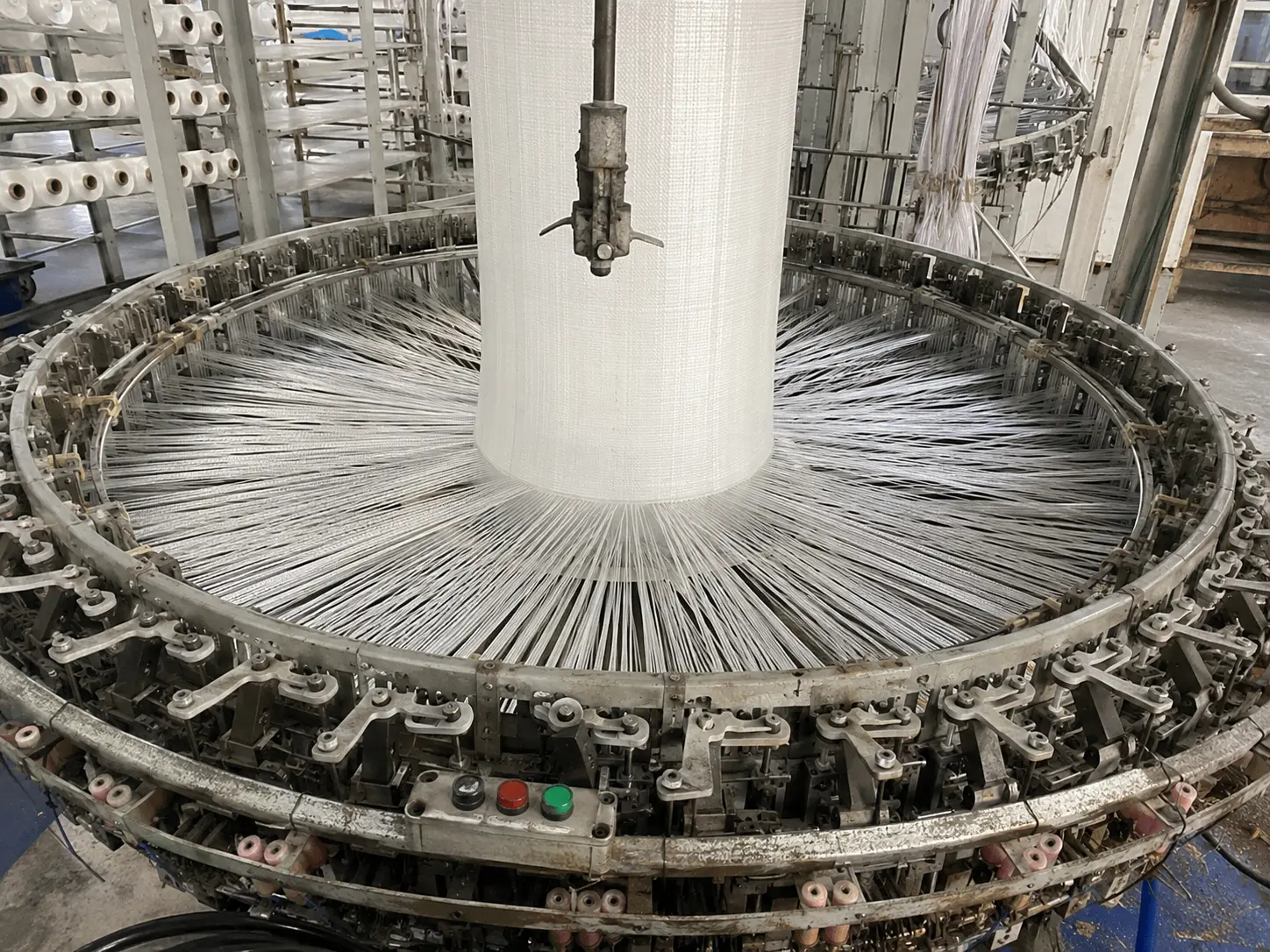
The body and lifting loops are polypropylene. Drawn into tape and woven, PP gives the strength-to-weight needed to lift a tonne or more, holds the bag’s shape under load, and tolerates hot product — cement or resin straight from the process — far better than PE would. The woven polypropylene guide explains how the tape and fabric are made, and a standard build is our Type A bulk bag.
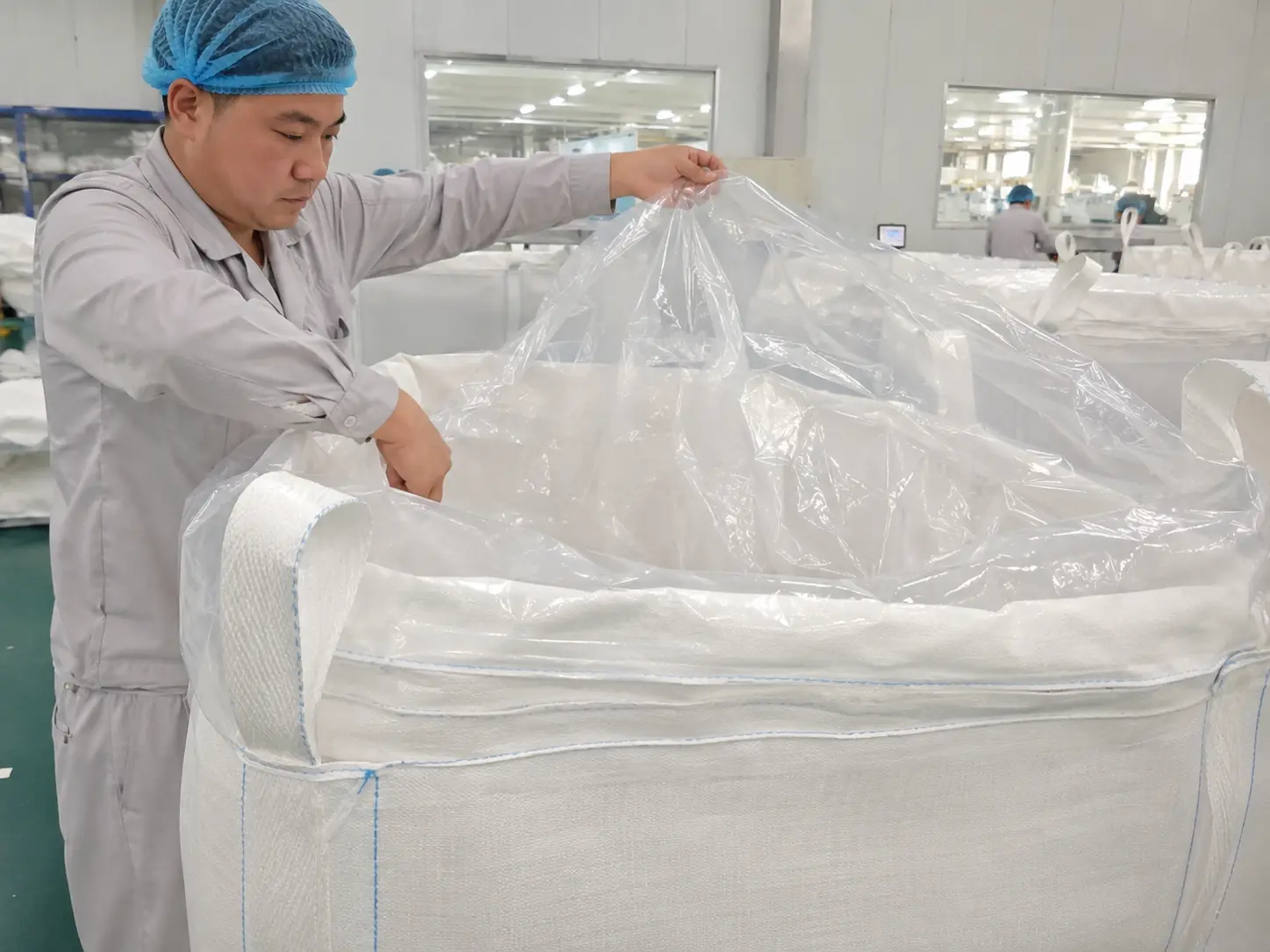
The liner is polyethylene. Inside the bag, strength matters less than sealing: PE film stays flexible in a cold container, heat-seals or ties off at the top and spout, forms a moisture barrier the woven fabric cannot, and comes in food-contact grades. That combination is what makes a food grade bulk bag possible. The liner types guide compares loose, form-fit and baffle liners, and why woven PP still lets water in explains when a liner is needed at all.
Which Should You Choose?
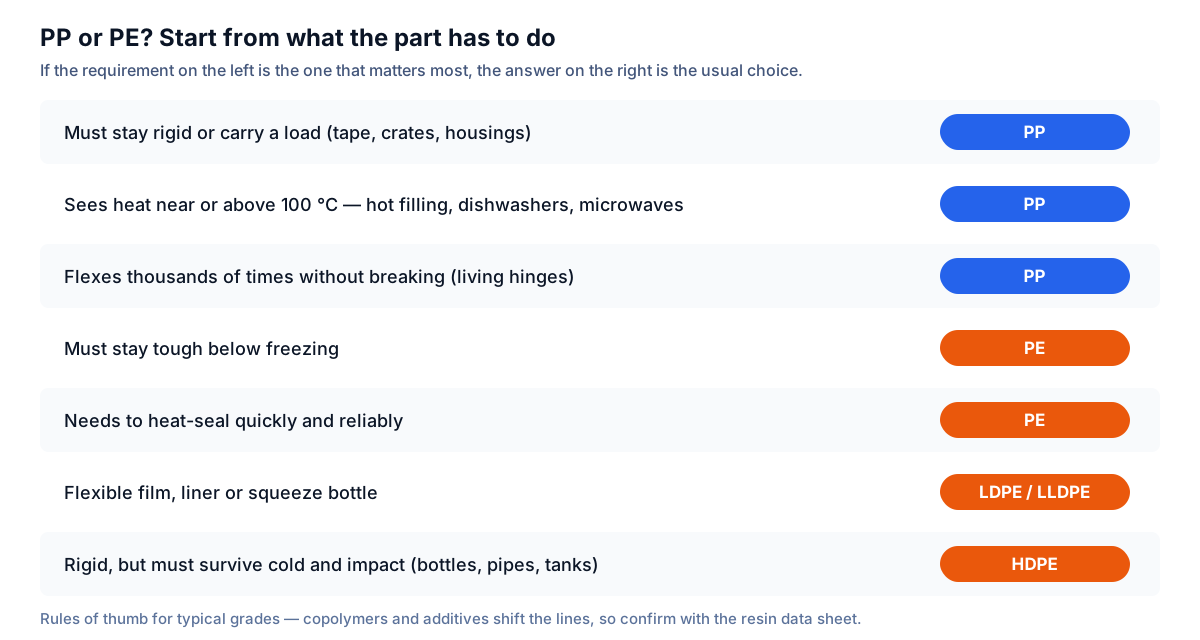
- Does it carry a load or need to stay rigid? Choose PP.
- Will it see heat near 100 °C or above? Choose PP.
- Will it flex repeatedly, like a hinge? Choose PP.
- Will it be used below freezing? Choose PE, or an impact-copolymer PP if it must be rigid.
- Does it need to heat-seal or work as a thin, flexible film? Choose PE — LDPE or LLDPE.
- Is it rigid but exposed to cold and impact, like a bottle, pipe or tank? Choose HDPE.
- Will it sit outdoors? Either can work, but specify UV stabilization, especially for PP.
Final Thoughts
Polypropylene and polyethylene are close cousins separated by one methyl group, and that small difference decides a lot: PP for stiffness, strength and heat; PE for flexibility, cold toughness and sealing. Most real products don’t choose one over the other — they use each where it is strongest, as a lined bulk bag does with a PP body and a PE liner.
Before You Request a Quote
If you are specifying bulk bags, tell us the product, how it is filled and stored, and whether it must stay dry or meet food-contact rules. We will match the polypropylene fabric and the polyethylene liner to the job, starting from our Type A bulk bags.
Common Questions
What is the main difference between polypropylene and polyethylene?
Polypropylene is stiffer, slightly lighter and melts at about 160 °C, so it suits rigid, load-bearing and hot-use parts. Polyethylene is softer and tougher in the cold, melts at roughly 105–135 °C and heat-seals easily, so it suits film, bags, liners, bottles and pipes. The difference comes from a methyl group on every second carbon of the PP chain.
Is polypropylene stronger than polyethylene?
In tensile strength and stiffness, yes: polypropylene is typically stronger and more rigid than LDPE and somewhat stronger than HDPE. Polyethylene is tougher — it absorbs impact better, especially below freezing, where standard polypropylene turns brittle. Which is “stronger” depends on whether the part is pulled, bent or struck.
Which is better for cold temperatures, PP or PE?
Polyethylene. LDPE and HDPE stay tough well below freezing, while polypropylene homopolymer becomes brittle at around 0 °C. Impact-copolymer grades of polypropylene extend its range to roughly −20 °C, but for freezer use, cold-climate outdoor parts or cold-chain packaging, polyethylene is the usual choice.
Which has a higher melting point, polypropylene or polyethylene?
Polypropylene. Homopolymer PP melts at about 160–165 °C, compared with roughly 105–115 °C for LDPE and 120–135 °C for HDPE. That is why PP is used for dishwasher-safe and microwave-safe containers and for parts that see hot filling, and PE is not.
Can polypropylene and polyethylene be recycled together?
They are usually sorted apart: PP carries resin code 5, HDPE code 2 and LDPE code 4. Mixed together they form a blend with weaker properties than either plastic alone, so most recyclers separate them. Some mixed-polyolefin streams are accepted for lower-grade products such as lumber substitutes.
Are polypropylene and polyethylene food safe?
Both have food-contact grades used worldwide, and in the US both fall under the FDA’s olefin polymer regulation, 21 CFR 177.1520. Food safety depends on the specific grade and its additives, so ask for a declaration of conformity for the exact material rather than relying on the resin name.
How can I tell if a plastic is PP or PE?
Check the resin code first: 5 is PP, 2 and 4 are PE. Without a code, PP feels stiffer and springs back, while PE feels softer and waxy. Both float in water, so a float test cannot separate them. A lab can confirm with a melting-point test (DSC) or infrared spectroscopy (FTIR).
Why are bulk bags made of polypropylene and not polyethylene?
Drawn into tape and woven, polypropylene gives high tensile strength at low weight, holds its shape under load and tolerates hot filling up to far higher temperatures than polyethylene. Polyethylene is used inside the bag instead, as the liner, where flexibility, heat-sealing and a moisture barrier matter more than strength.
More in Construction & Materials
All Construction & Materials guides- Is Polypropylene Food Safe? Why PP Resin Is Not the Same as a Food Grade BagFDA lets polypropylene be used in contact with food, but that covers the resin only. See what 21 CFR 177.1520 sets and what a food grade bulk bag also needs.
- What Is Polypropylene? 7 Properties That Explain Where It Is UsedPolypropylene is a lightweight, chemical-resistant thermoplastic that floats and melts near 160 °C. Seven properties explain its uses, from caps to bulk bags.
- Polypropylene Recycling: Why #5 Plastic Is Recyclable but Rarely RecycledPolypropylene is recyclable, yet most of it is not captured. See why access, sorting and degraded resin hold it back, and where your PP can actually go.
- Polypropylene Melting Point: Why 160 °C Is Not the Temperature a Bulk Bag Can TakePolypropylene melts at about 160–165 °C, but a bulk bag has lower limits: softening, shrinking tape and a PE liner. See the numbers and what to ask suppliers.