UV Resistance in FIBC Bags: The Damage You Can't See
UV breaks down the polymer itself, not just the color. A bag can look fine after months outdoors while having lost real tensile strength.
PackTonne Sourcing Desk · · 6 min read
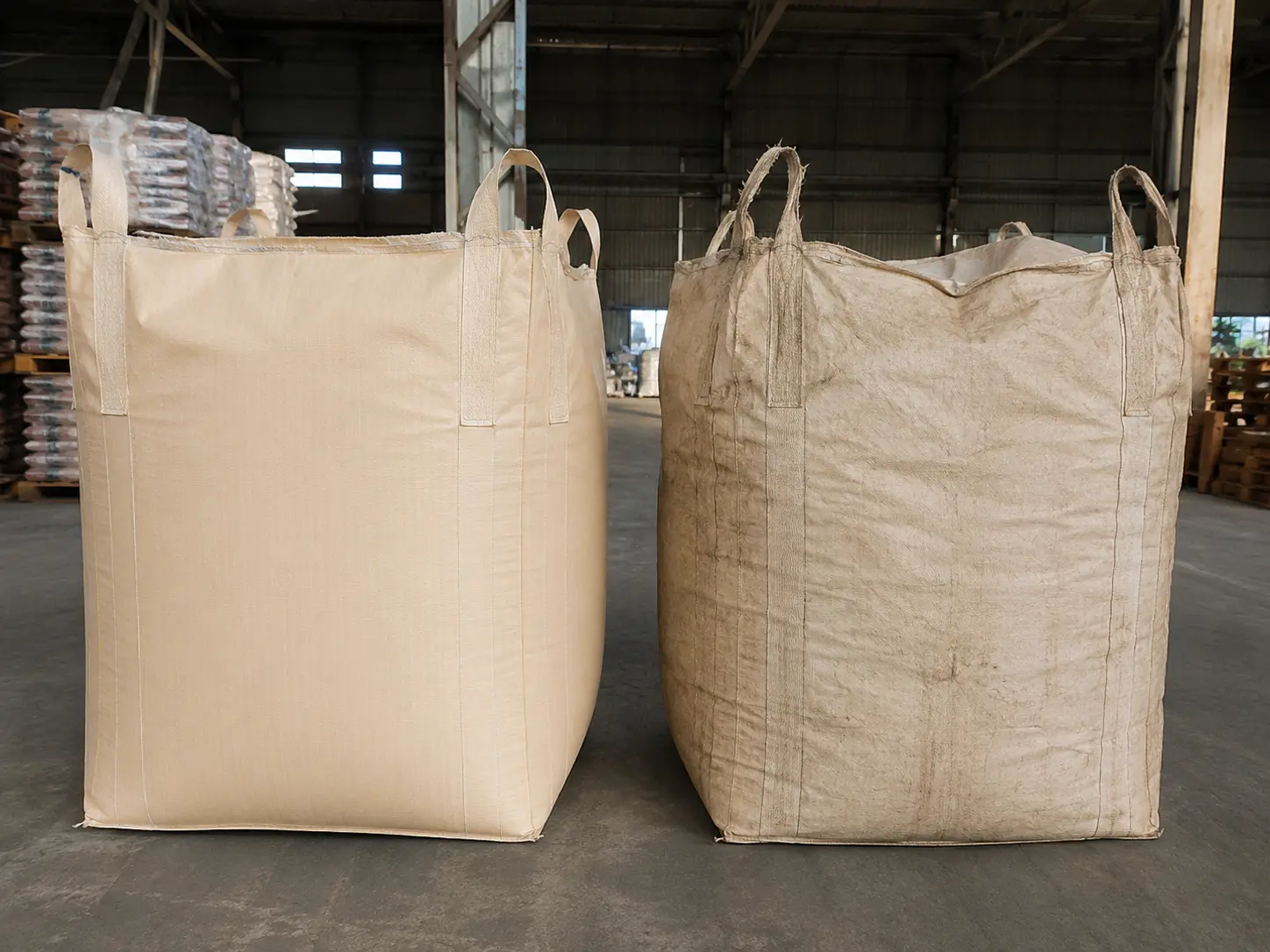
UV exposure degrades woven polypropylene by breaking down the polymer chains themselves, not just fading the fabric’s color — a bag can look only mildly weathered after months outdoors while having lost real tensile strength. Stabilization against this can be built into the base resin or applied as a coating layer, and each approach has different durability characteristics. Which means visual inspection is the wrong tool for judging whether an outdoor-stored bag is still safe.
How UV Actually Degrades Woven PP
Ultraviolet light breaks chemical bonds in polypropylene’s polymer chains through a process called photodegradation, and this happens progressively with cumulative sun exposure regardless of whether the fabric shows visible signs yet. The practical problem is that visible fading and chalking — a powdery surface residue from degraded material — don’t track tensile strength loss on the same timeline; a bag can retain a mostly normal appearance while its actual load-bearing capacity has measurably declined. This is why UV degradation is a genuine safety consideration, not just a cosmetic one.
Two Approaches to Stabilization
UV protection can be built into the fabric two different ways, and they’re not equivalent. Resin-level stabilization adds UV-absorbing compounds or hindered amine light stabilizers (HALS) directly into the polypropylene before it’s extruded into tape, protecting the fiber itself throughout its full thickness. Carbon black pigment, when used, also provides meaningful inherent UV protection at the resin level. Coating-level protection — a UV-stabilized film laminated onto the fabric surface — protects only that outer layer, which can wear, scratch, or degrade through handling in ways that expose the underlying fabric to full UV exposure again. Resin-level stabilization generally holds up more consistently over extended exposure, since it’s part of the fiber rather than a separate surface treatment.
There’s No Universal Safe Outdoor Duration
How long a bag can sit outdoors before UV becomes a real strength concern depends on climate and latitude, the season and sun intensity, whether bags are tarped or left fully exposed, and the specific stabilization the fabric was manufactured with — there’s no single “safe for X months” answer that applies everywhere. A bag stored outdoors in a low-latitude, high-UV climate degrades faster than the identical bag in a milder climate over the same calendar time. Ask your supplier for the tested UV exposure rating relevant to your actual conditions rather than relying on a generic industry rule of thumb.
Signs of UV Damage: What You Can and Can’t See
Chalking and visible color fade are the most obvious signs of UV exposure, but they’re an incomplete indicator — meaningful tensile strength loss can occur before these visible signs become obvious enough to notice during a casual inspection. If bags have sat outdoors for an extended, uncertain period, a strength test is a more reliable check than visual inspection alone, particularly before reusing multi-trip bags that have already seen one exposure cycle.
When UV Resistance Actually Matters
Construction, agriculture, and mining operations that store filled or empty bags outdoors for weeks or months at a time are where UV resistance is a genuine, ongoing spec consideration — these industries routinely leave bags exposed on job sites, in fields, or in yard storage well beyond a quick turnaround. Indoor storage or fast-turnaround operations where bags move from delivery to use within days carry much lower UV risk regardless of climate, and specifying premium UV stabilization for that use case adds cost without a corresponding benefit. Temporary structures are the extreme case: a bulk bag cofferdam can stand in full sun for months and then has to survive a heavy recovery lift.
Common Mistakes When Planning for UV Exposure
- Judging UV damage by appearance alone. Visible fading and chalking don’t reliably track how much tensile strength has actually been lost — a strength test is the only real confirmation for uncertain exposure history.
- Assuming coating-level UV protection performs the same as resin-level stabilization. Coating can wear or scratch through handling in ways that expose the underlying fiber; resin-level protection doesn’t have that failure mode.
- Applying one exposure duration assumption across different climates. The same calendar time produces very different UV damage depending on latitude and sun intensity.
- Reusing multi-trip bags after outdoor storage without checking cumulative exposure. Each outdoor cycle adds to total UV dose — a bag’s remaining strength margin depends on its full exposure history, not just its most recent trip.
- Over-specifying UV stabilization for fast-turnaround, indoor-only use. This adds cost without benefit if bags genuinely never face meaningful outdoor exposure.
UV Stabilization Interacts With Other Fabric Specs
UV protection is one more independent variable alongside fabric weight, safety factor, coating for moisture, and liner choice — see our woven polypropylene guide for how these fit together. A bag can be UV-stabilized and also coated for moisture resistance, since the two address different environmental risks through different mechanisms. Specify UV needs explicitly rather than assuming a general “outdoor-rated” claim covers both moisture and UV concerns adequately.
Decision Checklist
- Will bags sit outdoors for weeks or months, or move to use within days? That timeline difference determines how seriously UV stabilization needs to be prioritized.
- Do you know your specific climate’s UV intensity relative to the industry norm? Higher-UV climates need more conservative planning around exposure duration.
- Is stabilization built into the resin, or only applied as a coating? Resin-level protection holds up more consistently under handling and extended exposure.
- Are you reusing multi-trip bags that already had one outdoor exposure cycle? Consider a strength check rather than relying on visual inspection alone.
- Have you asked for a tested UV exposure rating specific to your conditions? A generic claim without a tested rating isn’t enough to plan storage duration against.
Final Thoughts
UV damage is the failure mode that gives the least warning — no tearing, no obvious wear, just a bag that quietly stops being as strong as its rating says. If your bags will sit outdoors for more than a few weeks, that risk belongs in the spec rather than in the storage plan alone. Tell us your climate and expected exposure time and we’ll confirm the right stabilization approach.
Before You Request a Quote
Send us your storage conditions and we’ll confirm the right UV stabilization approach:
- Expected outdoor storage duration, even approximately
- Your general climate and latitude
- Whether bags will be tarped/covered or fully exposed
- Single-trip or multi-trip use, and whether reuse spans multiple exposure cycles
Request a quote with your storage conditions and we’ll confirm resin-level or coating-level UV stabilization against your actual exposure risk.
Common Questions
Does UV exposure actually weaken an FIBC bag, or just fade its color?
Both, but the strength loss is the real concern. UV breaks down polypropylene's polymer chains at a molecular level, reducing tensile strength over time — a bag can look only mildly faded while having lost meaningful strength, since visible color change and structural degradation don't progress at the same rate.
What's the difference between UV stabilizer in the resin versus in a coating?
Resin-level stabilization — additives like HALS (hindered amine light stabilizers) or UV absorbers, or carbon black pigment — protects the fiber itself throughout the fabric. Coating-level UV protection only protects the surface layer. Resin-level stabilization generally offers more consistent protection since it's part of the fiber, not a separate layer that can be scratched or worn through.
How long can an FIBC bag sit outdoors before UV becomes a concern?
There's no universal safe duration — it depends on climate and latitude, season, whether bags are tarped or fully exposed, and the specific stabilization the fabric was made with. Ask your supplier for the tested UV exposure rating relevant to your specific storage conditions rather than assuming a generic timeframe.
Can I tell if a bag has UV damage just by looking at it?
Only partially. Chalking (a powdery surface residue) and visible color fade are signs of UV exposure, but they don't reliably indicate how much tensile strength has actually been lost — meaningful strength loss can occur before visible signs are obvious enough to notice casually.
Which industries need to specify UV resistance most carefully?
Construction, agriculture, and mining operations that store filled or empty bags outdoors for weeks or months are where UV resistance matters most. Indoor storage or fast-turnaround operations where bags are used within days of arrival have much lower UV exposure risk regardless of climate.
Does a tarp over stored bags solve the UV problem?
Largely, if it's opaque and stays in place. An opaque cover blocks direct exposure, which is the main driver of degradation. Translucent sheeting and partial coverage help far less than they appear to — and a tarp that blows off for a week undoes weeks of protection.
Can UV-degraded bags be identified before they fail?
Only partially. Chalking and fading confirm exposure has occurred but correlate poorly with how much tensile strength is actually gone. For bags with an uncertain outdoor history, a destructive strength test on a sample is more reliable than any visual assessment.
More in Construction & Materials
All Construction & Materials guides- Bulk Bag Closures: The Knot That Holds a Tonne Against ItClosure type is decided at the order stage and lived with at discharge. A drawstring carries the whole load against one knot, which is why it jams shut.
- Net Baffle FIBC Bags: When Fabric Baffles Leave Corners EmptyA baffle bag that never fills its corners costs you the premium and the space. Net baffles let poor-flowing product reach corners that fabric panels block.
- FIBC Stitching: The Failure Point GSM Doesn't CoverBags usually fail at the seams, not through the fabric. Stitch pattern and thread spec matter as much as GSM — and get checked far less often.
- U-Panel vs Circular vs Four-Panel: Seams, Shape and CostCircular, U-panel and four-panel construction trade seam count against shape stability and cost. Here's which one suits your product and freight.