Net Baffle FIBC Bags: When Fabric Baffles Leave Corners Empty
A baffle bag that never fills its corners costs you the premium and the space. Net baffles let poor-flowing product reach corners that fabric panels block.
PackTonne Sourcing Desk · · 7 min read
A baffle bag that never fills its corners is worse value than a plain bag. You pay the baffle premium, you ship the same tonnage, and the square shape you bought exists only on the outside. Whether the corners fill has almost nothing to do with your industry and everything to do with how your product flows — which is the decision a net baffle exists to solve.
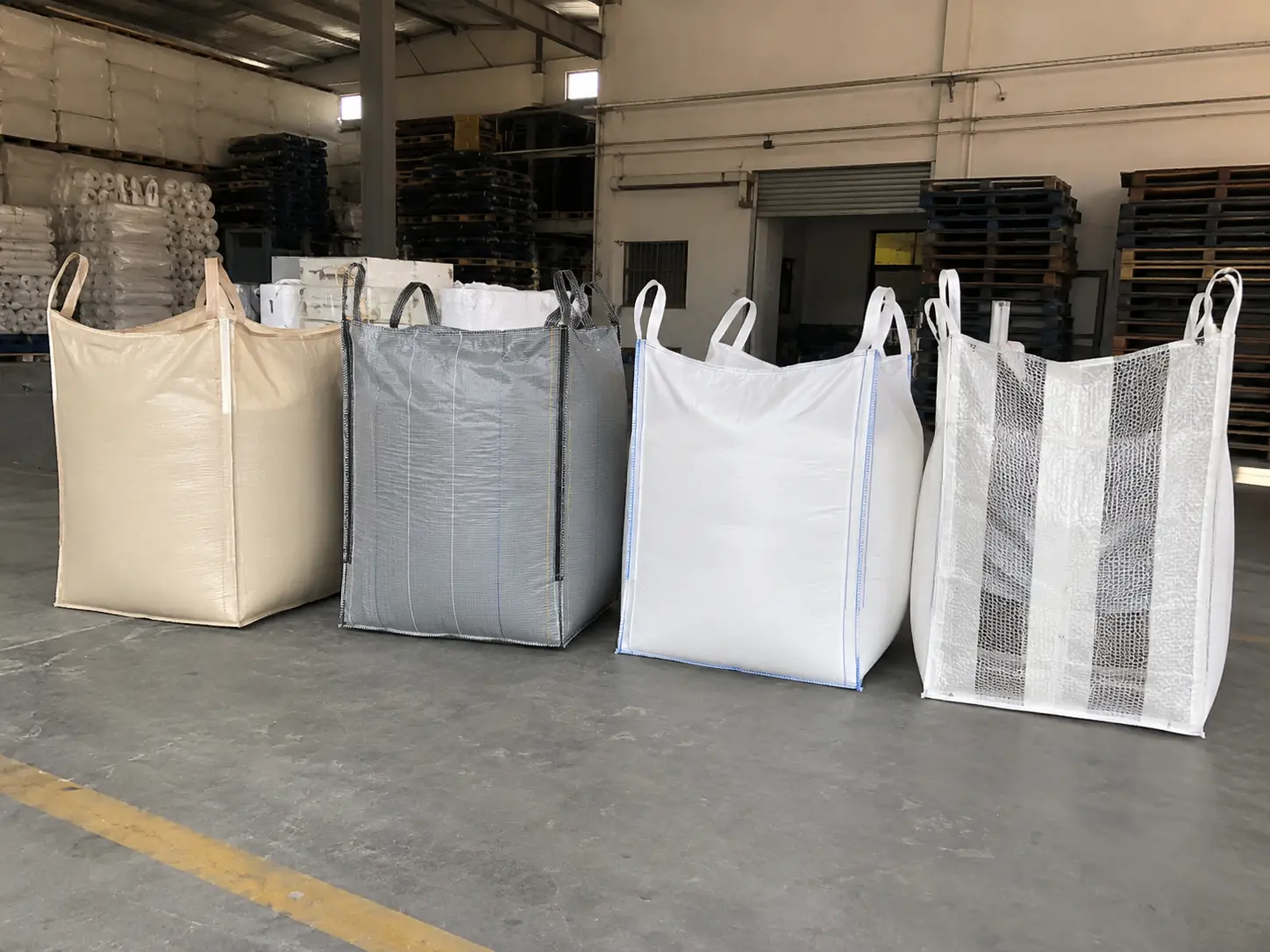
What a Net Baffle Changes
A net baffle replaces the solid fabric panel sewn across each internal corner with knitted polypropylene netting. Everything else is the same: same four corner positions, same square cross-section when filled, same body constructions available. The single difference is that product can pass through the baffle plane instead of having to travel around it.
That sounds minor. It decides whether a poorly flowing material reaches the corner at all.
The Failure Mode: Paying for Baffles and Still Shipping Air
Baffle construction earns its premium through container utilisation — square bags stack without the wasted gaps that round-filled bags leave, which is where the roughly 30% improvement commonly quoted comes from. That gain assumes the bag actually fills to its square profile.
When it does not, the economics invert:
- You paid a per-bag premium over a plain bag
- The bag’s outer shape still reads as square, so nobody notices during loading
- Actual filled weight comes in under target, so you ship more bags for the same tonnage
- Container utilisation ends up no better than the plain bag you did not buy
This failure is quiet. Nothing tears, nothing fails inspection, and the bag looks correct from outside. It shows up only as a filled weight that never quite matches what the volume should hold — which you can check against the geometric figure in our bag calculator before you blame the specification.
Flow Behaviour Decides, Not Product Category
The question is not which industry you are in. It is whether your material moves sideways under its own weight once the centre of the bag is full.
Products that generally reach the corners past a solid panel:
- Fine free-flowing powders
- Small uniform granules and prills
- Dry sand and similar fines
Products that often do not:
- Coarse or irregular aggregate with large particle size
- Lumpy, agglomerated or partially caked material
- Fibrous or flaky products that interlock rather than pour
- Damp material with any cohesion
Note what these lists cut across. A single chemical plant might ship a free-flowing prill and a flaky intermediate; a food processor might ship both fine starch and a coarse granulated product. The physical form drives the answer, not the company or the commodity.
Net vs Fabric Baffle
| Fabric baffle | Net baffle | |
|---|---|---|
| Baffle material | Woven PP panel | Knitted PP netting |
| Product passes through baffle | No | Yes |
| Corner fill with free-flowing product | Good | Good |
| Corner fill with coarse or cohesive product | Often incomplete | Good |
| Shape retention when filled | Good | Good |
| Load spread under heavy stacking | Across whole panel | Along yarn lines |
| Material used | More | Less |
| Body constructions available | Circular, U-panel, four-panel | Circular, U-panel, four-panel |
| Visibility of fill level | None | Partial, through the netting |
Body construction is a separate axis from baffle type — U-panel, circular or four-panel can each carry either baffle, so treat them as two independent decisions rather than a bundled spec.
What to Put on the Spec Sheet
Baffle type is one field, and quoting it alone leaves three more undecided. A quote that says only “baffle bag” is not a specification.
Baffle material and opening. Net or fabric, and for fabric, whether the panels carry openings and roughly how open they are. A fabric baffle with generous openings behaves closer to a net baffle than to a closed panel, so “fabric baffle” on its own does not tell you how much your product will be obstructed.
How the baffles are attached. Baffles sewn into the body side seams carry load differently from baffles tacked to the inner wall as a secondary operation. Seam-integrated baffles are the more robust construction and the one worth naming explicitly, since it is not a universal default across factories.
Baffle height coverage. Baffles that run the full body height hold shape over the whole bag; partial-height baffles leave the top section free to bulge. Both exist, and the shorter version is cheaper — which is exactly why it turns up in quotes you did not spell out.
Interaction with fill and discharge fittings. A spout bottom or duffle top changes how product enters and leaves the corner volumes, so the baffle decision and the fitting decision belong in the same conversation. The full field list for a comparable quote is in our guide to reading a bulk bag spec sheet.
Where Fabric Baffles Still Win
Solid panels are not a legacy option. Under sustained stacking pressure with dense product, a closed panel spreads load across its entire surface rather than concentrating it along sewn yarn lines, which matters most for heavy materials stored stacked for long periods. Some buyers also prefer a fully closed internal structure where any migration of product between corner and centre is undesirable during long ocean transit.
And for genuinely free-flowing product, the two perform the same. If your current fabric baffle bags fill their corners, there is no reason to change — the net version solves a problem you do not have.
Your Decision Checklist
- Do your current filled bags look square all the way to the corners, or rounded at the bottom edges? Rounded corners on a baffle bag is the symptom this whole decision exists to fix.
- Does your filled weight match what the bag’s volume should hold at your bulk density? A persistent shortfall points at corner voids, not at the scale.
- Would you describe your product as pouring, or as tumbling and interlocking? Anything in the second category is a net baffle candidate.
- Is the load stacked under other bags for long periods? That is the one case where a solid panel’s load spreading is worth keeping.
- Can you run a sample fill of each? For a decision this specific, one filled bag of each type tells you more than any spec discussion will.
Final Thoughts
The baffle premium only pays back if the corners fill. If your bags are coming out rounded at the base, the fix is not a heavier fabric or a bigger bag — it is a baffle your product can actually get past. Send us the material, its particle size and how it behaves at the filling head, and we will tell you whether net or fabric fits, including the common case where your current bags are already doing the job.
Tell us the product, target fill weight, bulk density and how the bags are stored after filling. That is enough to confirm a baffle type and quote against baffle bags built to it.
Common Questions
What is a net baffle bulk bag?
A net baffle bag uses knitted polypropylene netting in place of the solid fabric panels sewn across each internal corner. The geometry is identical to a standard baffle bag and it holds the same square shape, but product passes through the netting rather than having to flow around a closed panel.
Why doesn't my baffle bag fill the corners?
Usually because the product cannot flow past a solid baffle panel. Free-flowing powders and small granules find the corners on their own; coarse, lumpy, fibrous or damp materials pack against the panel and leave the corner void. The bag still holds its square outline while carrying less than the shape suggests.
Do net baffles hold shape as well as fabric baffles?
For most loads, yes. The netting is sewn horizontally under tension and restrains the fabric wall the same way a solid panel does. Where fabric still has an edge is under sustained stacking pressure with heavy dense product, since a closed panel distributes load across its whole surface rather than along yarn lines.
Are net baffle bags cheaper than fabric baffle bags?
Often slightly, because netting uses less material than woven panels, but the gap is small enough that it should not drive the decision. Both carry a premium over a plain bag. Choose on whether your product reaches the corners, then treat any material saving as a bonus.
Can I get net baffles on any body construction?
Yes. Net baffles are fitted to circular, U-panel and four-panel bodies the same way fabric baffles are. The baffle choice and the body construction are separate decisions, and neither one constrains the other.
Do net baffles work with fine powders?
They do, and the netting does not need to contain the powder — the outer bag and any liner do that. Fine free-flowing powders are also the case where the choice matters least, since they fill corners readily behind either baffle type.
How do I know whether my product flows well enough for fabric baffles?
Watch how it behaves on your existing fill. If your current bags come out visibly rounded at the corners or the filled weight falls short of the target for the volume, flow is the limiting factor. A sample fill with each baffle type settles it faster than any specification discussion.
More in Construction & Materials
All Construction & Materials guides- Bulk Bag Closures: The Knot That Holds a Tonne Against ItClosure type is decided at the order stage and lived with at discharge. A drawstring carries the whole load against one knot, which is why it jams shut.
- FIBC Stitching: The Failure Point GSM Doesn't CoverBags usually fail at the seams, not through the fabric. Stitch pattern and thread spec matter as much as GSM — and get checked far less often.
- U-Panel vs Circular vs Four-Panel: Seams, Shape and CostCircular, U-panel and four-panel construction trade seam count against shape stability and cost. Here's which one suits your product and freight.
- UV Resistance in FIBC Bags: The Damage You Can't SeeUV breaks down the polymer itself, not just the color. A bag can look fine after months outdoors while having lost real tensile strength.