Baffle Bags (Q Bags): When the 30% Space Gain Pays Off
Baffle construction is a shape feature, not a compliance category — it adds 8–15% per bag and can return around 30% in container utilization.
PackTonne Sourcing Desk · · 6 min read
Baffle construction is a shape feature, not a hazard or compliance category — internal fabric panels sewn across the corners keep the bag square when filled, instead of bulging round like a standard bag. That squared profile can improve container utilization by roughly 30% — provided your product actually reaches the corners, which is where the net baffle versus fabric baffle choice comes in — but the construction adds 8–15% to the per-bag price. Whether a baffle bag is worth it comes down to whether your freight savings outweigh that premium, not a general upgrade every buyer needs.
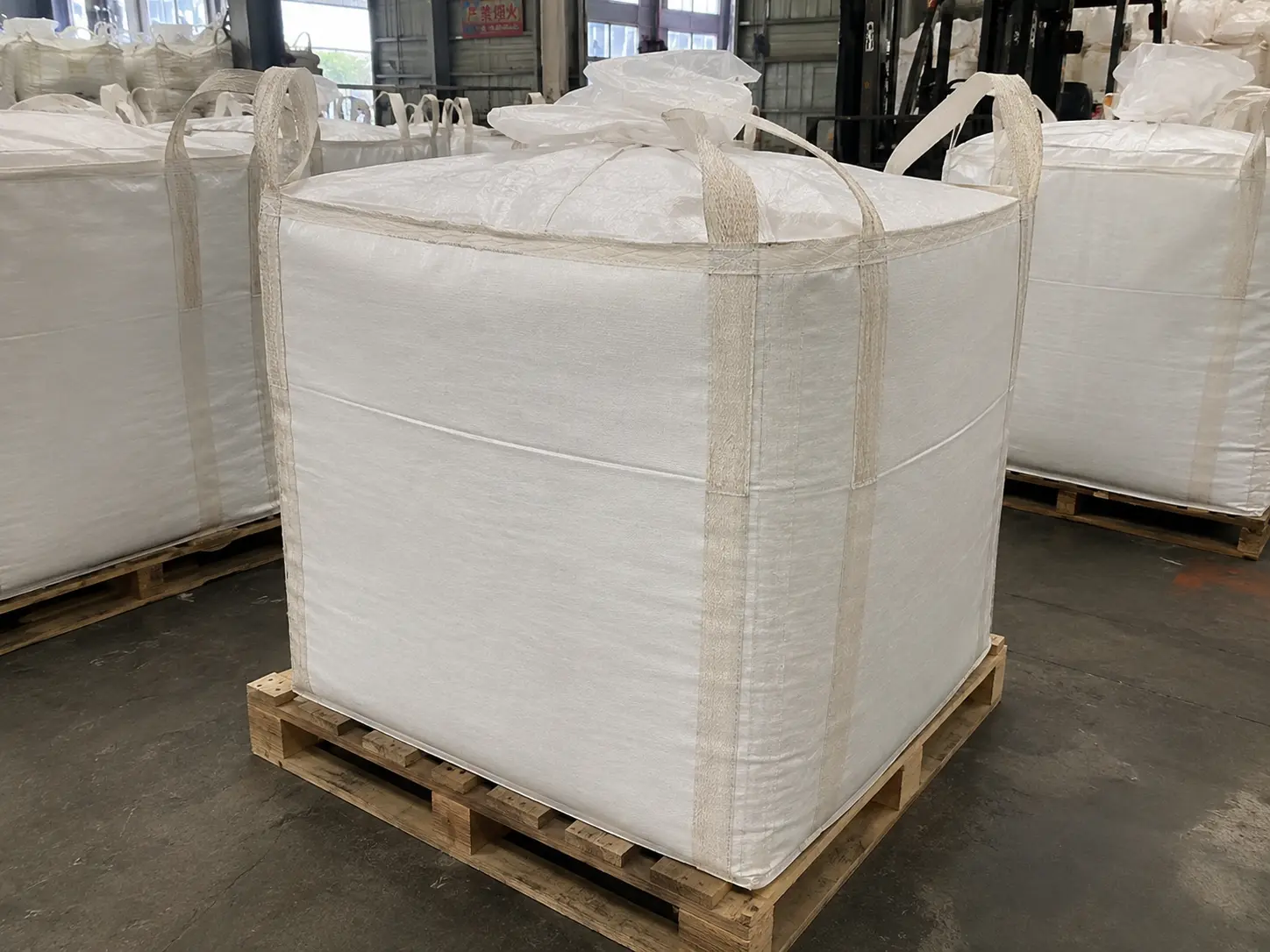
Baffle vs Standard Bag at a Glance
| Standard bag | Baffle (Q) bag | |
|---|---|---|
| Shape when filled | Rounds outward at the sides | Holds a square profile |
| Container/pallet utilization | Lower — gaps between rounded bags | Higher — squared bags nest tightly |
| Cost premium | Baseline | +8–15% |
| Best fit | Low-volume, short-haul, loose storage | High-volume, long-haul, tight container loading |
| Compatible with food grade / UN certified / static protection | Yes | Yes — independent spec |
How Baffle Construction Actually Works
Internal fabric panels are sewn across the bag’s corners, running roughly from the top opening down to the base, so that when the bag fills, the panels pull the corners inward and hold a square cross-section instead of letting the sides bulge outward under fill pressure. This is a purely mechanical shape control — it doesn’t change the bag’s rated capacity, safety factor, or any compliance classification, just how the fabric distributes when loaded.
The panels add stitching length and fabric to the construction, which is where the 8–15% cost premium comes from — it’s a real material and labor cost, not a markup for a “premium” label. A well-made baffle bag also tends to stack more stably on a pallet than a round-sided standard bag, since flat sides sit against each other rather than rounded surfaces that can shift or roll slightly under vibration during transport. The same holds in storage: a square-filling bag stays close to its nominal footprint, which is what lets it fit a super sack rack or pallet racking bay sized from the quote.
The Container Utilization Case
Square-profile bags nest against each other with far less wasted space than round-sided bags, which is where the roughly 30% container utilization improvement comes from — fewer air gaps between bags means more product per container at the same bag count, or the same product volume in fewer containers. That figure is a useful planning reference, but your actual gain depends on your specific bag dimensions, product bulk density, and whether you’re pallet loading or floor loading — see our container loading guide for the variables that affect the real number for your shipment.
When the Premium Actually Pays Off
The baffle premium pays for itself through freight savings, so it matters most on high-volume, long-haul shipments where container count directly drives cost — every container saved is real money, and a 30% utilization gain can mean shipping in fewer containers at the same total volume. On smaller or occasional orders, the freight savings from better packing density rarely offset the added per-bag cost, since you’re not shipping enough volume to hit a full-container difference.
Run the math before committing either way: take your target order volume, estimate container count under standard bag packing versus baffle packing using your actual dimensions and product density, then compare the freight cost difference against the total baffle premium across the order. If the container count doesn’t actually drop — because your order is too small to hit a full-container threshold either way — the premium is pure added cost with no freight offset.
When It Isn’t Worth It
Short-haul shipments, low-volume orders, and bags stored loose rather than stacked or containerized all reduce or eliminate the case for baffle construction — if you’re not paying for container space or pallet density in the first place, the squared shape isn’t solving a cost problem you actually have. Local distribution, small-batch orders, and warehouse storage where bags sit individually rather than stacked tightly are all scenarios where a standard bag is the more economical choice.
There’s also a product-fit consideration: very free-flowing, fine powders sometimes settle and pack down inside a baffle bag in a way that partially reduces the squaring benefit compared to coarser granular products that hold their fill shape better. If your product is unusually fine or flowable, ask your supplier whether the utilization gain holds up for that specific material before assuming the standard 30% reference applies.
Baffle Bags Combine With Other Specs
Baffle construction is independent of static protection class, food grade status, and UN certification — a bag can be baffle-constructed and also food grade, or baffle-constructed and Type C anti-static, since these address entirely separate requirements (shape vs. contamination control vs. ignition risk vs. hazard classification). Don’t assume ordering baffle construction rules out or requires any of these other specs; each one gets specified independently on your order.
Common Mistakes When Specifying Baffle Construction
- Assuming the 30% utilization figure applies universally. It’s a reference point — your actual gain depends on bag size, product density, and loading method.
- Ordering baffle construction for low-volume or short-haul shipments. The premium rarely pays back without enough volume to realize the container savings.
- Treating baffle as a hazard or compliance upgrade. It’s a shape feature — it doesn’t add safety factor, static protection, or certification on its own.
- Forgetting to combine baffle with other needed specs explicitly. Food grade, static class, and certification all need to be specified separately even with baffle construction.
- Comparing baffle and standard bag prices without factoring in freight. The per-bag price comparison alone misses where baffle construction actually earns its cost back.
Decision Checklist
- Is your shipment high-volume and long-haul? That’s where the freight savings from better container utilization actually materialize.
- Are you pallet loading or floor loading? Squared bags benefit both, but the gain is more pronounced in tightly packed container loads.
- Do you also need food grade, static protection, or certification? Specify those independently — baffle construction doesn’t include or exclude them.
- Is your order volume small or occasional? The premium likely won’t pay back — a standard bag is probably the better economic choice.
- Have you calculated the actual container count difference for your specific order? Don’t rely on the general 30% figure alone for a firm cost comparison.
Final Thoughts
Baffle construction is a freight decision dressed up as a bag decision. The premium is real and so is the space gain, but only one of them shows up on your invoice — the other shows up in container count. Run the math on your actual volume before deciding: total baffle premium against the freight saved by shipping fewer containers. Send us your dimensions and volume and we’ll calculate both sides.
Before You Request a Quote
Send these details and we’ll confirm whether baffle construction makes sense for your order:
- Target order volume and shipping frequency
- Product bulk density and bag dimensions
- Pallet or floor loading preference
- Any additional spec needs — food grade, static protection, certification
Request a quote with your volume and we’ll run the container math against baffle vs standard construction for your actual shipment.
Common Questions
What is a baffle bag?
A baffle bag has internal fabric panels sewn across the corners that keep the bag square when filled, instead of bulging into a rounder shape the way a standard bag does. It's a shape and stacking feature, not a hazard or compliance category.
How much more does a baffle bag cost than a standard bag?
Baffle construction typically adds 8–15% to the per-bag price, driven by the extra internal panels and reinforced corner stitching. Whether that premium pays off depends on how much your container or pallet utilization improves as a result.
Do baffle bags really improve container loading by that much?
A square-filled baffle bag can improve container utilization by roughly 30% compared to a standard bag's rounder profile, though the real gain depends on your specific bag size, product density, and loading method — treat that figure as a planning reference, not a guarantee for every shipment.
Can a baffle bag also be food grade or UN certified?
Yes. Baffle construction is independent of food grade status and UN certification — a bag can combine baffle panels with a food-contact liner or a certified hazardous goods construction, since these address entirely different requirements.
When is a baffle bag not worth the extra cost?
On short-haul, low-volume shipments where container space isn't the limiting cost factor, or where bags are stored loose rather than stacked, the baffle premium often doesn't pay back. It's a freight-and-storage-efficiency feature, not a universal upgrade.
Do baffle bags take longer to fill than standard bags?
Slightly, in some setups — internal panels can slow product settling into the corners, particularly with materials that don't flow freely. On automated lines running high volume, confirm cycle time with your filling equipment before assuming baffles are a drop-in change.
Can baffles be added to circular or U-panel construction?
Yes. Baffle panels are independent of how the bag body is assembled, so they work with circular, U-panel or four-panel construction. Panel count and baffle construction are separate spec decisions addressing related but distinct aspects of shape control.
More in Construction & Materials
All Construction & Materials guides- Bulk Bag Closures: The Knot That Holds a Tonne Against ItClosure type is decided at the order stage and lived with at discharge. A drawstring carries the whole load against one knot, which is why it jams shut.
- Net Baffle FIBC Bags: When Fabric Baffles Leave Corners EmptyA baffle bag that never fills its corners costs you the premium and the space. Net baffles let poor-flowing product reach corners that fabric panels block.
- FIBC Stitching: The Failure Point GSM Doesn't CoverBags usually fail at the seams, not through the fabric. Stitch pattern and thread spec matter as much as GSM — and get checked far less often.
- U-Panel vs Circular vs Four-Panel: Seams, Shape and CostCircular, U-panel and four-panel construction trade seam count against shape stability and cost. Here's which one suits your product and freight.