Super Sack Racks: Why the Bag Spec Decides Which Rack Works
Rack vendors sell capacity and stack height. What they rarely mention is the bag — its filled footprint, shape and bottom decide whether any rack works.
PackTonne Sourcing Desk · · 8 min read
Rack decisions for bulk bags usually get made on capacity and stack height, because that is what rack vendors quote. Whether a rack actually works in your warehouse is decided by something they rarely mention: the bag. Its filled footprint, its shape after it settles and the way its bottom sits on a pallet are what make a bay fit or jam, and a plain bag that bulges past its nominal size will defeat a rack that was specified perfectly on paper.
Three Ways to Store Filled Bags
| Block stacking | Portable stack racks | Pallet racking | |
|---|---|---|---|
| Equipment cost | None | Moderate, per rack | Higher, permanent |
| Who carries the load | Bags below carry bags above | The rack frame | The racking beams |
| Practical height | Limited by bag and stack guidelines | Typically 2–4 high | Set by racking design |
| Access to any single bag | Poor — bottom bags are trapped | Good | Good |
| First-in, first-out | Hard | Workable | Easy |
| Floor space flexibility | High | High — racks can be moved | Fixed |
| Demands on the bag | Seams under sustained load | Footprint must fit the frame | Footprint, pallet fit, height clearance |
Commercially available stack racks are typically rated by their makers somewhere around 2,000 to 4,000 lb per level, stacked two to four high. Pallet racking capacity comes from the racking design itself and your installer.
Why Racking Changes the Load on the Bag
In a block stack, every bag above the first layer rests on the bags below, and the bottom row carries the weight of the whole column for as long as the stack stands. That is a sustained load on fabric and seams, which is a different condition from the lift test a bag’s safe working load is based on. It is why the storage guidelines cap stack height relative to base width and favour pyramid stacking over straight columns.
A rack removes that. In a stack rack, the steel frame carries the racks above it; in pallet racking, the beams do. Each bag supports only its own contents. Racking turns a stacking problem into a single-bag problem — which is the real reason to use it once you need to go higher than a stable two-high block stack, or when product sits for months.
The second reason is access. The bottom bag in a block stack is the last one you can reach, which fights first-in, first-out rotation. A rack puts every bag within reach of a forklift.
It also changes inspection. In a rack you can see all four sides of every bag and catch a leaning load, a weeping seam or faded fabric early; in a block stack, the bags most at risk are the ones buried in the middle where nobody looks.
What the Bag Has to Do for a Rack to Work
This is where rack projects fail, and it is entirely a bag specification question.
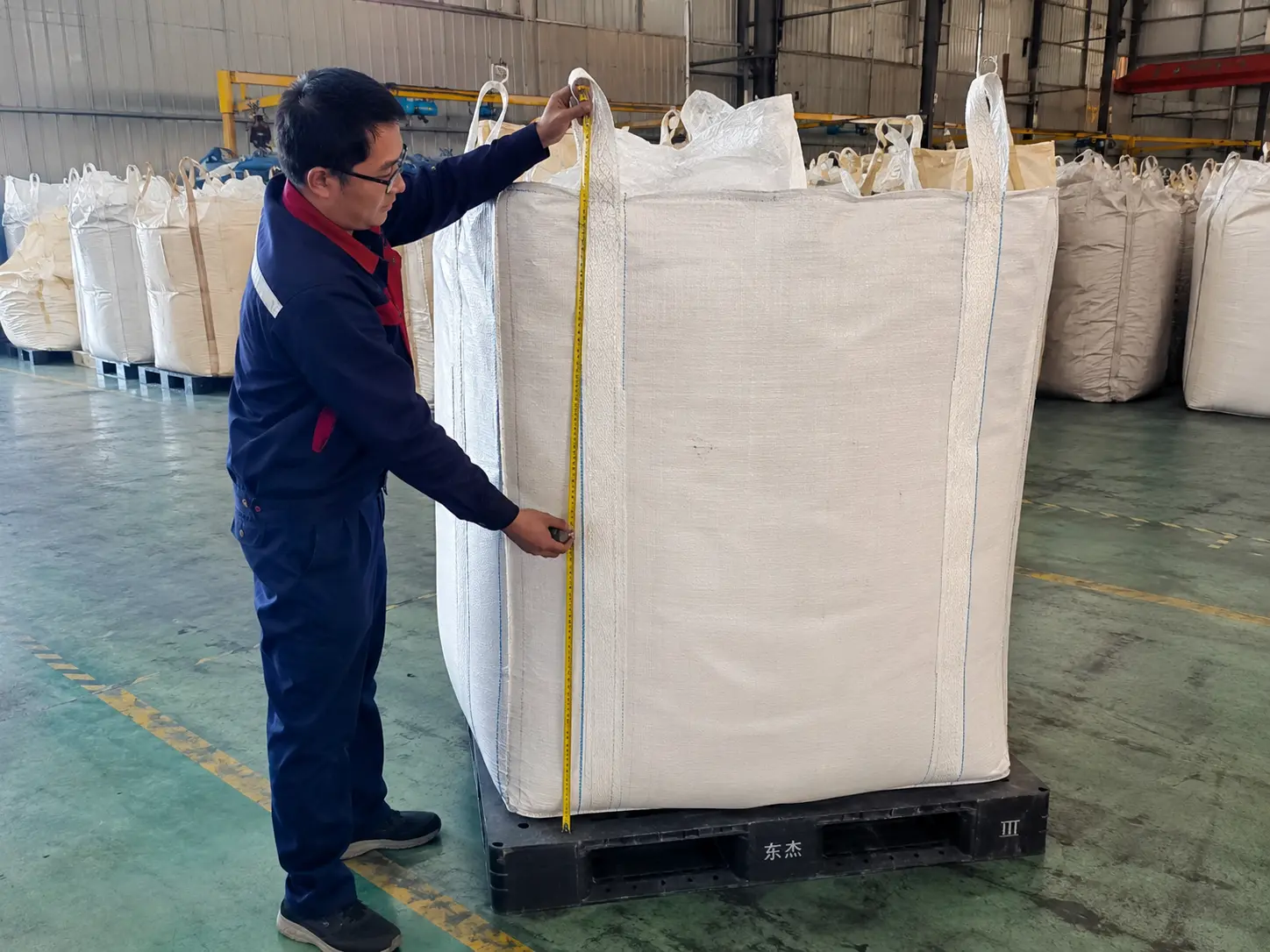
The filled footprint has to clear the bay. A plain U-panel or circular bag bulges as it fills, so a bag quoted at a given flat size can come out noticeably wider — enough to rub uprights, jam in a stack rack frame or hang over a pallet edge. Rack bays get sized from nominal bag dimensions, and nominal is not what arrives. Measure a filled bag of your actual product, or specify baffle construction, which holds a square profile much closer to its stated size.
Filled height includes the loops. Clearance to the beam or rack level above has to cover the filled body, the loops standing up above it, and the lift height the forklift needs to get the load off its support. Settled product lowers the body over time; loops do not move.
The bag must sit on the pallet, not over it. On pallet racking, a bag that overhangs the pallet edge snags on beams and decking and tears at the base seam — the most expensive place for a bag to fail, because it happens overhead. Match pallet size to filled footprint, not to the footprint on the quote.
A spout bottom needs somewhere to go. On a solid pallet, a spout bottom gets folded under the bag and carries its weight. Either use a pallet or frame with an opening for the spout, or specify a flat bottom where the discharge method allows it.
Loops have to be reachable in a stack rack. With pallet racking you move the pallet, not the bag. In a stack rack, bags are often lifted in and out by their loops, so loop position and length need to suit a spreader bar or lifting attachment working inside the frame.
The bag must not lean as it settles. Product settles over days in storage. A bag that slumps to one side pushes against the rack or its neighbour, and in pallet racking that can mean a load that no longer sits squarely on its pallet when someone lifts it.
When Block Stacking Is Still the Right Answer
Racking is not free, and it is not always necessary. Block stacking is perfectly sound when:
- Turnover is low and bags are used in the order they can be reached
- The product is stable and dense enough to form a firm block
- Bags are square-filling, so the stack stays vertical
- Height stays within the usual two-to-one guideline
- Storage time is weeks rather than many months
Outside those conditions — high turnover, fragile or free-flowing product, long storage, or a need to go three or four high — racking earns its cost back in bags that do not fail and stock you can actually reach.
Your Rack Checklist
- Have you measured a filled bag of your actual product, or are you sizing from the quote? Nominal and filled dimensions are different numbers.
- Does the filled height plus standing loops plus forklift lift clearance fit the bay height?
- Will the bag sit entirely on the pallet without overhang? If not, change the pallet or the bag, not the tolerance.
- What happens to the spout on a spout bottom bag? It needs an opening or a different bottom.
- Are the bags square-filling? If they are plain bags that bulge, most of the problems above get worse, and baffle construction fixes several of them at once.
Final Thoughts
A rack is only as good as the bag that goes into it. Specify the storage system and the bag together — filled footprint, height with loops, bottom type and shape stability — and racking gives you height, access and bags that are not crushing each other. Specify them separately and you find out on the first day of racking that the bays are a few centimetres too narrow for the bags you bought.
Send us your rack or bay dimensions, the product and how the bags will be lifted in and out. We will size and specify the bag to fit the storage you have, rather than leaving you to discover the mismatch on the warehouse floor.
Common Questions
Can bulk bags go on standard pallet racking?
Yes, on a pallet sized to the bag and usually with decking on the beams. The bag must sit entirely on the pallet without overhanging its edges, and its filled height plus the loops must clear the beam above with room for the forklift to lift. Round-filled bags often bulge past their nominal footprint, which is where most racking problems start.
Is it better to stack or rack bulk bags?
Racking wins when you need access to every bag, faster turnover or more than two bags high. Block stacking costs nothing and works for low-turnover, stable product within the usual height guideline. The deciding difference is load: in a block stack the bottom bag carries everything above it, while in a rack each bag carries only itself.
How high can I stack bulk bags without racks?
A common guideline keeps stack height at or below twice the base width, and pyramid stacking is more stable than straight columns. Beyond that, lower bags carry sustained loads their seams were not necessarily tested for. If you need to go higher, a rack that takes the load off the bags below is the safer route.
What is a super sack stack rack?
A portable steel frame that holds one bag and stacks on top of identical frames, typically two to four high. The frame carries the weight of the racks above, so the bag inside only supports itself. Many are collapsible for storage and can be moved by forklift, which suits sites without permanent racking.
Why won't my bulk bags fit into the rack bay?
Usually because the bag filled wider than its nominal dimensions. A plain bag bulges as it fills, so a bag quoted at a given footprint can come out noticeably wider and rub or jam against uprights. Baffle bags hold a square profile much closer to nominal, which is why they are the usual choice for racked storage.
Do spout bottom bags work on pallets in racking?
They can, but the spout needs somewhere to go. On a solid pallet the spout is folded under the bag and carries its weight, which can crush or damage it. A pallet or frame with an opening, or a flat bottom where discharge does not need a spout, avoids the problem.
Do I need baffle bags for racking?
Not always, but they solve the most common racking failure. Square-filling bags hold their footprint, lean less as they settle, and sit neatly against neighbours and uprights. For plain bags, specify and check the filled dimensions rather than the flat dimensions before sizing any rack.
More in Handling & Equipment
All Handling & Equipment guides- Bulk Bag Unloaders: Why the Bag Spec Matters More Than the FrameMost bulk bag unloader problems start at the bag, not the frame: loops that hang the spout short of the clamp, spouts too narrow for the valve, liners that drag.
- Bulk Bag Stands: How to Fill a Super Sack Without a MachineA bulk bag stand holds the empty bag open and square. It cannot weigh the fill — and a bag shovelled to the brim with sand can be well over its rating.
- How to Empty a Bulk Bag Safely: Plan for the Flow StoppingDischarge methods get chosen for how material flows when everything works. The injuries happen in the next ten minutes, when it stops and someone intervenes.
- FIBC Spreader Bars: The Cheapest Way to Save LoopsBare forklift tines abrade lifting loops every cycle. A proper spreader bar spreads the load and protects the loops — here's what to look for.