What Makes a Bulk Bag Food Grade? FDA Rules Explained
Food grade is defined by production environment and liner material, not by the label on a listing. Here's what actually makes an FIBC food-safe.
PackTonne Sourcing Desk · · 6 min read
A food grade bulk bag is defined by its production environment and liner material — not by a label on a product listing. Making a bag food grade means producing it in a controlled, contamination-free environment and fitting it with a PE liner rated as food-contact safe, both aimed at FDA-relevant requirements for food, feed, and pharmaceutical ingredients. If a supplier can’t explain what’s actually different about the process, the label alone doesn’t mean much.
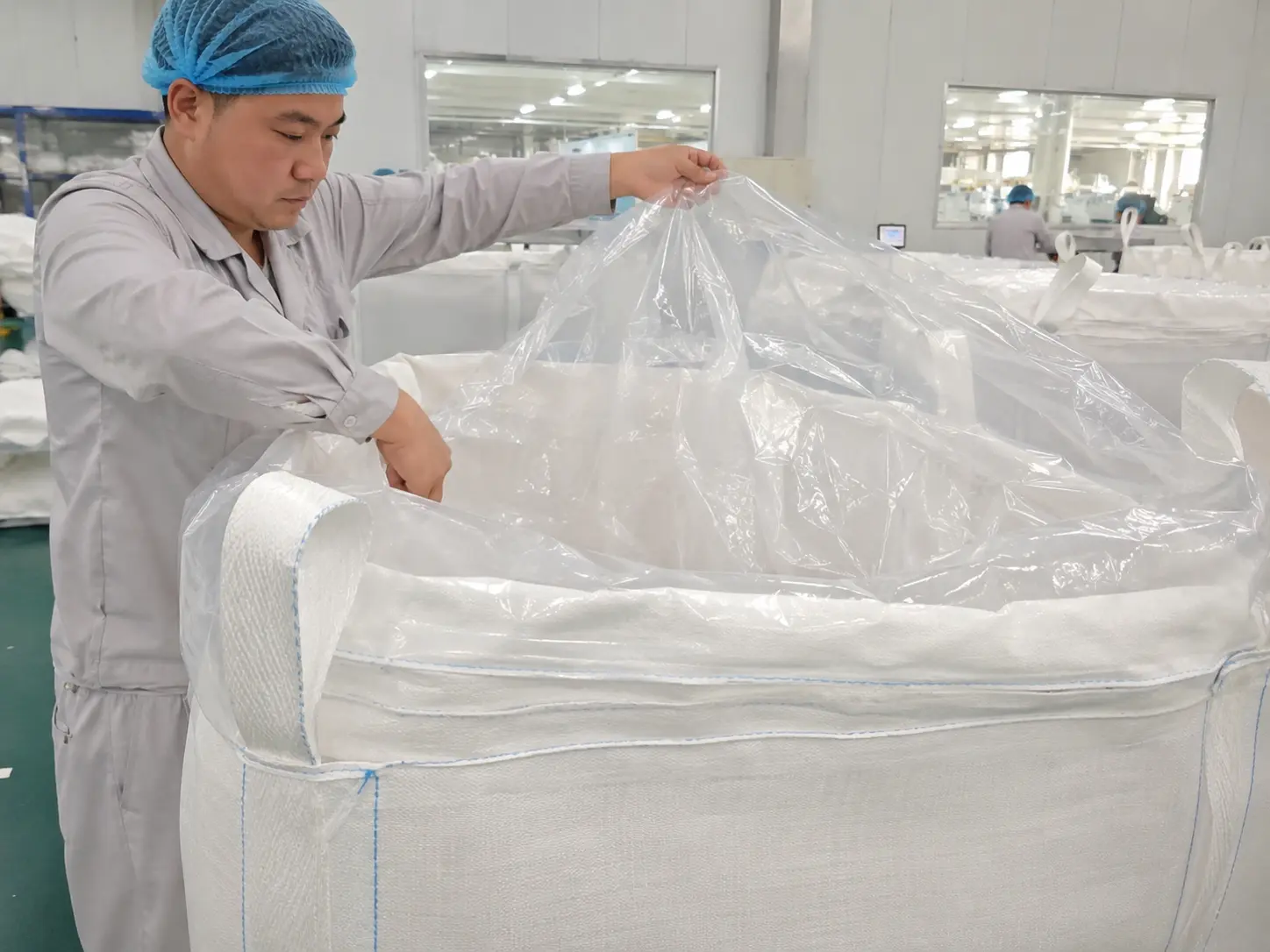
Food Grade vs Standard Bag
| Standard bag | Food grade bag | |
|---|---|---|
| Production environment | General factory floor | Controlled, contamination-managed area |
| Liner | Optional, general-purpose | PE liner, food-contact rated |
| Typical use | Non-food dry goods | Food, animal feed, pharmaceutical ingredients |
| Traceability | Order-level | Batch-level, tied to production date |
| Static protection | Independent spec | Independent spec — can combine with either |
The Production Environment Is Half the Definition
“Food grade” starts with how and where the bag is made, not just what it’s made of. A clean production environment limits exposure to contaminants — dust, pests, chemical residue from other production runs — that a general factory floor doesn’t control for. This is the part of the claim hardest to verify from a product photo, which is why asking a supplier direct questions about their process matters more than trusting the word “food grade” printed on a listing.
The PE Liner Is the Actual Food-Contact Barrier
Woven polypropylene, the outer fabric on nearly every FIBC, isn’t itself a food-contact material — it’s a structural fabric. The polyethylene (PE) liner fitted inside is what actually touches the product, and it’s the liner’s material rating that carries the food-safety compliance, not the outer bag. A woven PP bag without a food-contact-rated liner isn’t functionally food grade no matter how it’s described. When comparing quotes, ask specifically about liner spec — loose-fit or form-fit, material grade — not just whether a liner is included.
A form-fit liner, sewn to match the bag’s inner wall, seals more precisely and reduces the gap where product could contact the outer fabric during filling or transit — a meaningful difference for fine powders or moisture-sensitive ingredients. A loose liner costs less and works fine for many products, but it’s worth confirming which type your supplier means by “liner” before assuming the protection level matches your product’s sensitivity.
What “FDA Compliant” Actually Means
The FDA doesn’t issue a certificate for packaging products the way a testing body issues a UN or ISO mark — it sets material and process requirements that food-contact packaging has to meet. “FDA compliant” describes a liner material and production process that meet those requirements, documented through the material supplier’s compliance statements rather than a single certificate covering the whole bag. Be skeptical of any claim phrased as “FDA certified” — ask instead for the specific compliance documentation behind it.
We work directly with partner factories in Shandong capable of food grade production; ask us for the specifics of a given order rather than relying on a general claim, since compliance detail depends on the exact liner and process used for that run.
This distinction matters when you’re documenting your own supply chain for an auditor or a downstream customer. “Our supplier says FDA compliant” is weaker than “our liner material meets FDA food-contact requirements, documented in [specific record]” — the second version is what actually holds up under a compliance review, and it’s the level of detail worth pushing for before an order ships, not after.
Food Grade and Static Protection Are Independent
A bag can be both food grade and anti-static — the two specs address different risks and don’t conflict. Fine food powders with a combustion risk, like some milled grains, may need food grade construction combined with Type B or C static protection. See our static protection guide if your product needs both; don’t assume ordering a food grade bag automatically rules out or includes anti-static features.
Contamination Risk Doesn’t End at the Factory Floor
A clean production run can still end up compromised in storage or transit if the finished bags sit in a general warehouse alongside chemical or industrial packaging before shipment. Ask how food grade bags are stored and handled after production, not just how they’re made — segregated storage from non-food inventory is part of the same contamination-control chain that starts on the production floor. This is a reasonable follow-up question for any supplier claiming food grade capability, and one a generic listing rarely answers.
Common Mistakes When Buying “Food Grade” Bags
- Trusting the word alone. “Food grade” on a listing without liner spec or process detail behind it isn’t a verifiable claim.
- Assuming any liner counts. A liner needs a food-contact material rating specifically — not just the presence of a liner.
- Skipping batch traceability. A shipment without batch-level labels can’t be isolated if a quality issue surfaces later.
- Treating FDA compliance as a single certificate. It’s documentation tied to the liner material and process, not one universal stamp.
- Ignoring post-production handling. Contamination control that stops at the factory gate isn’t complete control.
Traceability Matters More for Food-Contact Products
Every food grade bag should carry batch-level labeling — production date, batch number, and production facility — because traceability is what lets a quality issue get isolated to a specific run instead of an entire shipment. This matters more for food-contact packaging than for general industrial bags, where a labeling gap is an inconvenience rather than a compliance gap. Confirm batch labeling is included before ordering, not after a shipment arrives.
What to Verify Before You Order
- Liner material spec: food-contact rating, loose-fit or form-fit construction
- Production environment controls: ask directly, don’t assume from “food grade” wording alone
- Batch traceability: production date and batch number on every bag
- Compliance documentation: specific to the liner material, not a general certificate claim
- Static protection, if relevant: confirmed as a separate, compatible spec
Final Thoughts
Food grade is a claim about how a bag was made, not a sticker applied after the fact. The two things worth verifying are the liner’s food-contact rating and what the production environment actually controls for — everything else follows from those. Tell us what you’re packing and which market it ships to, and we’ll confirm what documentation your order needs.
Before You Request a Quote
Send these details so we can confirm the right construction:
- Product type — food, feed, or pharmaceutical ingredient
- Whether the product is combustible dust (affects static protection needs)
- Target capacity and dimensions
- Liner preference, if you already know it — loose-fit or form-fit
- Any specific compliance documentation your buyer or import market requires
Request a quote with these specs and we’ll confirm liner spec and production requirements against your actual product.
Common Questions
What makes a bulk bag food grade?
Three things: a controlled, clean production environment free of cross-contamination risk, a PE liner material rated as food-contact safe, and construction that meets FDA-relevant requirements for food, feed, or pharmaceutical packaging. A bag isn't food grade just because it's labeled that way — ask what's actually different about how it was made.
Does a food grade bag need a liner?
Almost always, yes. The woven PP outer fabric isn't a food-contact material on its own — the PE liner is what actually touches the product and provides the food-safe barrier. Without a liner, a woven PP bag isn't functionally food grade regardless of how it's marketed.
Is FDA certification the same as FDA compliance?
No. The FDA doesn't certify packaging products directly — it sets requirements that materials and production processes must meet. "FDA compliant" means the liner material and production process meet those requirements; ask your supplier for documentation showing compliance rather than a certificate that doesn't exist in this form.
Can a food grade bag also be anti-static?
Yes. Food grade status and static protection class are independent specifications — a bag can be manufactured to food grade standards and also carry Type B or C anti-static protection if the product needs both, such as a fine food powder with combustion risk.
How do I verify a supplier's food grade claim before ordering?
Ask for documentation on the liner material's food-contact compliance, details on the production environment's contamination controls, and batch traceability records. A supplier who can't provide specifics beyond the word "food grade" on a product listing hasn't given you enough to verify the claim.
Is a food grade bag automatically suitable for pharmaceutical ingredients?
Not necessarily. Pharmaceutical raw materials generally require cleanroom production at a stated ISO classification plus a full GMP documentation chain — a higher bar than food grade's contamination controls. If your material is pharmaceutical-grade, treat it as its own sourcing conversation rather than food grade with extras.
Can I reuse a food grade bag for a second food shipment?
Only if it was built as a multi-trip bag and has been cleaned and inspected under a controlled process. Residue from a previous product is a genuine cross-contamination risk that visual inspection alone doesn't rule out, which is why most food-contact operations treat these bags as single-use.
More in Standards & Compliance
All Standards & Compliance guides- Pharma-Grade FIBC: Why Food Grade Isn't Close EnoughCleanroom classification, a full GMP documentation chain and often two-way containment — pharma grade is a different category, not food grade with extras.
- FIBC Safety Labels: An Unreadable Tag Means Stop WorkA bag whose label you can't read is a bag with unknown specifications. Here's what has to be on it, and why a faded tag stops the job.
- GB/T 10454-2025: What Changed in China's FIBC StandardEffective March 2026, GB/T 10454-2025 replaces two older standards and is the first to formally separate single-trip from multi-trip requirements.
- ISO 21898 FIBC Testing: Six Tests, Not One Pass/FailISO 21898 is a suite — lift, drop, stacking, righting, tear and UV aging — each catching a failure mode the others miss. Here's what it checks.