Bulk Bag Shipping Documents: What Your Supplier Provides and What You Check Before Customs
A bulk bag shipment travels with customs documents and product documents. See what each is, what US rules say and how to check them before the shipment leaves.
PackTonne Sourcing Desk · · 7 min read
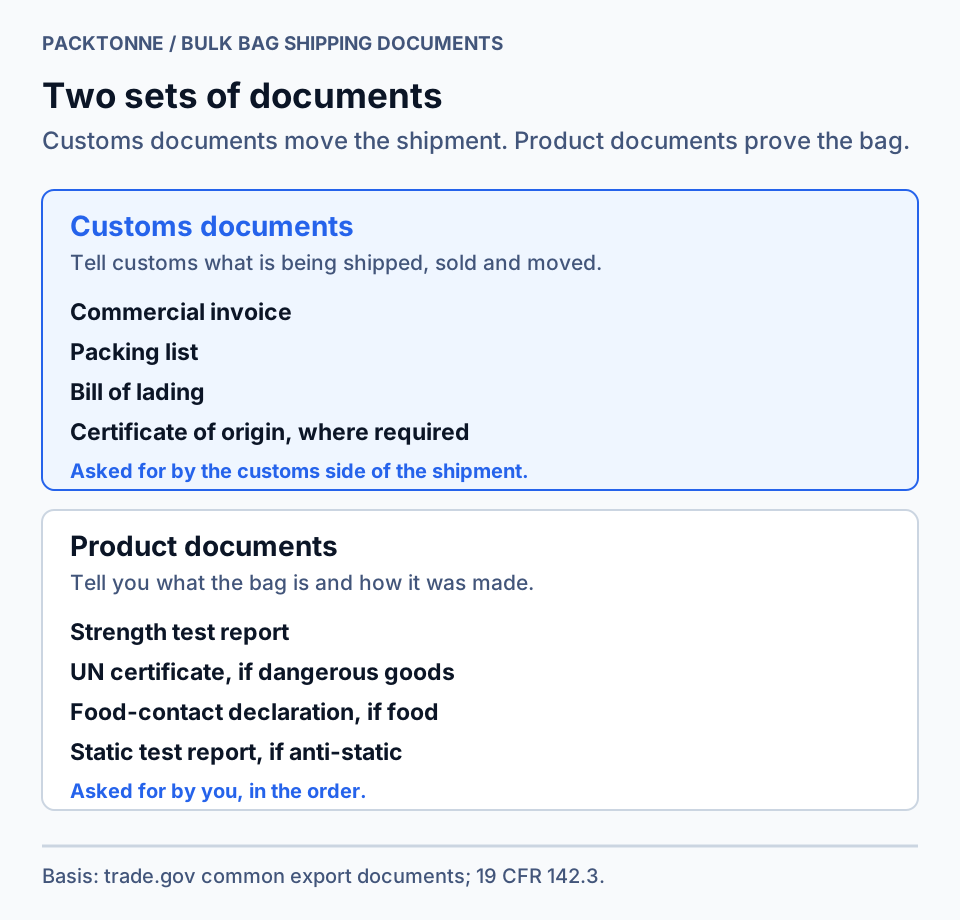
A bulk bag shipment travels with two sets of documents. Customs documents (commercial invoice, packing list, bill of lading and sometimes a certificate of origin) tell customs what is being shipped, sold and moved. Product documents (test reports, certificates and declarations) tell you what the bag is and how it was made. Mixing them up is how shipments get delayed or bags arrive without the proof you needed.
Customs Documents: What Moves the Shipment
The US Department of Commerce’s common export documents page says the best place to start is your foreign customer or importer, and your freight forwarder. It is written for US exporters, but the same documents travel with imports, and US entry rules list them from the import side. Under 19 CFR 142.3, entry documentation consists of the entry, evidence of the right to make entry, a commercial invoice, a packing list where appropriate and any other documents CBP or another agency may require.
| Document | What it is | How it is used |
|---|---|---|
| Pro forma invoice | A quote-stage document from the seller; it can become the final commercial invoice | Used to negotiate before shipment |
| Commercial invoice | A bill for the goods from seller to buyer | One of the main documents customs uses to determine duties |
| Packing list | Itemizes quantity, package type, package count, net and gross weight and marks | Customs may use it to check the cargo; it does not replace the invoice |
| Bill of lading | A contract between the owner of the goods and the carrier | The customer usually needs the original to take possession from an ocean carrier |
| Certificate of origin | A signed statement of where the goods come from | Required by some countries, even if the invoice states origin |
What Customs Looks For on the Invoice
19 CFR 141.86 lists what an invoice of imported goods must set out. The items most likely to matter for bulk bags are:
- the port of entry and the parties, with the time and place of sale
- a detailed description of the goods, with the marks and numbers of the packages
- quantities, and the price in the currency of purchase
- itemized charges such as freight, insurance and packing
- the country of origin
The invoice and its attachments must be in English or carry an accurate English translation. Our guide to the HS code for FIBC bags covers classification, and the tariff guide covers the duty side.
Product Documents: What Proves the Bag
Customs documents do not show that a bag is the right bag. Product documents do that, and you ask for them in your order.
| What you need to know | Document that answers it | Where to read more |
|---|---|---|
| The design lifts its rated load safely | A strength test report for the design | FIBC testing standards |
| The bag may carry dangerous goods | A UN certificate | UN marking codes |
| The bag is suitable for food contact | A food-contact declaration for the materials | FDA requirements |
| The fabric meets an anti-static class | A static test report | IEC 61340-4-4 testing |
| The factory runs controlled production | A current audit certificate and batch records | Manufacturer audit checklist |
These are separate from customs documents. A commercial invoice does not show that the bag passed a strength test, and a test report does not clear goods through customs.
Check Three Documents Against Each Other
Before the shipment leaves, put the commercial invoice, packing list and bill of lading side by side. trade.gov notes that the invoice should reflect the information on the packing list, because customs officials may use the packing list to check the cargo.
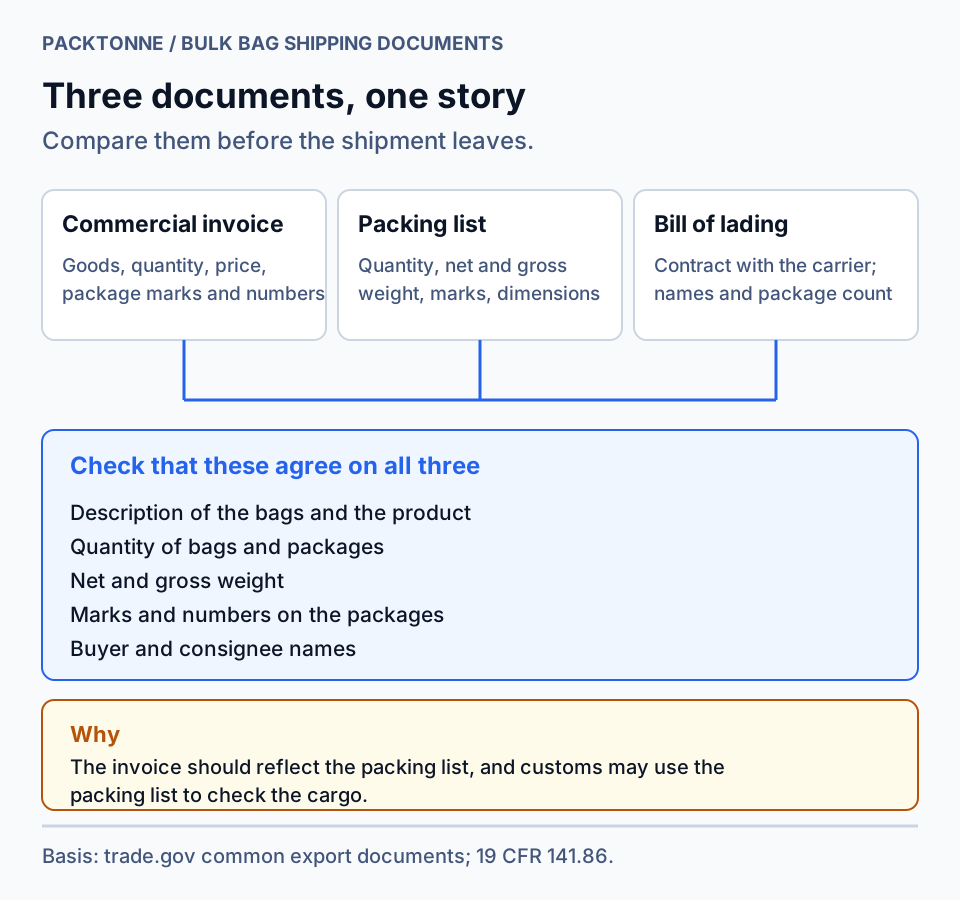
Look for the same description of the bags, the same quantity of bags and packages, matching net and gross weight, the same marks and numbers, and the same buyer and consignee names. Net, tare and gross weight are easy to confuse, as our weight calculation guide explains. A mismatch is far cheaper to fix before departure.
How to Ask Your Supplier
Put the documents in the order, not in a follow-up email.
- List the customs documents you want, and ask your freight forwarder or broker to confirm what your destination requires.
- List the product documents that apply to your bag: strength test, UN, food-contact, static.
- Ask for drafts before shipment so you can check them against each other.
- Keep the documents with the order so you can match them to what arrives.
Our guide to importing bulk bags from China covers the wider process from order to delivery, and pre-shipment sampling and QC covers checking the bags themselves.
Your Shipping Documents Checklist
- If you do not know what your destination requires, you should ask your customs broker or freight forwarder before ordering.
- If the order includes a UN, food-contact or anti-static bag, you should name the matching product document in the order.
- If you receive draft documents, you should compare the invoice, packing list and bill of lading line by line.
- If the invoice is not in English, you should ask for an accurate English translation.
- If a document is missing at departure, you should resolve it before the shipment leaves the factory.
Final Thoughts
Two sets of documents travel with a bulk bag shipment, and each answers a different question. Customs documents say what is moving and what it is worth. Product documents say what the bag is. Ask for both in the order, and make the three customs documents agree before the shipment leaves.
Before You Request a Quote
If you are planning an import, send us these details and we will tell you which documents to ask the partner factory for:
- Bag type and what it will carry
- Destination country and port
- Whether the bag needs UN, food-contact or anti-static documents
- Order quantity and delivery terms
We will check them against a UN certified or Type A construction and tell you what to confirm.
Common Questions
What documents are needed to import bulk bags into the US?
Under 19 CFR 142.3, entry documentation consists of the entry form or its electronic equivalent, evidence of the right to make entry, a commercial invoice, a packing list where appropriate, and any other documents that CBP or another agency may require for the shipment. Your customs broker confirms what applies to your goods.
What must a commercial invoice show?
19 CFR 141.86 lists the contents, including the port of entry, the parties and the time and place of sale, a detailed description of the goods, quantities, the price and currency, itemized charges such as freight and packing, and the country of origin. The invoice and its attachments must be in English or carry an accurate English translation.
Is a packing list required?
Entry rules call for one where appropriate. trade.gov describes an export packing list as listing items such as quantity, package type, the number of packages, net and gross weight and package marks. It does not replace the commercial invoice, and customs may use it to check the cargo, so the invoice should match it.
What is a bill of lading?
It is a contract between the owner of the goods and the carrier. For ocean shipments there are two common types, a non-negotiable straight bill and a negotiable shipper's order bill. The customer usually needs an original bill of lading to take possession of the goods from the ocean carrier.
Do I need a certificate of origin for bulk bags?
Some countries require one and some do not. trade.gov says a certificate may be required even when the commercial invoice states the origin, and that the best place to start is your customer or importer and your freight forwarder. Ask your broker whether your destination and any trade agreement call for it.
What product documents should I ask my bulk bag supplier for?
Ask for what proves the bag, not the shipment: a strength test report for the design, a UN certificate if the bag will carry dangerous goods, a food-contact declaration if it will touch food, a static test report if it is anti-static, and batch traceability. State them in your order so the supplier prepares them.
What should I check before the shipment leaves?
Compare the commercial invoice, packing list and bill of lading. Description, quantity, weights, package marks and buyer names should agree, because the invoice should reflect the packing list and customs may use it to check the cargo. Fix mismatches before departure, not at the port.
More in Buying & Importing
All Buying & Importing guides- FIBC Industry 2026: India Supplies Two-Thirds of US Bulk Bag ImportsUS customs data for 2019–2025 shows where bulk bags are imported from and how fast the mix changed. See the shares by country and what the data cannot tell you.
- Inspected Used Bulk Bags: Why a 5:1 Bag Can't Be ReusedInspected is not a standard — it covers everything from a visual glance to light-table and loop-pull testing. No inspection makes a single-trip bag reusable.
- FIBC Tariffs: Why the Factory Quote Isn't Your Real CostFIBC imports can carry standard tariffs plus trade remedy duties on top. Here's the landed-cost framework, and where to verify the current rate.
- HS Code for FIBC Bags: Why 6305.32 Isn't EnoughFIBC bags sit under HS 6305.32 internationally, but your country extends that into a longer code. Here's how classification actually works.