FIBC Industry 2026: India Supplies Two-Thirds of US Bulk Bag Imports
US customs data for 2019–2025 shows where bulk bags are imported from and how fast the mix changed. See the shares by country and what the data cannot tell you.
PackTonne Sourcing Desk · · 9 min read
India supplies about two-thirds of US bulk bag imports. In 2025 it accounted for roughly 66% of the customs value of bulk bags (HS 6305.32) entering the United States, up from about 50% in 2019. Over the same period, China’s share fell from about 27% to about 5%. The data describes where imports came from, not where every bag is made.
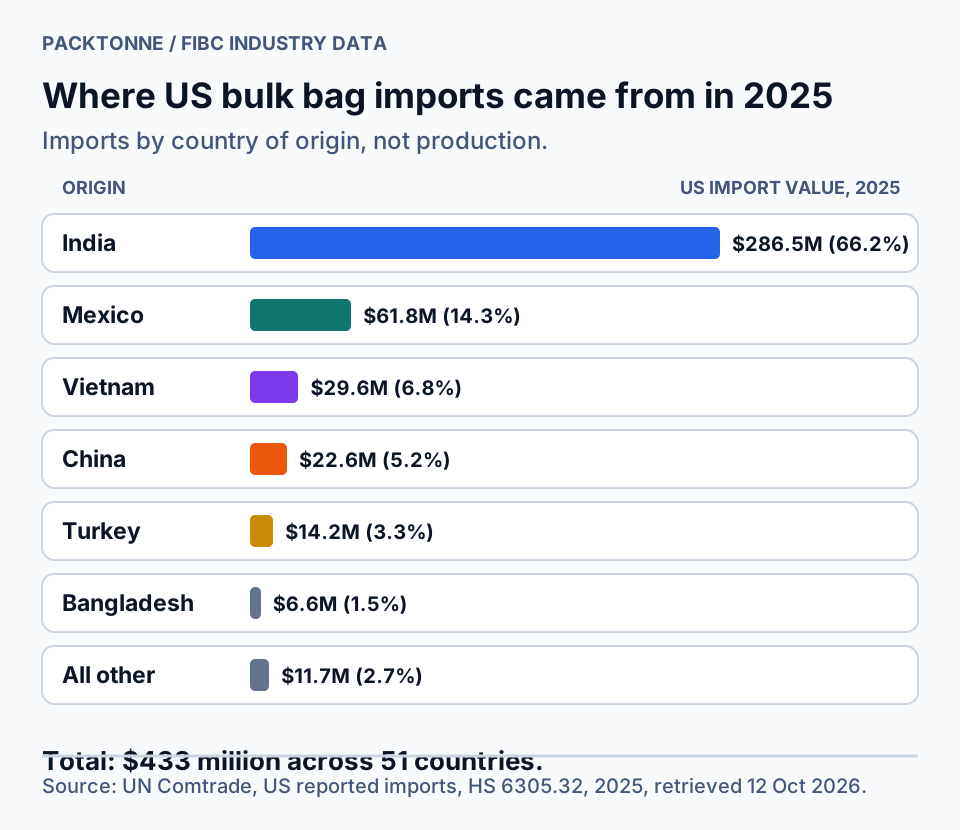
Where US Bulk Bag Imports Come From
Five countries account for more than 95% of US bulk bag imports by value. The table uses United States import data for HS 6305.32, retrieved from UN Comtrade on 12 October 2026.
| Origin | US import value, 2025 | Share |
|---|---|---|
| India | USD 286.5 million | 66.2% |
| Mexico | USD 61.8 million | 14.3% |
| Vietnam | USD 29.6 million | 6.8% |
| China | USD 22.6 million | 5.2% |
| Turkey | USD 14.2 million | 3.3% |
| Bangladesh | USD 6.6 million | 1.5% |
| All other (45 countries) | USD 11.7 million | 2.7% |
| Total | USD 432.9 million |
Seven Years of Change
India’s share rose almost every year while China’s fell. The mix in 2025 looks very different from 2019.
| Year | India | Mexico | China | Vietnam | Total value |
|---|---|---|---|---|---|
| 2019 | 50.4% | 12.9% | 27.0% | 2.3% | USD 424 million |
| 2021 | 57.1% | 16.2% | 15.1% | 3.6% | USD 519 million |
| 2023 | 60.2% | 16.0% | 10.1% | 4.4% | USD 377 million |
| 2025 | 66.2% | 14.3% | 5.2% | 6.8% | USD 433 million |
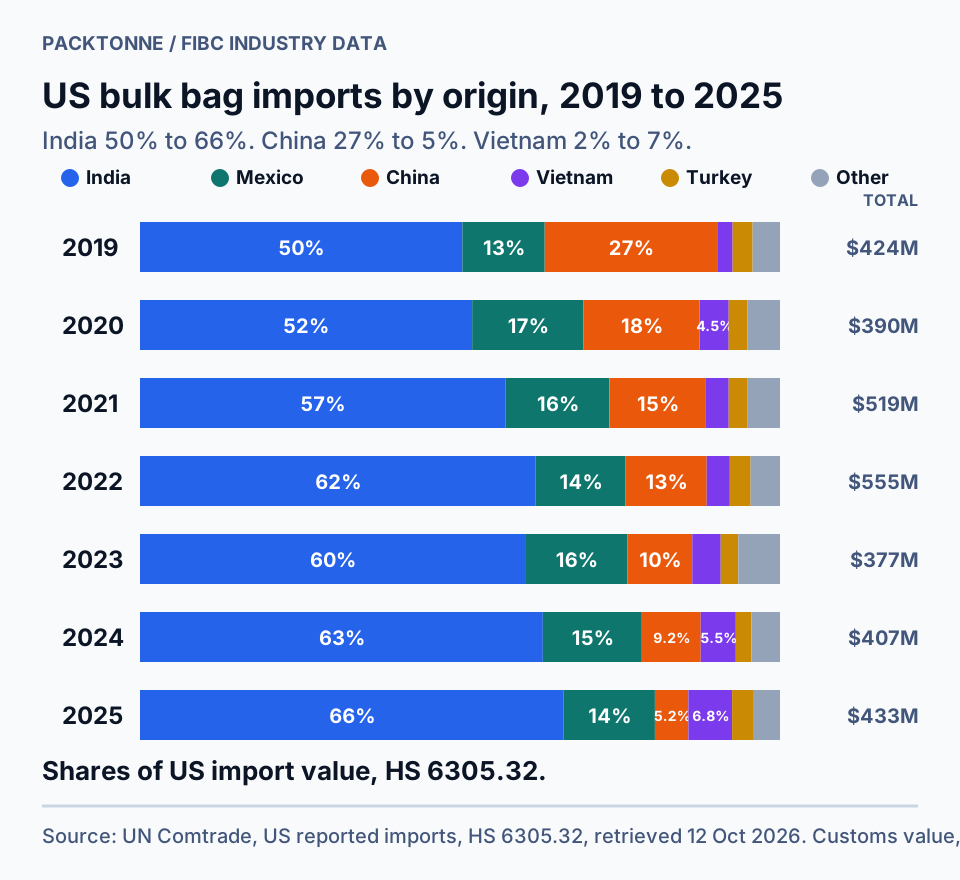
Total import value moved between about USD 377 million and USD 555 million over the period, so the shift is in the mix, not in a collapse of demand. The data does not say why the mix changed. Duties, trade remedies and freight can all play a part, and our guide to FIBC tariffs for US importers covers the duty side. Do not assume any single cause.
Who Exports Bulk Bags
Reported exports in 2024 were led by India, then China and Turkey. This chart covers the 18 reporting countries we queried that returned 2024 data.
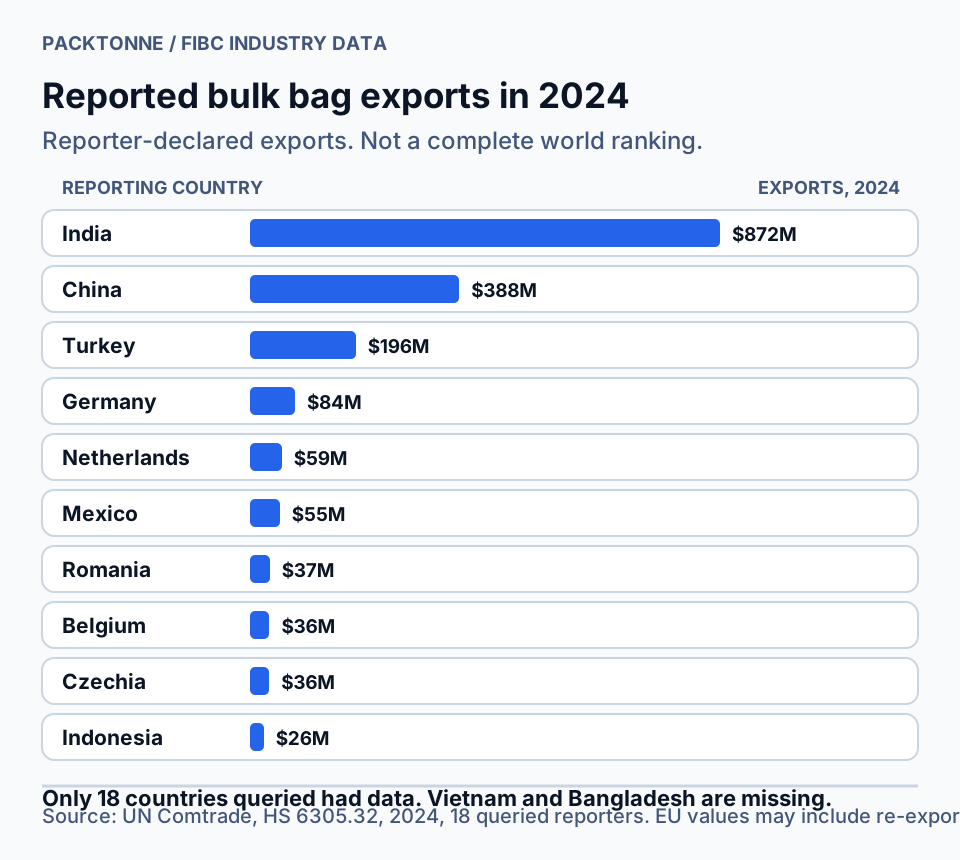
India declared about USD 872 million of exports, China about USD 388 million and Turkey about USD 196 million. Germany, the Netherlands and Belgium also appear, and their figures may include re-exports. Vietnam and Bangladesh returned no data, so they are missing even though both appear in the US import figures. Do not read the chart as a full world ranking.
How Big Is the FIBC Market?
Published market-size estimates disagree by about half or more, so no single number is reliable. Global Market Insights puts the global market at USD 5.3 billion in 2024. IMARC reports USD 6.0 billion in 2025, and Mordor Intelligence reports USD 9.05 billion in 2026. Each firm defines the market, the years and the forecast differently. Two of them name North America as the largest regional market.
For decisions, use verified trade data like the figures above rather than a headline market size.
What the Data Can and Cannot Tell You
Import data shows origin, not manufacturing quality. It records the country of origin declared at import and a customs value. It does not show factories, specifications, certifications or defect rates, and some trade is re-exported. The figures also come from a public preview interface and can be revised. Use them to see sourcing patterns.
Do not use them to rank suppliers. A country’s share says nothing about whether any factory in it suits your product. That requires audits, samples and documents, covered in our manufacturer audit checklist.
Five Questions to Ask Before You Pick a Source Country
Pick the supplier first, then check what its country means for your landed cost and risk.
- What is the current duty on this HS code and origin? Check with a customs broker, and see our HS code guide.
- What does a full container cost delivered, and how many bags fit? See bags per 40ft container.
- Can the supplier show current certificates and accept a third-party inspection?
- How concentrated is your supply? If all your bags come from one country or factory, a shift in duties or freight hits you directly.
- Who is the supplier, factory or distributor? See distributor versus factory direct.
Your Sourcing Checklist
- If your information on suppliers is more than a couple of years old, you should refresh it, because the mix has moved a lot since 2019.
- If a supplier cites a market share or a ranking, you should ask for the source and the year.
- If you rely on one country for every order, you should price a second source.
- If you have not confirmed the HS code and current duty, you should do it before comparing quotes.
- If you have not seen the factory or a third-party report, you should not compare on price alone.
Final Thoughts
The data says the US bulk bag supply pattern changed substantially in seven years, and it can change again. Pick suppliers on evidence, not on a country’s reputation. Get the duty, the documents and an inspection in place before the first order, and keep a second source in view. Our guide to importing bulk bags from China covers the process from the factory side.
Before You Request a Quote
If you are comparing sources for a US order, send us these details:
- Bag type, size and safe working load
- Product and filling method
- Annual quantity and order size
- Destination port and delivery terms
- Certificates and inspection you require
We will reply with what we need to confirm and the documents to ask for. For standard construction, see our Type A standard bags.
Common Questions
Where do US bulk bag imports come from?
India supplies most of them. In 2025, India accounted for about 66% of the value of US imports of bulk bags (HS 6305.32), followed by Mexico at about 14%, Vietnam at about 7%, China at about 5% and Turkey at about 3%. The figures are customs import values reported by the United States and may be revised.
Which country exports the most bulk bags?
Among the 18 reporting countries we queried for 2024, India declared the highest export value at about USD 872 million, followed by China at about USD 388 million and Turkey at about USD 196 million. Vietnam and Bangladesh had no data, so this is not a complete world ranking, and EU values may include re-exports.
How big is the global FIBC market?
Published estimates disagree by about half or more. Global Market Insights puts it at USD 5.3 billion in 2024, IMARC at USD 6.0 billion in 2025 and Mordor Intelligence at USD 9.05 billion in 2026. Each publisher defines the market and forecasts differently, so treat any single figure as an indication, not a fact.
Does the country of import show where a bag was made?
Not reliably. Customs data records the country of origin declared at import, and some trade passes through other countries, including re-exports. It also says nothing about the factory, the specification or the quality of any bag. Use it to see sourcing patterns, then check each supplier's actual plant, documents and samples.
Did China's share of US bulk bag imports really fall?
Yes, in the US customs data. China's share of US import value was about 27% in 2019 and about 5% in 2025. The data shows the change but not the cause. Duties, trade remedies, freight, capacity elsewhere and buyer choices can all contribute, so do not assume a single reason.
What HS code covers bulk bags?
Bulk bags of man-made textile materials fall under HS 6305.32, which covers flexible intermediate bulk containers. Countries add their own digits beyond the six-digit level. HS 6305.33 is a different subheading for other sacks and bags of polyethylene or polypropylene strip, so use 6305.32 when looking up bulk bag trade data.
How should I choose a supplier country for bulk bags?
Choose the supplier first and the country second. Compare landed cost, lead time, documents, third-party inspection and the supplier's willingness to be audited. Check current duties with a customs broker. Avoid depending on one country or one factory for every order, because the pattern in the data shows the mix can shift within a few years.
More in Buying & Importing
All Buying & Importing guides- Bulk Bag Shipping Documents: What Your Supplier Provides and What You Check Before CustomsA bulk bag shipment travels with customs documents and product documents. See what each is, what US rules say and how to check them before the shipment leaves.
- Inspected Used Bulk Bags: Why a 5:1 Bag Can't Be ReusedInspected is not a standard — it covers everything from a visual glance to light-table and loop-pull testing. No inspection makes a single-trip bag reusable.
- FIBC Tariffs: Why the Factory Quote Isn't Your Real CostFIBC imports can carry standard tariffs plus trade remedy duties on top. Here's the landed-cost framework, and where to verify the current rate.
- HS Code for FIBC Bags: Why 6305.32 Isn't EnoughFIBC bags sit under HS 6305.32 internationally, but your country extends that into a longer code. Here's how classification actually works.