How Many Bulk Bags Fit on a Truck? Floor Space and Weight Limits for a 53 Ft Dry Van
A 53 ft dry van holds about 36 bulk bags in one layer on floor space, but weight can cap a load at 18 to 22. See how to work out both and load the lower number.
PackTonne Sourcing Desk · · 7 min read
A 53 ft dry van holds about 36 bulk bags in one layer on floor space, but weight can cap the load at 18 to 22. Work out both numbers and load the smaller one. Dense products such as sand or cement reach the weight limit first. Light products such as resin pellets reach the floor limit first.
What a 53 Ft Dry Van Gives You
A 53 ft dry van is about 630 inches long and 100 inches wide inside. Cargo-Planner lists about 630 × 101 × 110 inches, Hale Trailer puts the inside length at 52 ft 5 in or 52 ft 6 in, and a Utility Trailer spec sheet gives an inside width of 100 to 101 inches at the wearband and an inside height of about 110½ to 111 inches. Sources differ by an inch or two, and builders vary, so confirm the trailer you will use.
Three federal rules shape the limits:
| Rule | Limit |
|---|---|
| Width, 23 CFR 658.15 | States may not set a width limit other than 102 inches on the National Network |
| Length, 23 CFR 658.13 | States may not limit a semitrailer to less than 48 feet |
| Weight, 23 CFR 658.17 | 80,000 lb gross, 20,000 lb single axle, 34,000 lb tandem axles, plus the bridge formula |
Utility Trailer rates the trailer itself at 55,000 lb of payload, but the road limit is lower once the tractor is counted. Cargo-Planner gives a typical payload near 40,000 lb and Hale Trailer about 44,000 to 45,000 lb. Use about 40,000 to 45,000 lb as a working range and ask the carrier for the real figure.
Count by Floor Space
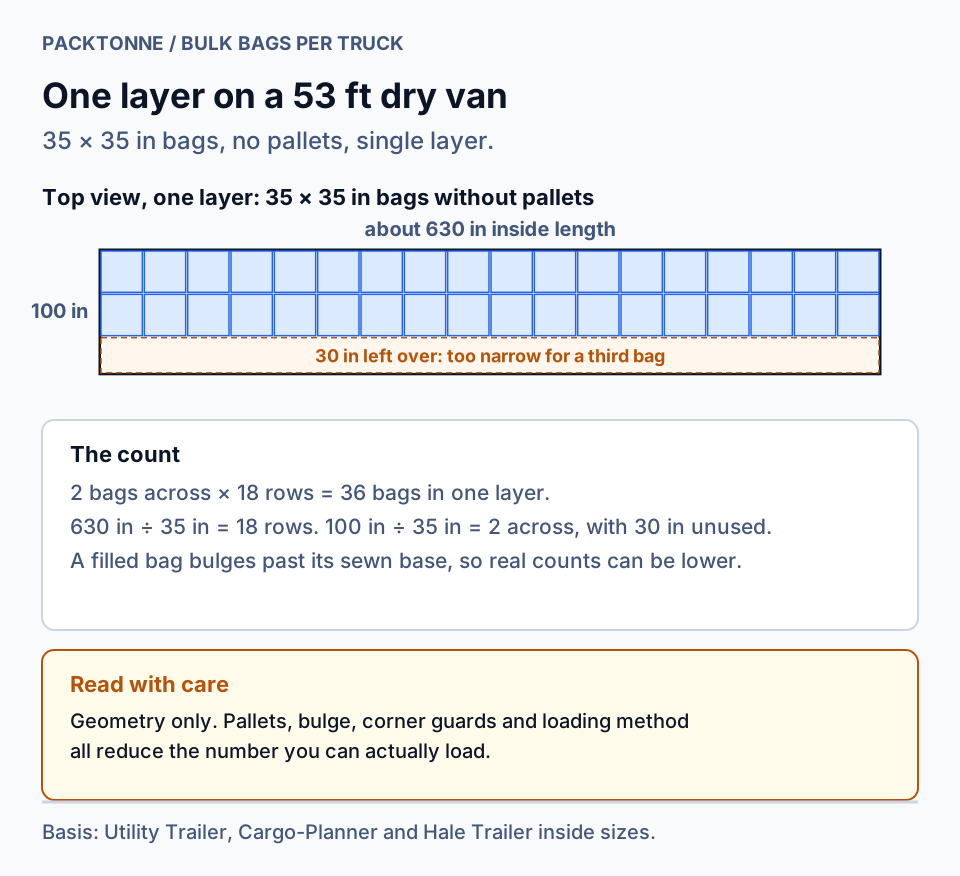
Divide the trailer’s inside length and width by the bag’s base. For a 35 × 35 inch bag: 630 ÷ 35 gives 18 rows, and 100 ÷ 35 gives two across with 30 inches left over, which is too narrow for a third bag. That is 36 bags in one layer.
| Bag base | Across | Rows | Bags per layer |
|---|---|---|---|
| 35 × 35 in, no pallet | 2 | 18 | 36 |
| 35 × 35 in on a 40 × 48 in pallet | 2 | 15 | 30 |
| 40 × 40 in, no pallet | 2 | 15 | 30 |
| 48 × 48 in, no pallet | 2 | 13 | 26 |
The pallet row uses pallets with the 48 inch side across the width (two across is 96 inches) and the 40 inch side along the length (15 rows). A filled bag bulges past its sewn base, as our super sack dimensions guide explains, so the real footprint is larger than the table. Our guide to super sacks on pallets covers when a pallet earns its place.
Count by Weight
Divide the payload by the filled weight of one bag. With a 40,000 to 45,000 lb payload:
| Filled bag weight | Bags by weight |
|---|---|
| 2,200 lb | 18 to 20 |
| 2,000 lb | 20 to 22 |
| 1,000 lb | 40 to 45 |
This ignores the weight of the bags and any pallets, which reduces the count slightly. Our weight calculation guide explains net, tare and gross weight.
Axle limits matter too. A 34,000 lb tandem limit means the load has to be spread along the trailer, not stacked at one end. The carrier or the loading plan should confirm axle weights.
Which Limit Comes First
Put the two counts side by side and load the lower one.
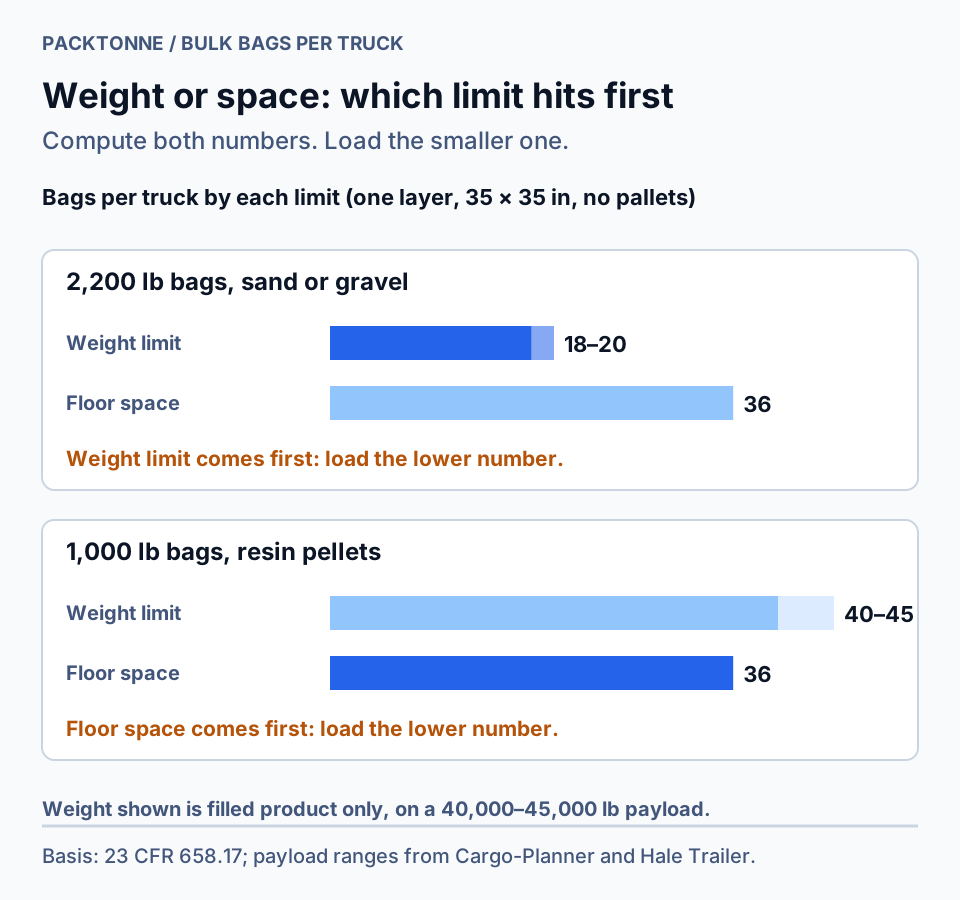
For 2,200 lb bags of sand or gravel, weight allows 18 to 20 bags while floor space would allow 36, so about half the floor is empty. For 1,000 lb bags of resin pellets, floor space allows 36 and weight 40 to 45, so floor space limits the load. Product density decides which case you are in. Our dimensions guide shows how to work out fill weight from bulk density.
A one-layer count is the baseline. Whether a light product can go two high depends on the bag design, the load and the stability of the stack, so check the supplier’s guidance and our storage guide before planning a two-high load.
Flatbeds and Other Trailers
Federal rules set a 102 inch width and a 48 ft minimum semitrailer length that states must allow, but not a deck length. This guide does not use a manufacturer or government source for flatbed deck sizes, so ask the carrier for the deck length and use the same method: floor-space count, weight count, and load the lower one. Bags on an open deck also need securing and weather protection, which the carrier should plan.
Containers have different interior dimensions, so the counts differ. Our guide to bulk bags in a 40 ft container covers that case.
What Pushes the Real Number Down
- Bulge. A filled bag is wider than its sewn base.
- Pallets. They cost floor space, weight and height.
- Corner guards and spacing. Room for strapping and handling.
- Loading method. Whether bags go in by forklift, from the side or from the back.
- Uneven weight. Axle limits can force a lighter load.
Treat any computed count as an upper bound until the carrier and the loading team confirm it.
Your Truckload Checklist
- If you know the bag base, you should work out the floor count: inside length ÷ base, and inside width ÷ base.
- If you know the filled weight, you should divide the carrier’s payload by it.
- If the two numbers differ, you should plan for the lower one.
- If you plan to use pallets, you should recalculate the floor count with the pallet size.
- If you plan to stack, you should get the bag supplier’s stacking guidance first.
Final Thoughts
Bags per truck is two sums, not one: how many fit on the floor and how many the payload allows. The lower answer is the load. Run both with your bag size and filled weight before you quote freight, and confirm the payload with the carrier.
Before You Request a Quote
If you are planning a truckload, send us these details:
- Bag size, base and height
- Product, bulk density and filled weight per bag
- Pallet size, if any
- Trailer type and destination
We will check them against a 1 ton bulk bag or Type A construction and tell you what to confirm.
Common Questions
How many bulk bags fit on a 53 ft truck?
On floor space alone, about 36 bags of 35 × 35 inches fit in one layer of a 53 ft dry van, with no pallets: two across and 18 rows. With 40 × 48 inch pallets it is about 30. Weight often sets a lower limit, so work out both numbers and load the smaller one. These are geometric examples, not a loading guarantee.
How many 1 ton bulk bags can a truck carry?
Weight decides it. A 53 ft dry van commonly carries about 40,000 to 45,000 lb of payload, depending on the weight of the tractor and trailer, so about 20 to 22 bags of 2,000 lb each. Floor space would allow more, which is why dense products reach the weight limit first. Ask the carrier for the actual payload.
Does weight or space limit how many bulk bags fit on a truck?
Either can. Dense products such as sand, gravel and cement reach the weight limit first, with space left over. Light products such as resin pellets reach the floor-space limit first. Calculate the count each way and load the lower number.
What is the maximum legal weight of a loaded truck?
On the Interstate System, federal limits are 80,000 pounds gross vehicle weight, 20,000 pounds on a single axle and 34,000 pounds on tandem axles, under 23 CFR 658.17, and the bridge formula can lower the limit. The payload you can carry is the 80,000 lb ceiling minus the empty weight of the tractor and trailer.
Do pallets reduce how many bulk bags fit on a truck?
They can. With one 35 × 35 inch bag per 40 × 48 inch pallet, the floor count drops from about 36 to about 30 in one layer. Pallets also add weight and height. Palletizing makes handling easier, so the trade is fewer bags per load against faster loading and unloading.
Can bulk bags be stacked two high on a truck?
It depends on the bag design, the load, the product and how stable the stack is. This guide counts a single layer and does not give a stacking rule. For stacking limits, check the bag supplier's guidance and our storage guide before planning a two-high load.
How many bulk bags fit on a flatbed?
Federal rules set the width of a vehicle on the National Network at 102 inches and stop states from limiting a semitrailer to less than 48 feet, but they do not set a deck length. Ask the carrier for the deck length and use the same floor-space and weight method as for a dry van.
More in Sizes & Capacity
All Sizes & Capacity guides- Super Sack Dimensions: Why a Bag of Sand Only Fills 60% FullStandard super sack sizes in inches with the correct cubic feet for each — and why a 35×35×50 bag of sand hits its 2,200 lb rating at about 62% full.
- Jumbo Bag Loading in a Container: Weight Runs Out Before SpaceFilled bulk bags of dense product hit a container's payload limit long before its floor is full. How to load, balance and secure them so nothing shifts.
- Mini Bulk Bags: Why Dense Products Need a Smaller BagThe reason to order a mini bulk bag is almost never a small order. It is density — a heavy product hits the safe working load long before the bag is full.
- Tare, Net and Gross Weight: The Three Numbers on a BagMixing up tare, net and gross weight causes freight billing errors and customs delays. Here's how the three numbers actually relate on a shipment.