Mini Bulk Bags: Why Dense Products Need a Smaller Bag
The reason to order a mini bulk bag is almost never a small order. It is density — a heavy product hits the safe working load long before the bag is full.
PackTonne Sourcing Desk · · 7 min read
The reason buyers order mini bulk bags is almost never that their orders are small. It is that their product is heavy. A dense material reaches the bag’s safe working load long before it fills the bag, and once that happens you are paying for volume you are not legally allowed to use — and shipping the empty part of every bag across an ocean.
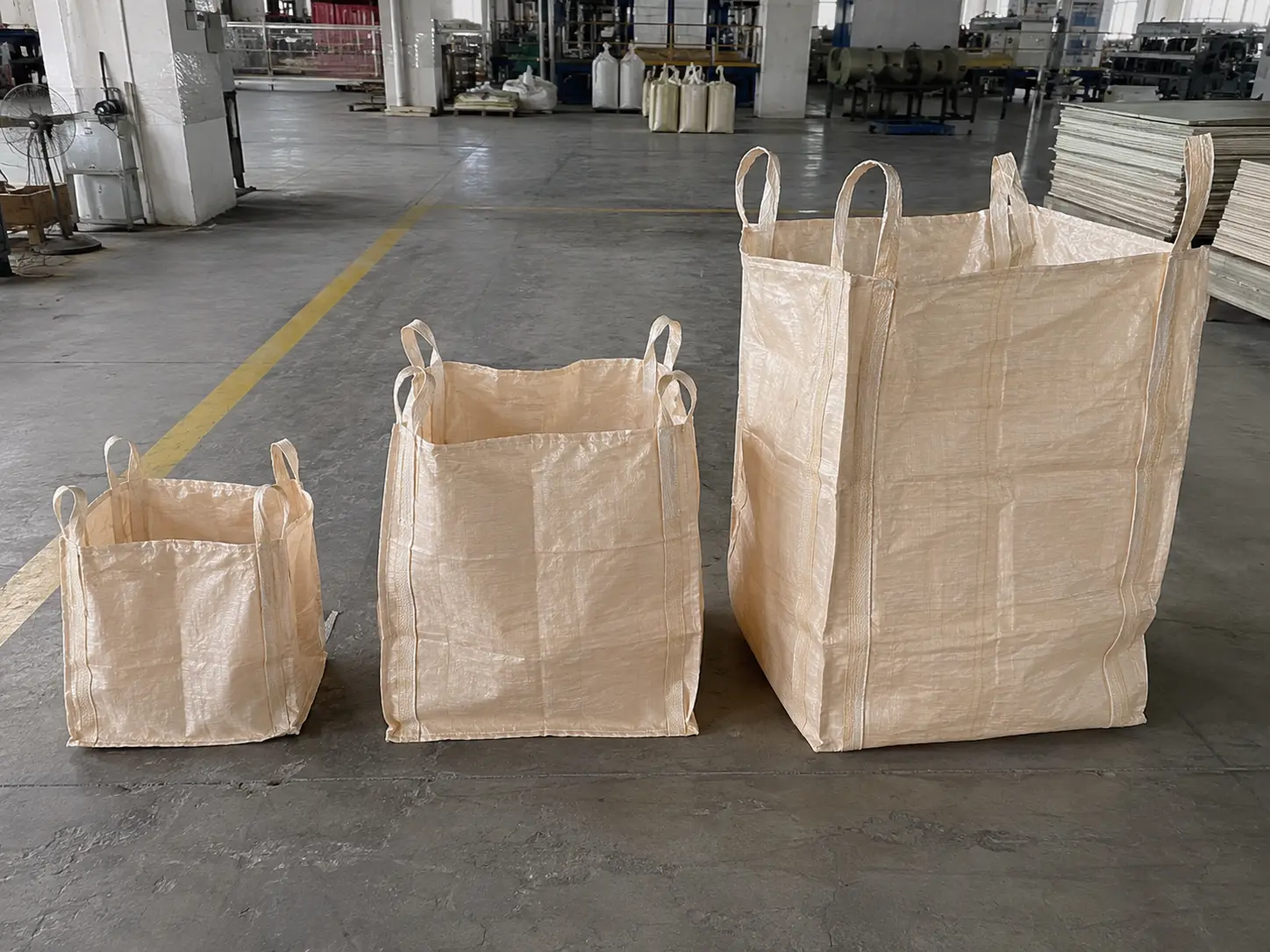
Density Decides the Size, Not Order Quantity
Run the arithmetic on a standard 90 × 90 × 110 cm bag, which encloses 0.891 m³.
| Product | Bulk density | Weight at full volume | Against a 1,000 kg SWL |
|---|---|---|---|
| Plastic resin pellets | 0.6 t/m³ | 535 kg | 53% — bag runs out of volume first |
| Wheat or corn | 0.75 t/m³ | 668 kg | 67% |
| Cement | 1.4 t/m³ | 1,247 kg | 125% — over rating |
| Ore concentrate | 2.5 t/m³ | 2,228 kg | 223% — badly over |
For the bottom two rows the standard bag is simply the wrong container. To carry 1,000 kg of ore concentrate at 2.5 t/m³ you need 0.4 m³ — roughly a 74 cm cube. That is a mini bulk bag, and it is not a compromise: it is the correct size for the load.
You can run this for your own material in the bag calculator by entering your density and watching where the percentage-of-SWL figure lands.
Why Not Just Part-Fill a Standard Bag?
This is the obvious workaround and it fails on shape. A bag filled to 40% of its height does not stand up — it slumps, the top folds over, and the stack becomes unstable. You lose the square-ish profile that made bulk bags efficient to load in the first place, and the load shifts in transit because there is void space above it.
Three practical consequences:
- Stacking height drops, so container utilisation falls
- Slumped bags are harder to handle cleanly with a forklift or spreader bar
- The fabric flexes more during transit at the unsupported section, which is not what the construction was designed around
A bag sized to the load carries the same tonnage in a shape that behaves.
The Other Reasons to Go Smaller
Density is the main one. Four others come up regularly:
Handling capacity. Not every site has equipment rated for a full tonne. Where the forklift, hoist or mezzanine floor loading tops out lower, the bag has to come down to meet it — and that is a hard constraint, not a preference.
Batch size and traceability. Operations running small batches often want one batch per bag rather than blending batches into a tonne. Where a quality system tracks per bag, smaller bags mean finer traceability.
Partial-use products. A bag that will be opened and drawn down over weeks exposes its contents to the plant environment each time. A smaller bag consumed in one or two runs limits that exposure.
Storage and floor space. Smaller footprints suit tight production areas, and some sites simply cannot stage a full-size bag where the material is needed.
A Dense Product Changes More Than the Size
Sizing down solves the volume mismatch. It does not by itself solve everything a heavy material does to a bag, and buyers who fix only the dimensions still see failures.
Fabric weight does not scale down. A smaller bag carrying the same 1,000 kg puts that load through less fabric area and shorter seams. Fabric weight is specified from the load and the handling, not from the body size, so do not let a small bag arrive at a light GSM because it looks like a lighter duty item.
Abrasion often comes with density. Ore concentrates, mineral fines and metal powders are usually abrasive as well as heavy, and abrasion is what wears fabric through at the bottom corners. The mining and minerals guide covers how that changes fabric and construction choices independently of size.
The safety factor question is unchanged. A mini bag rated 500 kg to 5:1 is a single-trip bag exactly as a 1,000 kg bag would be. Smaller does not mean sturdier, and if the bags will be reused they need 6:1 multi-trip construction at whatever size you order.
Loop length still has to suit your equipment. Loops are sized for the lifting method, not scaled to the body. A short body with short loops can be awkward on a spreader bar set up for standard bags, which is worth confirming before the first shipment rather than on the receiving dock.
What You Give Up
Mini bags are cheaper per bag and more expensive per tonne of product. Lifting loops, thread, labels and sewing labour barely scale down with body size, so a bag carrying half the load does not cost half as much to make. Two bags instead of one also means two lifts, two fill cycles and two discharge cycles.
| Standard bag | Mini bag | |
|---|---|---|
| Typical rating | 1,000–1,500 kg | 250–500 kg |
| Body size | around 90 × 90 × 110 cm | around 70–80 cm cube |
| Cost per bag | Higher | Lower |
| Cost per tonne shipped | Lower | Higher |
| Handling cycles per tonne | Fewer | More |
| Suits dense product | Poorly | Well |
| Suits light, bulky product | Well | Poorly |
Construction options are not the trade-off. Anti-static classes, food grade production, liners and UN certification are properties of the fabric and build rather than the size, so they carry across. Baffles are the exception worth questioning — they earn less in a small body, where the corner volume they recover is a smaller absolute gain.
Your Sizing Checklist
- What is your product’s bulk density in t/m³? Without it, every other sizing decision is a guess.
- Divide target fill weight by density. Does the resulting volume match a standard bag, or is it well under?
- If it is well under, are you planning to part-fill a standard bag? That is the option this article exists to talk you out of.
- What is the lifting and floor loading capacity at the receiving site? A tonne rating is useless if nothing there can lift a tonne.
- Have you compared quotes on cost per tonne rather than cost per bag? The per-bag number will always favour the smaller bag, and it is the wrong number.
Final Thoughts
Bag size follows from density and from what your site can lift, not from how much you happen to be ordering. If your material is heavy enough that a standard bag hits its rating at two-thirds full, a smaller bag is not a downgrade — it is the size that matches the load, and it stops you shipping air. Where the material is light — dried hemp biomass is the extreme case — the opposite holds and a bigger body earns its keep. The standard dimensions guide covers the range in between.
Send us the product, its bulk density and your target fill weight, along with the lifting capacity at the receiving end. That is enough to size the bag properly rather than defaulting to the one everyone quotes.
Common Questions
What counts as a mini bulk bag?
There is no formal cut-off, but the term generally covers bags rated around 250 to 500 kg, with bodies near 70 × 70 × 70 cm up to 80 × 80 × 80 cm and volumes around 0.5 to 0.8 m³. Anything much smaller stops being a lifted FIBC and becomes a sack handled by hand.
Why would I order a smaller bag rather than part-filling a standard one?
Because a part-filled bag does not hold its shape. It slumps, stacks badly and shifts in transit, so you lose the container utilisation that made the standard bag economic. A bag sized to the load carries the same tonnage in a stable shape.
Are mini bulk bags cheaper?
Cheaper per bag, more expensive per tonne of product. Loops, thread, labels and sewing labour barely scale down with size, so a bag holding half the load does not cost half as much. Budget on cost per tonne shipped, not cost per bag.
What products typically need a mini bag?
Dense ones. Metal ore concentrates, mineral powders, metal powders, some catalysts and abrasives reach a 1,000 kg rating in well under half the volume of a standard bag. Density above roughly 1.5 t/m³ is where the question starts to matter.
Does a smaller bag mean I fit fewer tonnes in a container?
Usually not, and sometimes the opposite. Container loading for dense cargo is limited by weight rather than volume long before the bags run out of room, so bag size affects how neatly the weight stacks rather than how much you can ship.
Can I get the same construction options on a mini bag?
Generally yes. Anti-static classes, food grade production, liners, baffles and UN certification are all available in smaller formats, since they are properties of the fabric and construction rather than the size. Confirm baffles specifically, since they make less difference in a small body.
How do I work out the right size for my product?
Divide your target fill weight by the product's bulk density to get the volume you need, then find dimensions that give that volume. A 1,000 kg target at 2.5 t/m³ needs 0.4 m³, which is roughly a 74 cm cube — not a standard bag with the top third empty.
More in Sizes & Capacity
All Sizes & Capacity guides- Super Sack Dimensions: Why a Bag of Sand Only Fills 60% FullStandard super sack sizes in inches with the correct cubic feet for each — and why a 35×35×50 bag of sand hits its 2,200 lb rating at about 62% full.
- Jumbo Bag Loading in a Container: Weight Runs Out Before SpaceFilled bulk bags of dense product hit a container's payload limit long before its floor is full. How to load, balance and secure them so nothing shifts.
- Tare, Net and Gross Weight: The Three Numbers on a BagMixing up tare, net and gross weight causes freight billing errors and customs delays. Here's how the three numbers actually relate on a shipment.
- 1 Ton Bags: Why Rated Capacity Isn't the Breaking PointA 1 ton bag's rating is its safe working load — not its breaking point. Here's how SWL, safety factor and real breaking strength actually relate.