Super Sack Dimensions: Why a Bag of Sand Only Fills 60% Full
Standard super sack sizes in inches with the correct cubic feet for each — and why a 35×35×50 bag of sand hits its 2,200 lb rating at about 62% full.
PackTonne Sourcing Desk · · 7 min read
Super sack dimensions tell you volume. The weight rating tells you how much of that volume you can use. A standard 35 × 35 × 50 inch super sack holds about 35 cubic feet, and filled with dry sand at roughly 100 lb per cubic foot it reaches a 2,200 lb safe working load at about 62% full. Pick the size from your product’s density and the rating first, then check the cubic feet.
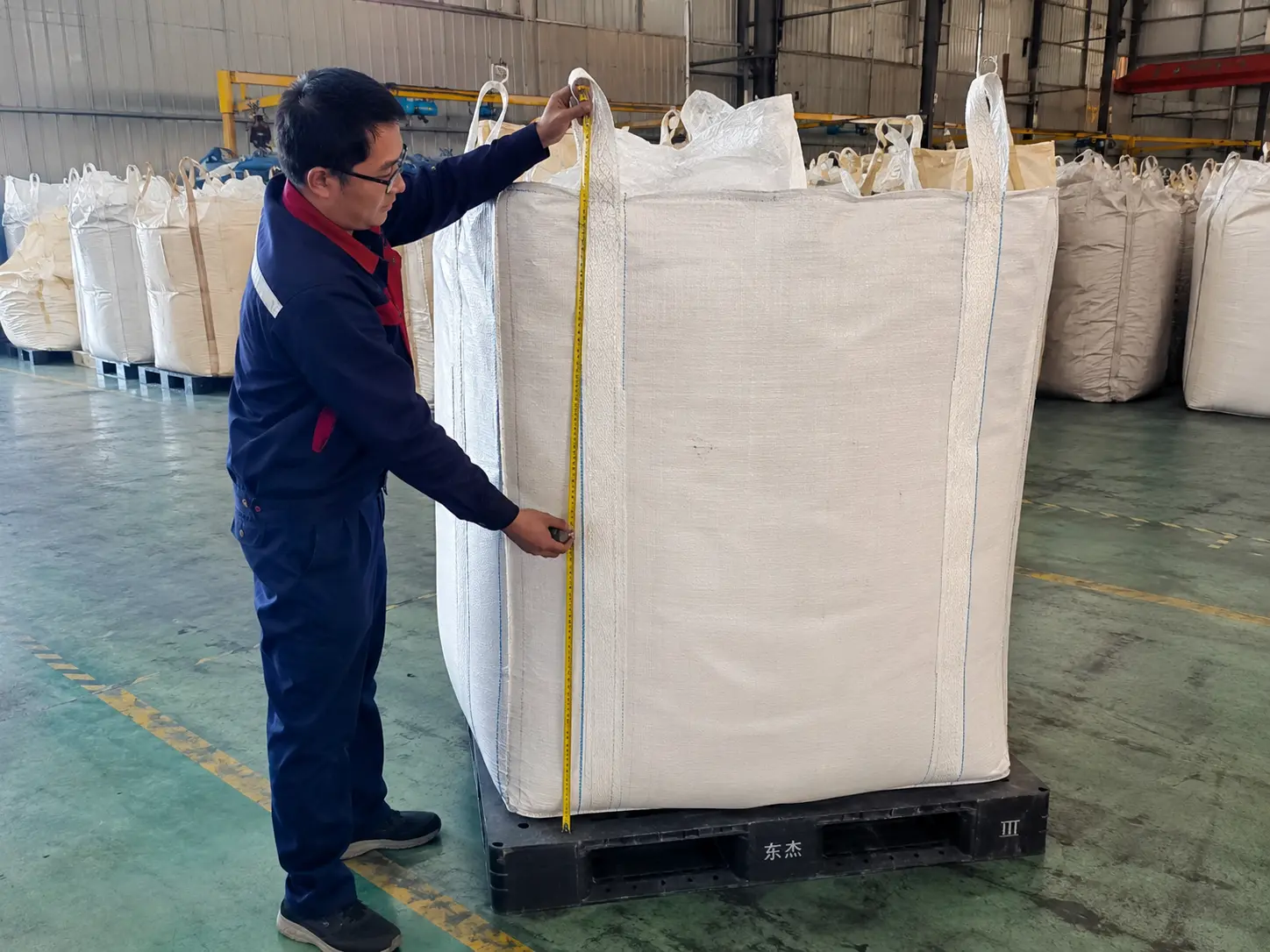
Standard Super Sack Sizes and Their Actual Volume
Most super sacks sold in North America have a 35 × 35 inch base and a body height between 35 and 60 inches, which works out to roughly 25 to 43 cubic feet.
| Body size (in) | Cubic feet | Cubic yards | Cubic meters | On a 40 × 48 in pallet |
|---|---|---|---|---|
| 35 × 35 × 35 | 24.8 | 0.92 | 0.70 | Fits, room to bulge |
| 35 × 35 × 40 | 28.4 | 1.05 | 0.80 | Fits, room to bulge |
| 35 × 35 × 45 | 31.9 | 1.18 | 0.90 | Fits, room to bulge |
| 35 × 35 × 50 | 35.4 | 1.31 | 1.00 | Fits, room to bulge |
| 35 × 35 × 60 | 42.5 | 1.58 | 1.20 | Fits, room to bulge |
| 40 × 40 × 48 | 44.4 | 1.65 | 1.26 | Flush on the 40 in side |
| 48 × 48 × 48 | 64.0 | 2.37 | 1.81 | Overhangs — needs a larger pallet |
These are nominal volumes: length × width × height of the body in inches, divided by 1,728 for cubic feet, then by 27 for cubic yards. A “one cubic yard” super sack is roughly 35 × 35 × 38 inches, so most standard sizes are larger than a yard, not equal to it.
Check any size chart against that arithmetic before you plan a fill. One chart ranking near the top of search lists a 35 × 35 × 42 inch bag at 81 cubic feet. Multiplied out, it is 29.8. An error that size means ordering for nearly three times the product one bag can take.
Cubic Feet Is Half the Answer: The Weight Rating Decides the Fill
A super sack is full when it reaches either its volume or its safe working load, and for dense products the rating comes first. Here is a 35 × 35 × 50 inch bag (35.4 ft³) rated at 2,200 lb:
| Product | Typical bulk density | Weight at full volume | Limit reached first |
|---|---|---|---|
| Dry sand | 90–110 lb/ft³ | 3,190–3,900 lb | Rating, at 56–69% full |
| Gravel | 90–105 lb/ft³ | 3,190–3,720 lb | Rating, at 59–69% full |
| Portland cement | 94 lb/ft³ | 3,330 lb | Rating, at 66% full |
| Urea prills | 45–48 lb/ft³ | 1,600–1,700 lb | Volume |
| Wheat | 48 lb/ft³ | 1,710 lb | Volume |
| Wood pellets | about 40 lb/ft³ | 1,420 lb | Volume |
| PE / PP resin pellets | 30–35 lb/ft³ | 1,060–1,240 lb | Volume |
Densities are typical loose values: wheat follows the USDA standard of 60 lb per bushel, and portland cement the 94 lb bag that fills one cubic foot. Moisture, particle size and settling all move these figures, so use the number on your SDS or measure a filled bag.
The table splits into two groups. Sand, gravel and cement reach the rating with a third of the bag still empty, so that body height is fabric you pay for and cannot fill — a shorter body or a mini bulk bag matches the load better. Grain, pellets and resin fill the bag well below the rating, so they want more volume, not a stronger bag. A 3,000 lb rating moves sand to about 85% full, but that rating comes from heavier construction, not from the dimensions.
How Much Does a Super Sack Hold? Work It Out From Bulk Density
The weight a super sack holds equals its volume in cubic feet times your product’s bulk density in pounds per cubic foot, capped at the safe working load. Run it in either direction:
- Weight a bag will hold = cubic feet × lb/ft³, up to the rating
- Cubic feet you need = target fill weight ÷ lb/ft³
Resin pellets at 32 lb/ft³ with a 2,200 lb target need 68.75 cubic feet. On a 35 × 35 inch base that is a 97 inch body — taller than most fill stations can reach and too tall to stack safely. On a 43 × 43 inch base the same volume needs a 64 inch body. Light products usually need a wider base, not just a taller bag.
Leave headspace for the closure; the bulk bag dimensions guide covers how much, in metric. The bag calculator switches to inches and pounds and runs both formulas for you.
Why Size Charts Disagree: Nominal vs Filled Volume
Two suppliers can list different cubic feet for the same size because a filled bag bulges beyond its sewn dimensions. A 35 inch square base has a 140 inch perimeter. If the filled bag rounded out into a full circle, its cross-section would grow from 1,225 to about 1,560 square inches — 27% more. Real bags stop short of that, because the corners and seams hold part of the square, so filled volume lands somewhere between the two. One large US supplier lists a 43 × 43 × 43 inch bag at 53 cubic feet, about 15% above its nominal 46.
That gap matters in two places:
- Fill weight. A bulging bag takes more product than its nominal volume, so a light product may fill closer to the rating than the table suggests.
- Footprint. The bulge widens the bag on the pallet and in the container. Baffle bags hold the square cross-section, so their filled volume stays close to nominal and the footprint stays at the sewn base.
Heights get quoted two ways too: body only, or body plus lifting loops. A duffle top adds a gathered skirt above the body that can take extra product; a spout top does not. Ask for body height, loop height and top style as separate figures.
Fitting the Footprint: Pallets, Stacking and Loading
The 35 × 35 inch base is standard because it sits on a 40 × 48 inch pallet with room left for the bulge. A 40 × 40 inch base sits flush with the pallet’s 40 inch side and overhangs once it fills. A 48 × 48 inch base overhangs a 40 × 48 pallet before it is filled at all.
Height sets what you can stack. The taller the body relative to its base, the less stable a two-high stack becomes, and in shipping the limit is often the box rather than the bag: a standard container has about 94 inches of internal height, so two 50 inch bodies on pallets will not double-stack. If you ship dense product, you will usually run out of payload weight before floor space anyway — the container loading guide works through that trade-off.
Your Super Sack Sizing Checklist
- Do you know your product’s bulk density in lb/ft³ — from the SDS or a measured fill, not an estimate?
- Divide your target weight by that density. Is the answer near 35 cubic feet, or far from it?
- Which limit do you reach first, volume or rating? If it is the rating, don’t pay for body height you cannot fill.
- Does the base fit your pallet with room to bulge — 35 × 35 on a 40 × 48?
- Is the supplier’s cubic-feet figure nominal or filled, and does their height include the loops? Get both in writing.
Final Thoughts
Super sack dimensions are the easy part — every size chart has them. The number that decides your order is how full the bag will be when your product reaches the rating, and that comes from your density, not from a chart. Check the cubic feet yourself, size for whichever limit you hit first, and the right base and height follow.
Before You Request a Quote
Send us your product, its bulk density, the fill weight you want per bag and the pallet you ship on. We will come back with a base, body height and rating that match, with the cubic feet worked out so you can check them. Most orders start from our Type A bulk bags and change only what the product needs.
Common Questions
How many cubic feet are in a super sack?
A standard 35 × 35 × 50 inch super sack holds about 35.4 cubic feet by its sewn dimensions, and common sizes run from about 25 cubic feet (35 × 35 × 35) to 43 (35 × 35 × 60). To check any size, multiply length, width and height in inches and divide by 1,728. A filled bag bulges, so it can take somewhat more than the nominal figure.
How much does a super sack hold?
As much as its safe working load allows, which is often less than it has room for. A 35 × 35 × 50 inch bag rated 2,200 lb fills with about 1,700 lb of wheat before reaching its rating, but reaches the rating with dry sand at about 62% full. Multiply cubic feet by your product's bulk density, then cap the result at the rating.
How much does a super sack weigh?
Empty, roughly 3–9 lb depending on size, fabric weight and whether it has a liner. Full, it weighs its volume times the bulk density of the product, up to its safe working load — commonly 2,000, 2,200 or 3,000 lb in North America. The rating on the label is a limit, not the weight of the filled bag.
Is a super sack one cubic yard?
Only at one size. A one-cubic-yard super sack is roughly 35 × 35 × 38 inches, and most standard sizes are larger — a 35 × 35 × 50 inch bag is 1.31 cubic yards. When a bag is described as a one-yard bag, ask for the actual body dimensions and work the volume out yourself.
Why do suppliers list different cubic feet for the same size?
Some quote nominal volume from the sewn dimensions, others quote filled volume, which is higher because a bag without baffles bulges as it fills. Heights can also be measured with or without the lifting loops. Ask which figure is quoted, and check nominal volume yourself: the three dimensions in inches multiplied together, divided by 1,728.
Can I fill a super sack to the top if my product is dense?
No. If the product reaches the safe working load before the bag is full, that weight is the limit — filling further loads the fabric, seams and loops beyond what the bag was tested for. The fix is a shorter or smaller bag sized to the load, not a fuller one.
What size super sack fits a standard pallet?
A 35 × 35 inch base is the usual match for a 40 × 48 inch pallet, because it leaves room for the bag to bulge as it fills. A 40 × 40 inch base sits flush with the pallet's 40 inch side and overhangs once full, and a 48 × 48 inch base needs a larger pallet.
More in Sizes & Capacity
All Sizes & Capacity guides- Jumbo Bag Loading in a Container: Weight Runs Out Before SpaceFilled bulk bags of dense product hit a container's payload limit long before its floor is full. How to load, balance and secure them so nothing shifts.
- Mini Bulk Bags: Why Dense Products Need a Smaller BagThe reason to order a mini bulk bag is almost never a small order. It is density — a heavy product hits the safe working load long before the bag is full.
- Tare, Net and Gross Weight: The Three Numbers on a BagMixing up tare, net and gross weight causes freight billing errors and customs delays. Here's how the three numbers actually relate on a shipment.
- 1 Ton Bags: Why Rated Capacity Isn't the Breaking PointA 1 ton bag's rating is its safe working load — not its breaking point. Here's how SWL, safety factor and real breaking strength actually relate.