Super Sacks on Pallets: When You Need One and How to Choose
Choosing super sacks on pallets? Check filled bag size, deck support, load ratings and fork access. A pallet's static capacity alone cannot confirm suitability.
PackTonne Sourcing Desk · · 10 min read
Super sacks on pallets work when the filled bag, pallet and handling method fit together. A pallet can provide base access for a forklift or pallet truck and support during storage, but it does not make an unsuitable load safe. Choose it against the bag’s filled footprint, the deck beneath it and the load conditions along the route. A familiar pallet size and a large capacity number are only the starting points.
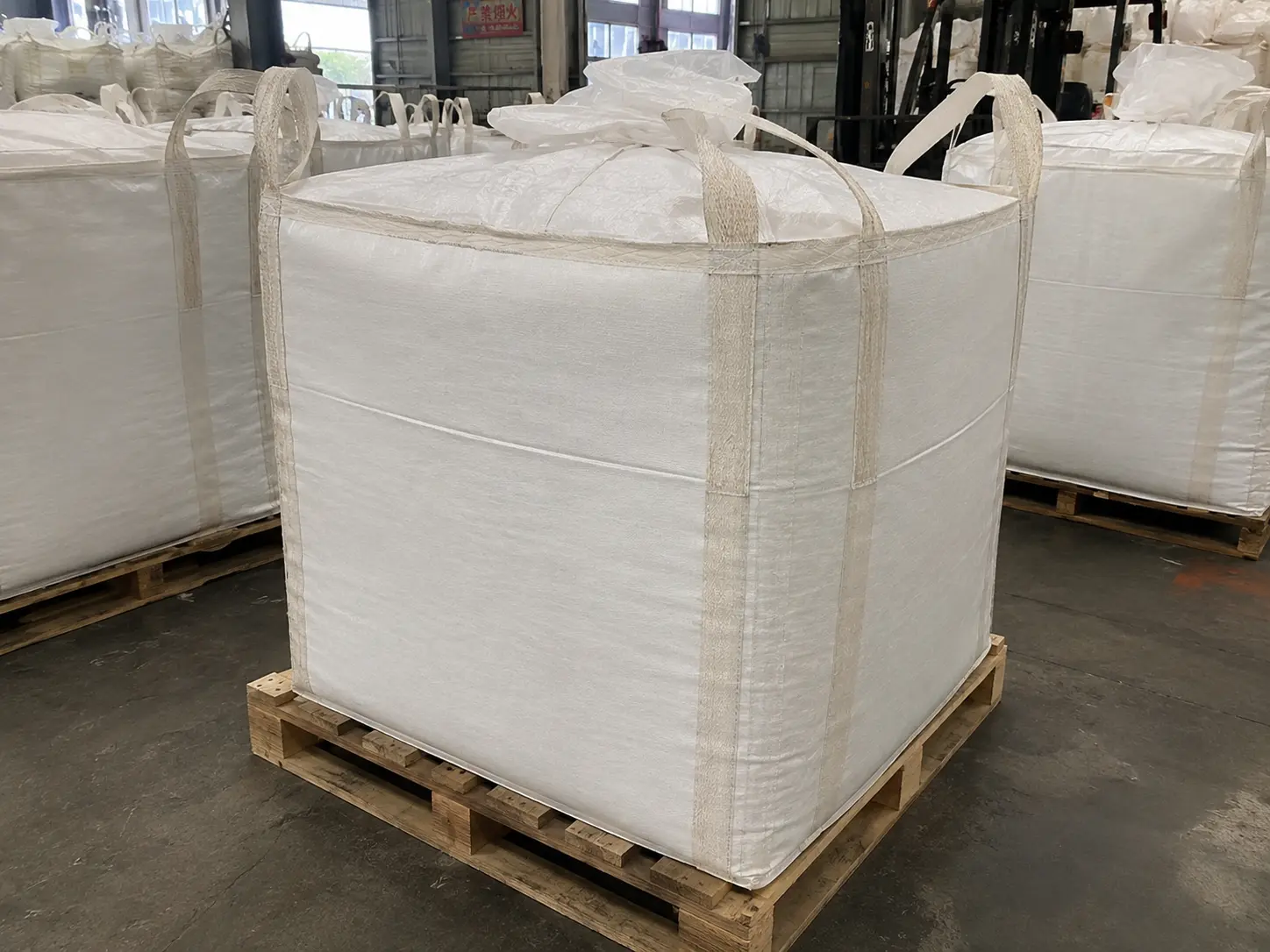
When Super Sacks Need a Pallet
A pallet is needed when the agreed handling or storage system depends on base support and pallet access.
A receiving site may use pallet trucks, fixed conveyors or a warehouse process that keeps each load on its own pallet. In those cases, the pallet is part of the delivery specification. Removing it to save space changes how the receiver can move the bag.
Pallet-free handling can be considered where the bag’s designated lifting arrangement and the site’s equipment support it. The question is whether that arrangement works throughout the journey, including transfers and unloading. The FIBCA design guide treats pallet-free shipping as an option to specify, rather than a rule for every bag.
| Situation | What to establish before ordering |
|---|---|
| Receiver moves loads with pallet trucks | Pallet entry and underside suit that equipment |
| Loads remain palletized through storage and dispatch | One agreed bag-and-pallet specification covers the route |
| Bag is lifted through its designated loops | Manufacturer’s instructions and compatible lifting equipment |
| Load goes into pallet racking | Approved pallet support condition, rack arrangement and filled dimensions |
| Pallet-free or slip-sheet shipment is proposed | Every transfer point can handle the specified arrangement |
Ask the receiver how the filled load will be removed from the vehicle. “We have a forklift” leaves the important detail unanswered: will it engage the pallet, the bag’s lifting features, or a dedicated attachment?
Super Sack Pallet Size Starts With the Filled Bag
Pallet size should be selected from the actual filled footprint, not just the empty bag dimensions on a quotation.
The FIBCA safe handling guidelines call for appropriately sized pallets without bag overhang, unless the manufacturer specifically designs and approves that exception. They also require pallets free of nails or protrusions that could damage the bag.
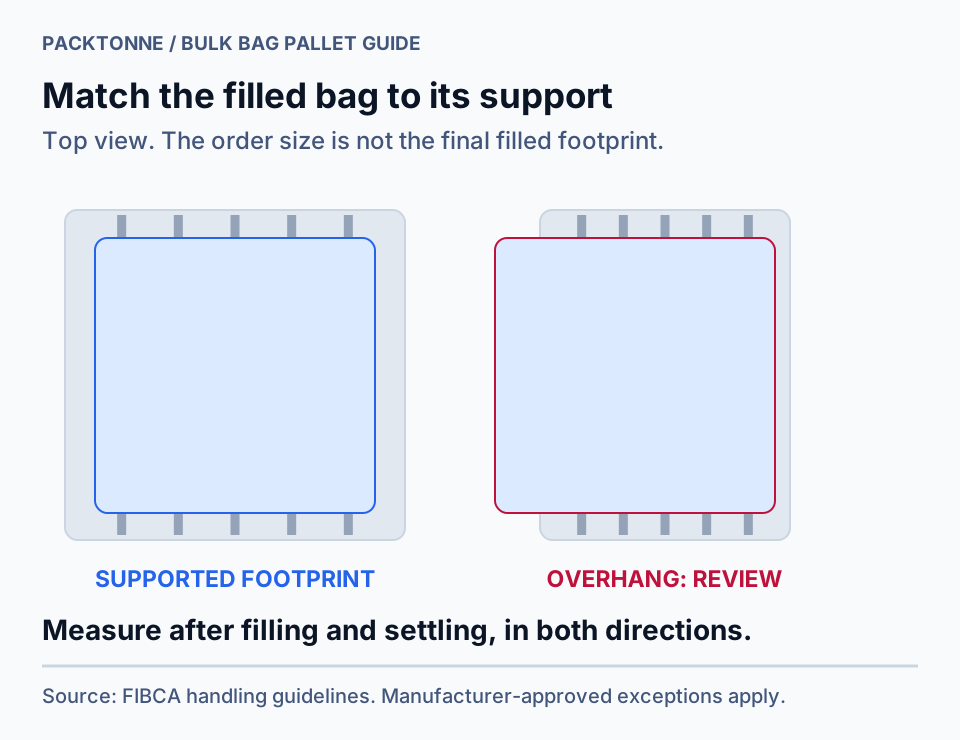
Use a filled sample of the intended product. Record its widest dimensions after filling and settling, the base contact area and the overall loaded height. A measurement taken from an empty bag laid flat cannot describe all of those features. Our bulk bag dimensions guide explains why the quoted dimensions need context.
For example, an illustrative 1,050 mm filled width exceeds a 1,000 mm pallet width by 50 mm. Centering the bag would leave 25 mm on each side. That calculation identifies an overhang to resolve; it does not establish how much overhang is acceptable.
Also check the space around the load. A pallet that supports the bag may still be awkward at a doorway, conveyor transfer or unloading station. Write down the filled load envelope and the pallet dimensions separately so neither disappears into a single “bag size” field.
Bulk Bag Pallets Have Different Load Conditions
A pallet’s floor-storage rating does not establish its suitability for forklift movement or racking.
The support changes between those operations. Manufacturer documentation may list static, dynamic and racking ratings, with defined load distribution, temperature and duration. Craemer’s L3 technical data, for example, distinguishes those conditions and notes that actual use conditions can change performance. Its figures belong to that model, not to every plastic pallet.
| Rating or analysis | Support condition to confirm | Question for the supplier |
|---|---|---|
| Static / floor supported | Specified support on a flat floor | What load and duration does this rating cover? |
| Dynamic / handling | Specified forklift or handling support | Does it cover our load distribution and equipment? |
| Racking / spanning | Specified beams, orientation and span | Which support spacing and storage duration were assessed? |
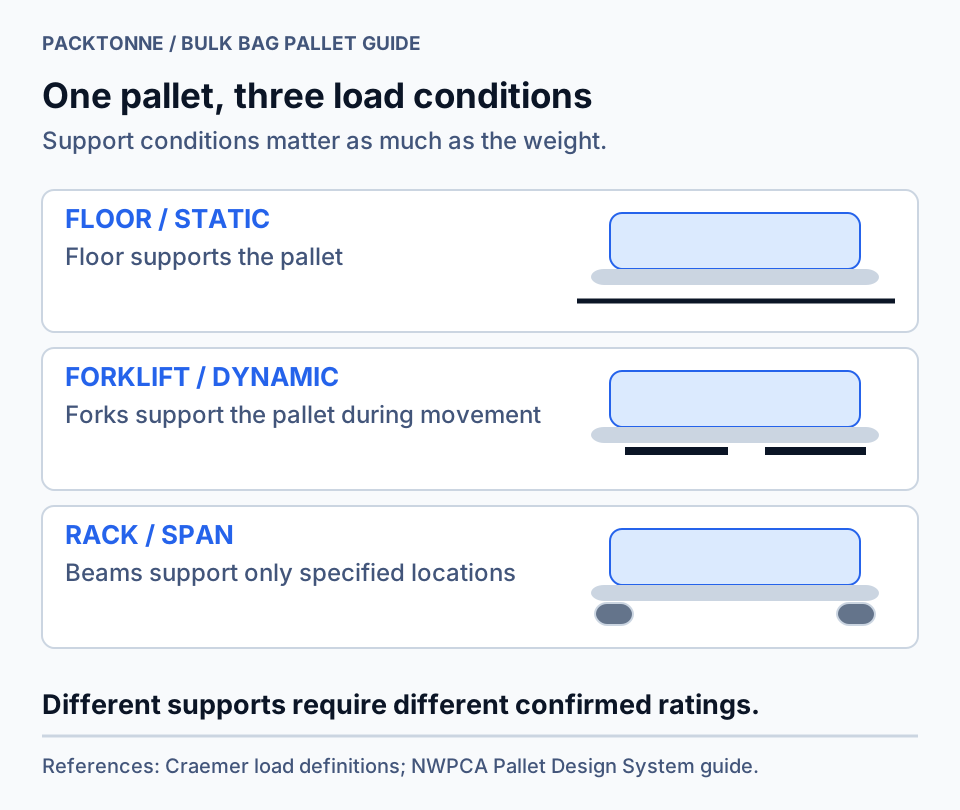
The NWPCA Pallet Design System guide ties pallet analysis to the load and support conditions specified by the preparer. For a wooden pallet proposal, request the design and relevant analysis rather than accepting a capacity statement detached from its application.
A useful inquiry describes the product, load distribution, storage duration, support locations and handling equipment. Ask the pallet supplier which conditions its recommendation covers. That gives the receiving team something concrete to check when a replacement pallet is proposed.
Calculate the complete handling load
Equipment carries the contents and all packaging that moves with them. As illustrative arithmetic, 1,000 kg of product plus a 5 kg bag and liner plus a 25 kg pallet equals a 1,030 kg handling load. Add other accessories where applicable.
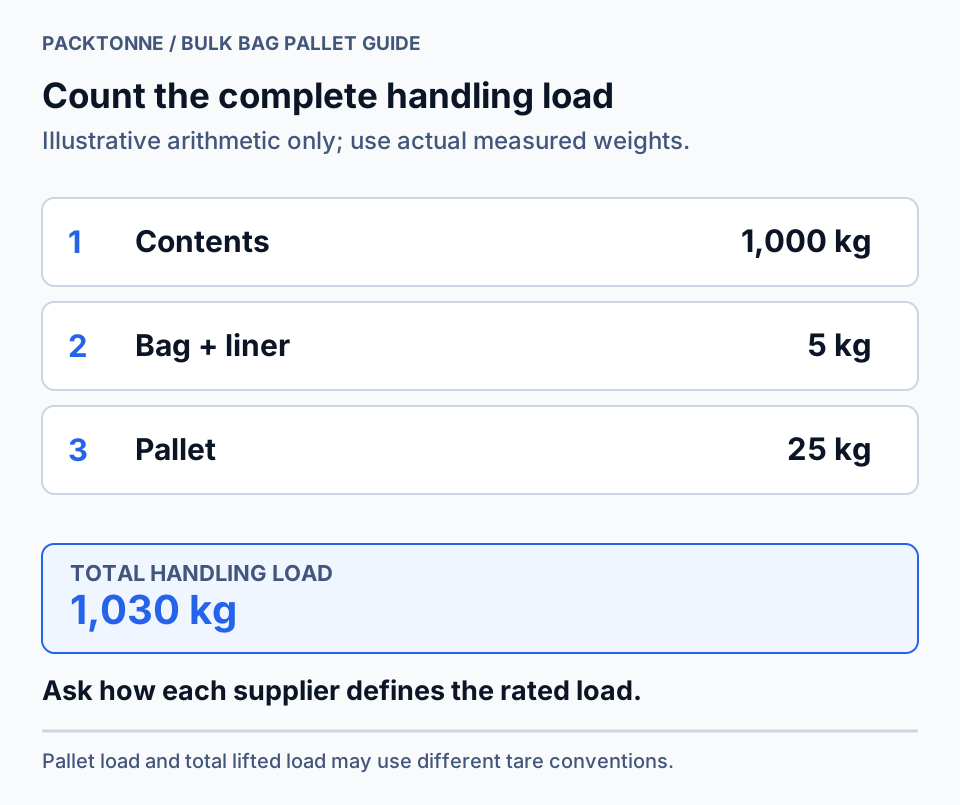
This total does not mean every supplier’s pallet payload field includes the pallet’s own tare. Ask how each rating is defined, then compare like with like. Keep the contents, bag and pallet weights as separate lines in the order.
Wood vs Plastic Pallets for Bulk Bags
The exact pallet design and operating requirements matter more than a general preference for wood or plastic.
Use this comparison as a purchasing checklist. Each point still needs confirmation for the proposed model and condition.
| Selection question | Wood pallet | Plastic pallet |
|---|---|---|
| Can it support this load? | Request design and application-specific assessment | Request the model’s relevant load ratings and conditions |
| What needs inspection? | Deck, joints, fasteners and previous repairs | Deck, feet or runners, cracks and wear |
| What does the destination require? | Check rules for regulated wood packaging | Confirm receiver acceptance and other shipment requirements |
| What does the operation require? | Agree condition and cleaning requirements | Agree cleaning method, surface and material requirements |
| Will it come back? | Price the agreed purchase, repair and return arrangement | Price the agreed purchase, return and inspection arrangement |
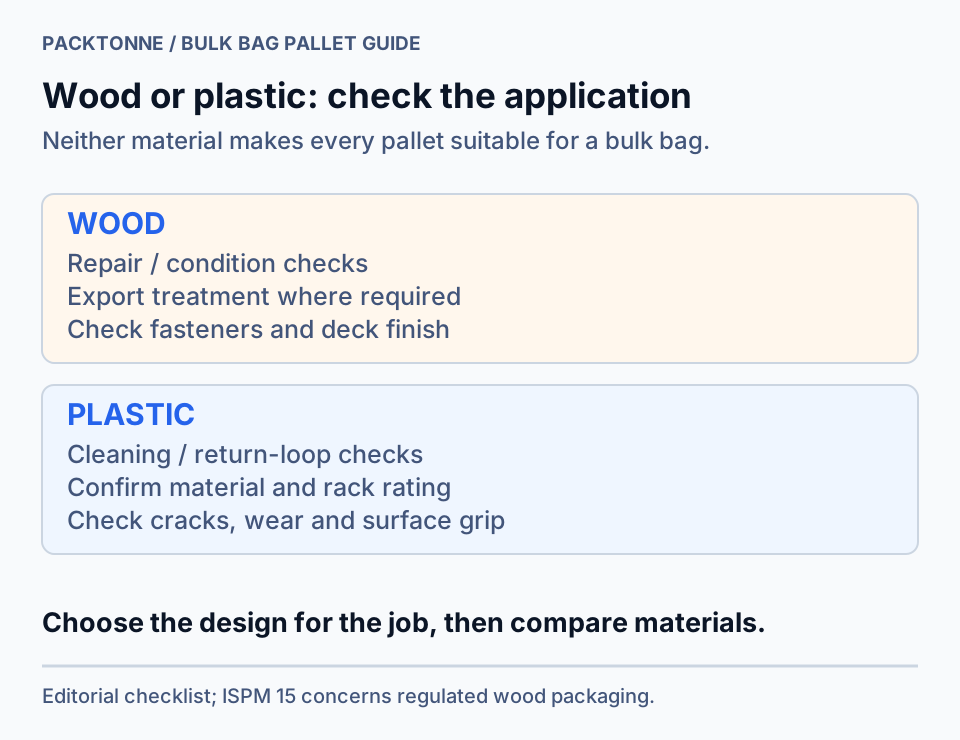
For US-bound cargo, APHIS wood-packaging guidance requires regulated wood packaging to be treated and certified under ISPM 15. The requirement concerns regulated wood packaging, not the woven PP bag. Check the destination’s rules and any applicable exemptions with the responsible shipping parties. A treatment mark does not establish the pallet’s structural capacity.
For a recurring order, compare the delivered arrangement rather than the empty pallet price alone. Include inspection, return transport, replacement availability and acceptance at the destination. If one supplier changes the pallet model between shipments, the earlier approval may no longer describe what arrives.
The Deck and Bag Bottom Must Work Together
The bag-to-deck interface needs review even when the pallet’s outer size and capacity appear suitable.
Look at the contact surface and the closure beneath the filled bag. Ask for the pallet deck drawing and the bag’s bottom detail. Record where a discharge spout is stowed and whether it contacts a gap, joint or projecting feature.
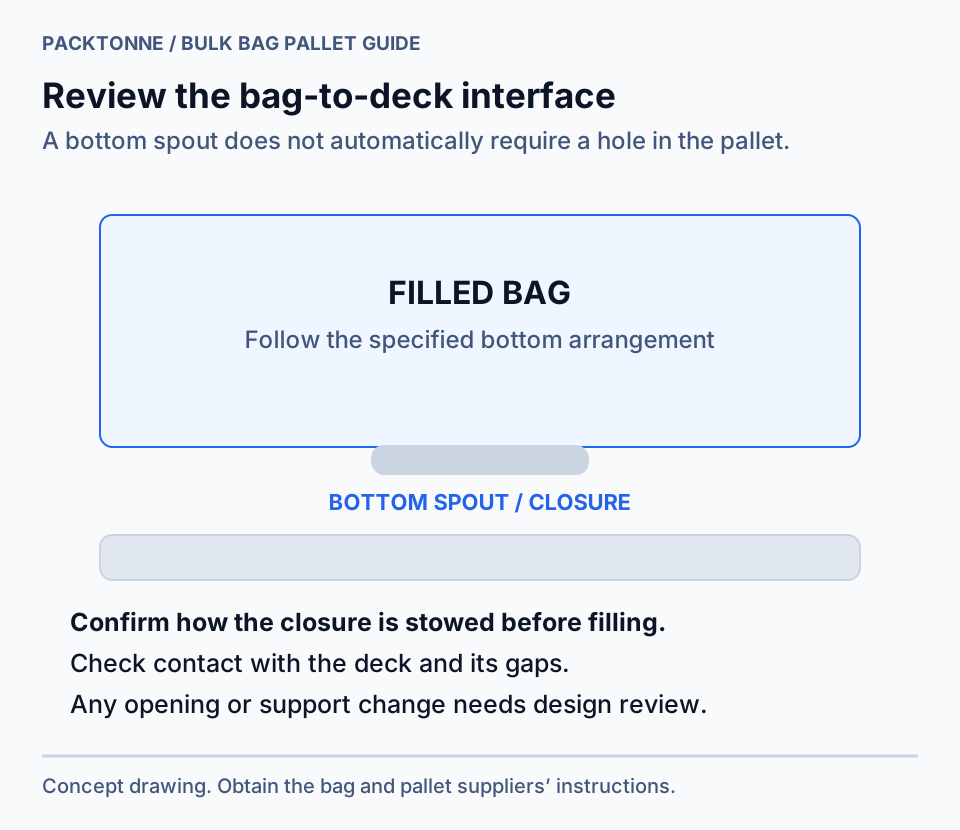
A bottom spout does not automatically mean the pallet needs a hole. The load may travel on its pallet and be transferred to discharge equipment later. Ask the bag supplier for the specified closure arrangement before deciding to alter the support.
If the operation requires access through the pallet, send that requirement to both suppliers. An opening changes the support geometry. A loose sheet or a cut-out should not be treated as an approved design modification without review. Describe the intended filling, transport and discharge sequence so the recommendation covers all three.
Baffle bags are worth evaluating when the filled profile needs to remain more square. Their construction does not approve a pallet, load rating or stack. For a straightforward non-hazardous application, Type A bulk bags may be considered, subject to the material’s handling requirements; the pallet cannot replace any required electrostatic protection.
Fork Access and Stacking Need Separate Checks
A suitable pallet still needs compatible equipment, and a palletized bag is not automatically stackable.
For base handling, provide the fork-entry direction, opening dimensions and handling equipment details. OSHA’s load-handling guidance explains that a forklift’s capacity is rated at a specified load center. An oversized or off-center load can exceed the truck’s effective capacity even when its mass appears below the headline rating.
OSHA’s load-composition guidance also identifies load size, position and weight distribution as factors in truck stability. Use the data plate and manufacturer instructions for the actual equipment. The pallet’s own rating cannot answer that equipment question.
If handling uses the bag’s loops instead, follow the specified lifting arrangement; pallet forks and loop lifting are separate methods. The FIBC loop types guide covers construction choices that need to match the lifting setup.
For stacking, establish whether upper loads rest on bags or are carried independently by a rack. FIBCA makes stacking conditional on the bag being designed for it and on a stable, specified arrangement. There is no universal layer count supplied by the words “one-ton bag” or “on a pallet.” Request the approved arrangement rather than transferring a lifting rating into a stacking permission.
Five Checks Before Ordering Pallets for Super Sacks
A useful purchasing specification matches the filled bag, pallet and handling route in writing.
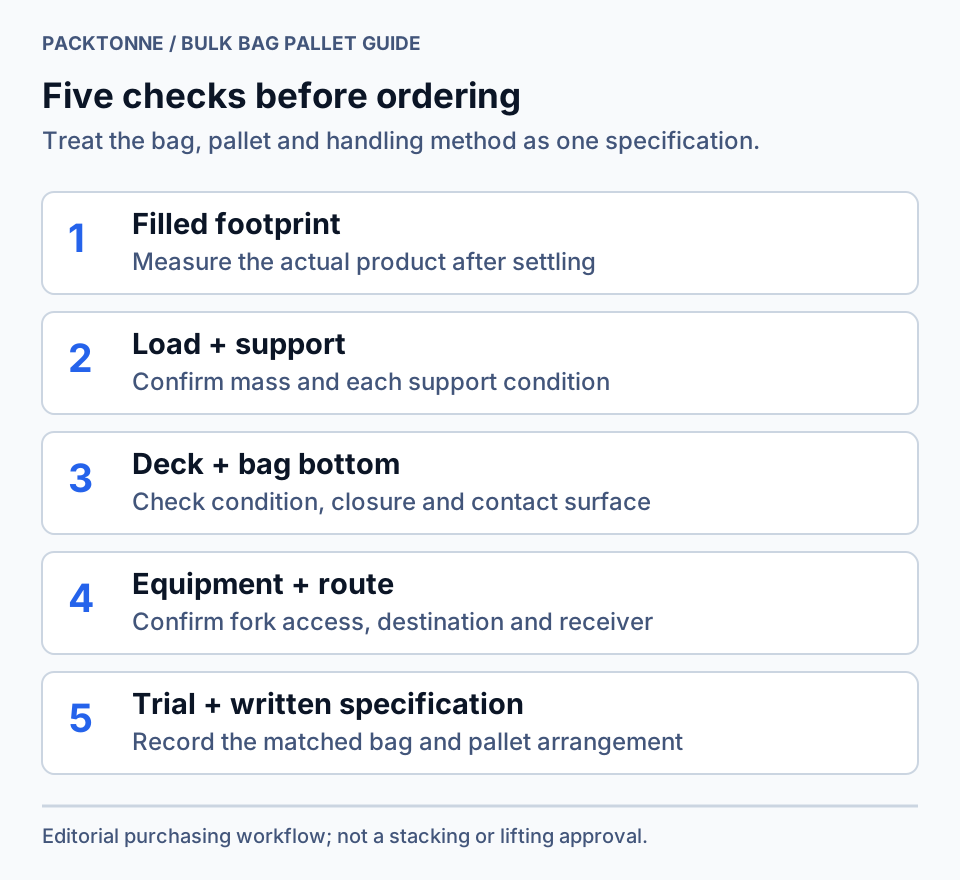
- Measure the filled load. Use the intended product, fill mass and settling conditions. Record the footprint, base contact and overall height, not just the empty bag dimensions.
- Define every load condition. Give the pallet supplier the load, storage duration and support arrangement. Request confirmation for handling and racking wherever those operations occur.
- Check the interface. Provide the deck drawing and bag-bottom detail. Resolve closure stowage and any proposed support modification before approving the order.
- Confirm the route. Check dispatch, transfers and arrival. Include equipment access, receiver acceptance and destination wood-packaging requirements where relevant.
- Trial and record the arrangement. Agree a representative trial with the responsible suppliers and site team. Keep the approved specifications, instructions and substitution limits with the order.
Final Thoughts
A super sack pallet is a component of a handling system. Start with the filled load and follow it through storage, movement and unloading; then select the supporting pallet. Keep size, support conditions, closures and equipment requirements in the same specification. When requesting a bag proposal from PackTonne, include the pallet and receiving-site details so the bag can be evaluated against the arrangement you actually intend to use.
Request a Bag Proposal for Your Pallet Setup
Send the product, bulk density, intended net fill mass, measured filled dimensions and pallet drawing. Add the handling equipment, storage method, destination and bottom-discharge requirements. If the receiver already specifies a pallet, include its model and operating instructions.
Contact PackTonne to discuss the bag specification for that setup. Confirm pallet capacity and equipment suitability with their respective suppliers before finalizing the combined arrangement.
Common Questions
Do super sacks need pallets?
Super sacks do not always need pallets, but the intended handling method must work without one. An FIBC can use its designated lifting arrangement where the manufacturer approves that use. A pallet is useful when the receiver moves loads by their base, or when storage and transport require that support. Confirm the complete route before ordering; removing the pallet at dispatch may create an unloading problem at arrival.
What super sack pallet size should I choose?
Choose a pallet against the bag's actual filled footprint and the equipment that will handle it. A nominal bag width is not enough: record the dimensions after filling with the intended product and allowing it to settle. Check both directions and the supporting deck layout. Give those measurements to the suppliers rather than assuming that a familiar warehouse pallet size fits every bulk bag.
Can you stack super sacks on pallets?
A pallet does not automatically make super sacks stackable. The proposed arrangement needs confirmation for the bag, pallet, contents and supporting structure. Specify whether an upper pallet rests on the lower bag or whether a rack carries the load independently; these are different cases. If the supplier has not approved the arrangement, do not invent a permitted number of layers from the bag's lifting label.
Is a pallet rated for one ton enough for a one-ton bag?
A one-ton rating is incomplete without its support and test conditions. Check whether it refers to floor storage, forklift handling or racking, and ask how the rated load treats packaging weight. Separately calculate the full load lifted by the equipment, including the bag, liner, pallet and accessories. Use the pallet specification and equipment data plate together rather than treating two similar numbers as approval.
Are wood or plastic pallets better for bulk bags?
Neither wood nor plastic is universally better for bulk bags. Compare the exact designs for support, load conditions, cleaning, destination requirements and return arrangements. For wood, inspect the deck and fasteners and check applicable export treatment. For plastic, inspect damage and confirm the relevant load rating. In either case, request the specification for your application; material choice alone cannot establish strength or hygiene suitability.
Does a bottom-spout bulk bag need a pallet with a hole?
A bottom-spout bag does not automatically require a pallet with a hole. The closure may be stowed against the base in a specified arrangement, with discharge performed later at suitable equipment. Ask the bag supplier how the closure should sit during filling and transport. If access through the pallet is required, have its support and strength reviewed; cutting an opening changes the original pallet design.
Can I use a slip sheet instead of a pallet?
A slip sheet can be considered only as part of a handling system designed for it. It does not reproduce a pallet's fork openings or rigid support. Confirm the sheet, bag and equipment arrangement at dispatch and at every transfer point, including the receiver. If the receiver has ordinary pallet forks but no compatible handling method, replacing the pallet with a sheet can prevent normal unloading.
More in Handling & Equipment
All Handling & Equipment guides- Bulk Bag Dispenser: 5 Bag Specs That Decide Whether the Hopper WorksA bulk bag dispenser only works when the bag fits it. Check the spout, body size, loops, closure and liner before you buy, or expect slow, messy emptying.
- Bulk Bag Filling: Why Most Filler Problems Start With the BagBags that lean, leak dust or won't seat on the hooks are usually a spec problem, not a machine fault. Check loops, spout, size, static type and liner first.
- Where to Sell Used Super Sacks (and the 5 Checks That Decide the Price)Selling used super sacks? Buyers price on previous contents, cleanliness, rating, volume and storage. See who buys, why bags get rejected and what to send.
- Bulk Bag Unloaders: Why the Bag Spec Matters More Than the FrameMost bulk bag unloader problems start at the bag, not the frame: loops that hang the spout short of the clamp, spouts too narrow for the valve, liners that drag.