What Is an FIBC Bulk Bag? A Buyer's Starting Guide
FIBC means Flexible Intermediate Bulk Container — a woven PP bag moving 500–3000 kg of dry product. Here's how it works and what to check before buying.
PackTonne Sourcing Desk · · 7 min read
FIBC stands for Flexible Intermediate Bulk Container — a large woven polypropylene bag built to move 500–3000 kg of dry bulk product between a producer and a processor, or a processor and an end user. “Flexible” distinguishes it from rigid containers; “intermediate” places it between small retail packaging and full bulk tank transport. Everything else — static class, liner, certification, loop type — is a decision layered on top of that basic definition.
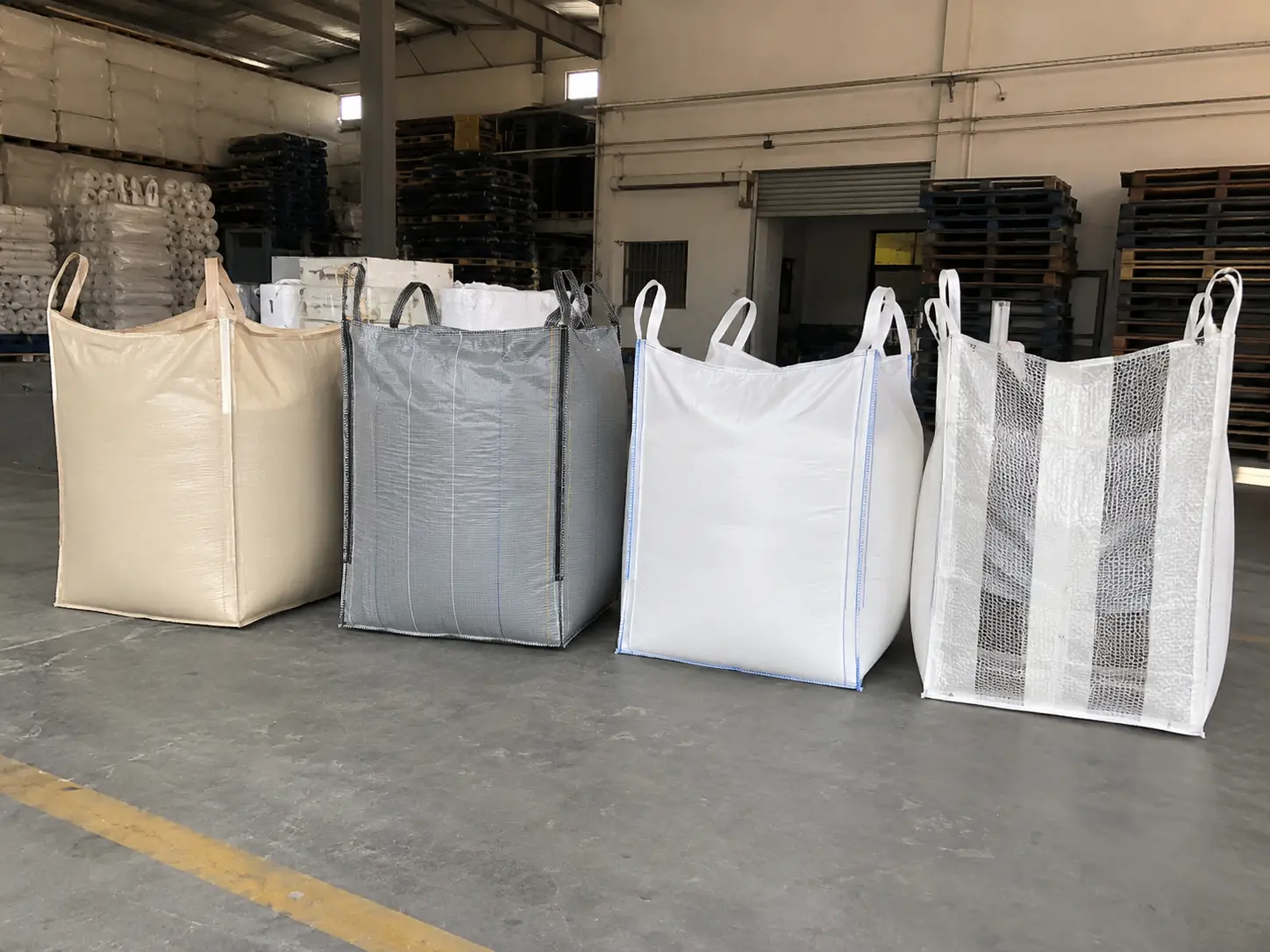
FIBC at a Glance
| Component | What it is | Learn more |
|---|---|---|
| Base fabric | Woven polypropylene, 140–210 g/m² | What is woven polypropylene? |
| Capacity | Typically 500–3000 kg, 1 ton most common | 1 ton bags explained |
| Dimensions | Roughly 90×90×110 cm, varies by capacity | Dimensions guide |
| Static protection | Type A (none) through D (dissipative) | Static protection guide |
| Fill/discharge style | Duffle, spout, or open top; spout or flat bottom | Filling & discharge guide |
| Full type range | Standard, anti-static, food grade, UN certified, baffle, ventilated | Types of FIBC bags |
The Full Form of FIBC
The full form of FIBC is Flexible Intermediate Bulk Container. Each word carries meaning: flexible distinguishes it from rigid drums and IBC totes, intermediate places it between a sack and a shipping container in scale, and bulk container describes what it does. The abbreviation is what appears on spec sheets, test certificates and customs paperwork, so it is worth recognising in full even if nobody says it aloud. It also explains a listing term you will meet in catalogues — bulk bag containers — which is the full name collapsed back into everyday words rather than a different product.
What FIBC Replaced
Before FIBC became the dominant bulk packaging format, dry bulk products commonly moved in smaller sacks requiring far more individual units per shipment, or in rigid containers and drums that didn’t collapse for return shipping and took up significant space whether full or empty. FIBC’s combination of high per-unit capacity, low empty-weight, and flat-folding collapsibility made it more efficient across nearly every stage of the supply chain — filling, transport, storage, and empty-container return.
That collapsibility is worth underlining, since it’s easy to overlook next to capacity and cost: an empty FIBC folds down to a small fraction of its filled volume, which meaningfully reduces freight and storage costs for empty units compared to rigid alternatives. This single property is a large part of why FIBC scaled globally rather than remaining a regional or niche packaging choice.
How an FIBC Is Built
An FIBC starts as polypropylene resin extruded into tape and woven on a circular loom into seamless tubular fabric, then cut into panels and sewn with reinforced stitching at the load-bearing loops and seams. Lifting loops — most commonly four, one per corner — attach at the top for forklift or crane handling. Depending on the product it’s built for, a liner may be fitted inside for moisture or contamination protection, and the fabric may include a coating, static-dissipative threads, or additional certification testing. See our manufacturing process guide for the full production sequence.
What FIBC Bags Are Used For
FIBC bags move dry bulk products across a wide range of industries: minerals and construction aggregates, agricultural products like grain and fertilizer, chemical powders and granules, food and feed ingredients, and industrial materials like plastic resin. The right construction depends heavily on the specific product — a non-combustible mineral needs none of the static protection a fine combustible chemical powder requires, and a food ingredient needs contamination controls a construction aggregate doesn’t. See our guide on FIBC for chemical powders, granules and flakes if you’re sourcing for a specific chemical product and unsure which spec applies.
The common thread across every application is the same: FIBC replaces smaller, less efficient packaging with a single container sized to move a meaningful quantity of product per lift, per fill cycle, and per shipment — which is why it became the default across such a wide range of industries rather than staying a niche solution for one sector.
Types of FIBC Bags
Six main categories cover nearly every application: standard (Type A) bags for non-combustible products, anti-static Types B/C/D for combustible powders and solvent environments, food grade bags for food and pharmaceutical ingredients, UN certified bags for regulated hazardous goods, baffle bags for tighter container and pallet stacking, and ventilated bags for products like firewood and produce that need continued airflow. Full breakdown in our types of FIBC bags guide, which also links to each dedicated product page.
Key Specs to Check Before You Buy
Beyond capacity and dimensions, confirm the safety factor (5:1 single-trip or 6:1 multi-trip) matches your reuse plans, the static protection class matches your product’s actual combustibility risk, and any certification — UN hazardous goods or food grade — matches your regulatory requirements. Our spec sheet guide covers all eight fields worth checking on any quote before comparing suppliers.
FIBC vs Other Bulk Packaging
FIBC isn’t the only bulk packaging option — rigid corrugated Gaylord boxes remain common for domestic, indoor, dry-goods handling, particularly in closed-loop reuse programs. See our bulk bags vs Gaylord boxes comparison for when each format actually makes sense; the short version is that FIBC generally wins for export shipping and specialty compliance needs, while Gaylord boxes can suit short-haul domestic operations well.
Where to Learn More
This site covers FIBC specs and selection in depth — start with whichever matches your actual question:
- New to sourcing? Start with how to import bulk bags from China
- Deciding between new and secondhand bags? See new vs used bulk bags
- Vetting a supplier before ordering? Use the manufacturer audit checklist
- Curious about pricing? Read the FIBC price guide
- Not sure which terminology you’re seeing — super sack, jumbo bag, FIBC? Check what is a super sack
Final Thoughts
Nearly every FIBC decision traces back to one question: what’s going in the bag. Flammability, moisture sensitivity, hazard class and particle size determine the static class, liner, coating and certification — and only then do capacity and dimensions follow. Tell us what you’re packing and roughly how much, and we’ll work forward from there rather than asking you to pick from a catalogue.
Before You Request a Quote
Send us these basics and we’ll help you work out the rest of the spec:
- Product type and target weight per bag
- Whether the product is combustible, food-contact, or hazardous
- Single-trip or multi-trip use
- Destination and any market-specific compliance needs
Request a quote and we’ll walk through the full spec with you from this starting point.
Common Questions
What does FIBC stand for?
Flexible Intermediate Bulk Container. Each word describes a property: flexible distinguishes it from rigid containers, intermediate places it between small retail packaging and full bulk tank transport, and container is the general descriptive term.
What is an FIBC bag used for?
Moving 500–3000 kg of dry bulk goods — minerals, agricultural products, chemicals, food ingredients, construction materials — between a producer and a processor, or a processor and an end user, more efficiently than small retail-size packaging.
What's the difference between an FIBC and a bulk bag?
None — they're the same product. FIBC is the formal technical term used in standards and certifications; bulk bag is the common generic term used in everyday conversation, particularly in North America.
How much weight can an FIBC bag hold?
Typically 500–3000 kg, with 1000 kg (1 ton) and 1500 kg (1.5 ton) the most common capacities. The right capacity depends on your product's bulk density and your site's handling equipment, not a single default number.
Is an FIBC bag reusable?
It depends on the construction. Single-trip bags are tested and rated for one use at a 5:1 safety factor; multi-trip bags are built and tested for repeated use at a 6:1 safety factor. Using a single-trip bag for multiple trips means operating outside its tested conditions.
How much does an FIBC bag cost?
There's no single price, because cost follows spec rather than capacity. Fabric weight, safety factor, static class, liner, certification and printing each move the number independently, and the gap between a basic and a fully specified bag of the same size can be substantial. Compare quotes line by line, not by headline price.
What's the first thing to decide when specifying a bulk bag?
What's going inside it. Product flammability, moisture sensitivity, hazard classification and particle size drive almost every other decision — static class, liner, coating and certification all follow from the material. Capacity and dimensions come second, once you know the bulk density.
More in FIBC Basics
All FIBC Basics guides- FIBC vs IBC Totes: Your Product State Decides ThisIBC totes are built for liquids, FIBC bags for dry solids. They rarely compete — except in the narrow band where your product is neither.
- Bulk Bags vs Gaylord Boxes: Which Fits Your Supply Chain?Gaylord boxes suit domestic, indoor, dry-goods handling. FIBC bags fold flat, resist moisture and scale to export. Here's when each one wins.
- What Is a Super Sack? FIBC vs Bulk Bag vs Jumbo Bag ExplainedSuper sack, FIBC, bulk bag and jumbo bag all describe the same product. Here's where each term comes from and why suppliers use them differently by region.
- Types of FIBC Bags: A/B/C/D, Baffle, Food Grade ExplainedSix FIBC types cover nearly every bulk product. Which one you need depends on what's inside the bag — flammability, moisture, hazard class — not price.