FIBC Bag Repair: Where the Damage Is Beats How Big
Not every damaged bag needs retiring, but not every tear is patchable either — the deciding factor is where the damage is, not just how big it looks.
PackTonne Sourcing Desk · · 6 min read
Not every damaged bag needs retiring, but not every tear is patchable either — the deciding factor is where the damage is relative to the bag’s load-bearing points, not just how big the tear looks. A small tear near a seam can mean retirement, while a larger surface puncture away from any critical point might be a reasonable repair candidate. A tear near a seam retires the bag; the same tear mid-panel often does not.
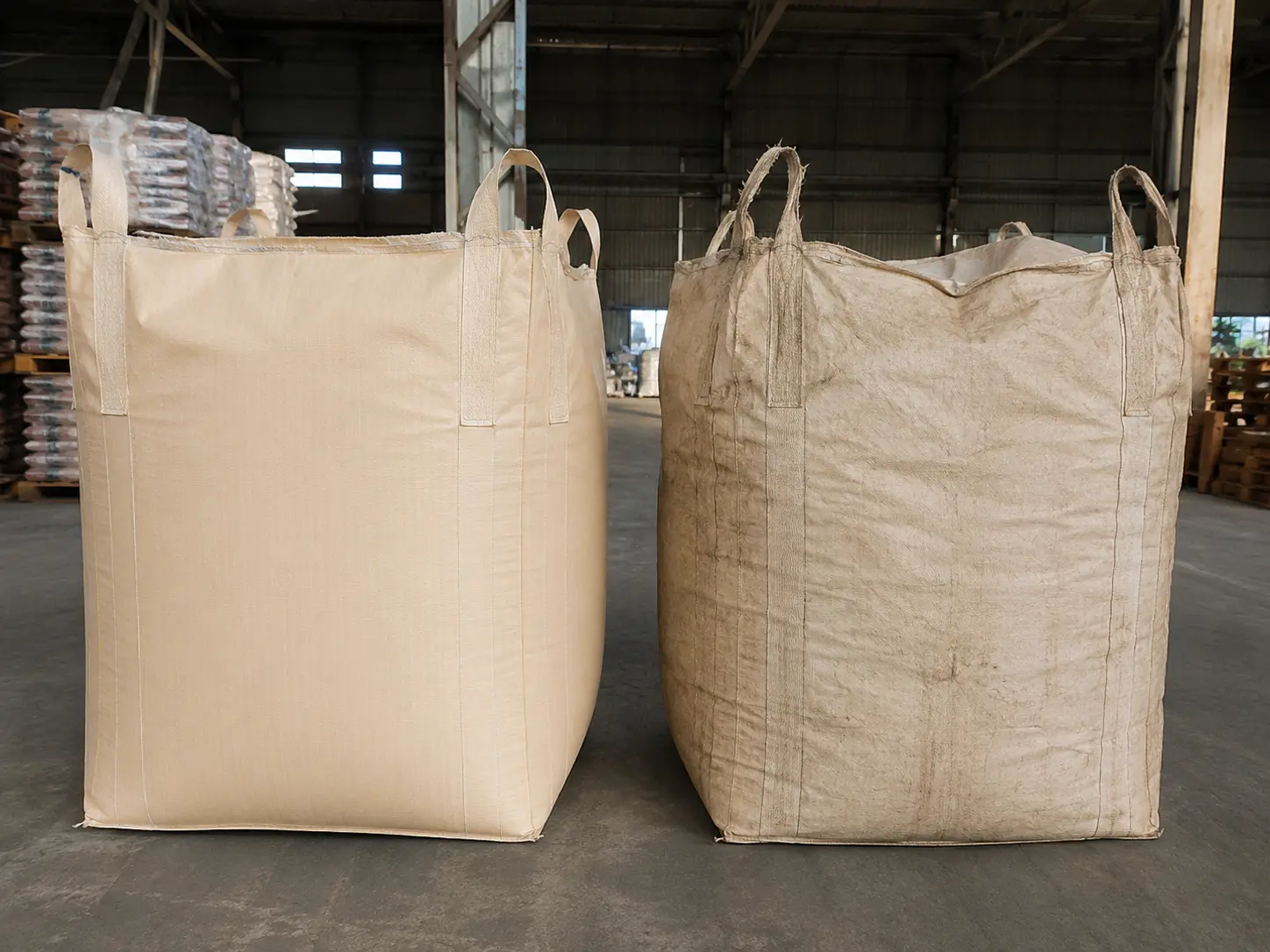
Patch vs Retire at a Glance
| Damage type | Location | Decision |
|---|---|---|
| Surface puncture, clean cut, small tear | Away from seams and loops | Reasonable repair candidate |
| Any damage to a load-bearing seam | Seam | Retire — don’t repair |
| Torn or frayed lift loop | Loop | Retire — don’t repair |
| Burst discharge spout | Spout | Retire — don’t repair |
| Tear extending near a critical seam | Near seam | Retire — don’t repair |
| Extensive surface cracking network | Across the body | Retire — past safe working life |
What Can Reasonably Be Patched
Surface punctures, clean cuts, and small tears — generally under about 4 inches — located away from seams and lift loops are reasonable repair candidates, since the damage doesn’t compromise a structural load path. The location relative to load-bearing points matters more than raw size: a small tear that’s crept toward a seam is a bigger concern than a larger puncture safely in the middle of a side panel.
What Means Immediate Retirement
Damage to any load-bearing seam, a torn or frayed lift loop, a burst discharge spout, or a tear extending into the body near a critical seam all mean retirement, not repair — these are structural failure points where a surface patch doesn’t address the underlying loss of integrity. A bag showing extensive wear across its whole body, like a network of surface cracks, has also passed its safe working life regardless of whether any single point looks patchable in isolation. Treat these as non-negotiable, not judgment calls to weigh against convenience.
Pre-Repair Inspection: Look Beyond the Obvious Tear
Before deciding to patch, lay the bag flat on a clean surface and examine both the inside and outside in good light, checking for issues beyond the visible damage that prompted the inspection — abrasion wear elsewhere on the bag, UV degradation showing as powdery surface residue (chalking), or chemical contamination that may have weakened fabric in ways that aren’t obvious from a quick glance. A bag with one visible tear and hidden UV or abrasion damage elsewhere isn’t a good repair candidate even if the original tear itself would have been patchable on its own.
A Patched Bag Needs a Downgraded Duty Cycle
A repaired bag shouldn’t be treated as restored to its original rated capacity — it should be downgraded from its original duty cycle, used for lighter, non-critical loads, and monitored more closely than an undamaged bag for the remainder of its service life. This is consistent with how safety factor actually works: a repair addresses the visible damage but doesn’t restore the fabric and stitching to their original tested condition, so the remaining safety margin should be treated as reduced, not equivalent to a new bag.
Only Multi-Trip Bags Are Candidates for Repair
Only bags designed and rated for multiple uses — 6:1 safety factor construction — are legitimate candidates for patching and continued reuse. A single-trip (5:1) bag was never tested or built for the fatigue a second use introduces, and patching a tear doesn’t change that underlying design limitation. See our new vs used bags guide for the broader reasoning behind why single-trip construction shouldn’t be reused regardless of apparent condition.
Common Mistakes in Repair Decisions
- Judging repair candidacy by tear size alone. A small tear near a seam is a bigger problem than a larger puncture safely away from any load-bearing point.
- Patching a single-trip bag because it “still looks fine.” Single-trip construction was never designed for a second use, repaired or not.
- Treating a patched bag as restored to full original capacity. Downgrade duty cycle and monitor more closely — a repair doesn’t undo fabric and stitching fatigue.
- Stopping inspection at the obvious damage. Related issues elsewhere on the bag — UV chalking, abrasion, contamination — change whether a repair is actually a good idea.
- Repairing seam, loop, or spout damage instead of retiring the bag. These are structural failure points a surface patch doesn’t fix, regardless of how minor the visible damage looks.
When Replacement Is Simply the Better Call
For operations weighing repair against replacement at any real volume, it’s worth stepping back from the per-bag decision: if a significant share of your inventory needs repair, that’s often a signal your bags are reaching the end of their service life as a batch, not an argument for repairing each one individually as damage appears. At that point, planning a replacement order — possibly with a construction or fabric weight adjustment based on what’s actually been failing — is usually more efficient than an ongoing cycle of individual repairs.
Decision Checklist
- Is the damage located away from seams and lift loops? Location matters more than size for the patch-or-retire decision.
- Have you inspected beyond the obvious damage for UV degradation, abrasion, or contamination? Hidden weakening elsewhere changes the calculus even for an otherwise patchable tear.
- Is the bag rated for multi-trip use (6:1 safety factor)? Single-trip bags aren’t legitimate repair candidates regardless of damage type.
- Are you prepared to downgrade a patched bag’s duty cycle? A repair reduces remaining safety margin — plan usage accordingly.
- Does any damage touch a seam, loop, or spout? Any of these means retirement, not a judgment call.
Final Thoughts
The useful discipline here is treating location as the first question and size as the second. A written rule — seams, loops and spouts retire the bag, mid-panel damage under a few inches is assessable — takes the judgment out of a moment when nobody has time for judgment. If a meaningful share of your stock is reaching this decision, the more efficient answer is usually a replacement order. Tell us what’s failing and we’ll spec against it.
Before You Request a Quote
If you’re evaluating whether to repair existing inventory or replace it, tell us your situation:
- Bag construction — single-trip or multi-trip rated
- Damage type and location
- Typical remaining use plans if repaired
- Whether replacement volume makes more sense than repair
Request a quote if replacement is the right call, or consult a qualified inspector for repair decisions on bags already in service.
Common Questions
What kind of damage can be patched on a bulk bag?
Surface punctures, clean cuts, and small tears — generally under about 4 inches — located away from seams and lift loops are reasonable repair candidates. The location of the damage relative to load-bearing points matters more than the size alone.
What damage means a bag should be retired, not repaired?
Any damage to a load-bearing seam, a torn or frayed lift loop, a burst discharge spout, or a tear extending into the body near a critical seam means retirement, not repair. These are structural failure points that a surface patch doesn't actually fix.
Can single-trip (5:1) bags be patched and reused?
No — only bags designed and rated for multiple uses, meaning a 6:1 safety factor, are legitimate candidates for repair and continued use. A single-trip bag was never tested or built for the fatigue a second use introduces, patched or not.
Does a patched bag carry the same rated capacity as before?
No — a patched bag should be downgraded from its original duty cycle and used for lighter, non-critical loads, monitored more closely than an undamaged bag. Treat a repair as reducing the bag's remaining safety margin, not restoring it to full original spec.
What should I check before deciding whether to patch a bag?
Inspect the bag on a flat surface in good light, both inside and out, looking beyond the obvious tear for related issues — abrasion wear, UV degradation (visible as powdery surface residue), or chemical contamination that may have weakened the fabric elsewhere.
Who should make the patch-or-retire call on a busy site?
Someone trained to read the criteria, not whoever is handling the bag at the time. The decision hinges on damage location relative to load paths, which is a judgment call that degrades badly under production pressure. Write the criteria down and name who owns the call.
Is repair tape strong enough for a load-bearing repair?
No, and it isn't meant to be. Repair tape closes a surface breach on a non-critical panel; it restores containment, not structural strength. Any damage sitting in a load path is a retirement decision regardless of what tape could cosmetically cover.
More in Handling & Equipment
All Handling & Equipment guides- Bulk Bag Unloaders: Why the Bag Spec Matters More Than the FrameMost bulk bag unloader problems start at the bag, not the frame: loops that hang the spout short of the clamp, spouts too narrow for the valve, liners that drag.
- Bulk Bag Stands: How to Fill a Super Sack Without a MachineA bulk bag stand holds the empty bag open and square. It cannot weigh the fill — and a bag shovelled to the brim with sand can be well over its rating.
- Super Sack Racks: Why the Bag Spec Decides Which Rack WorksRack vendors sell capacity and stack height. What they rarely mention is the bag — its filled footprint, shape and bottom decide whether any rack works.
- How to Empty a Bulk Bag Safely: Plan for the Flow StoppingDischarge methods get chosen for how material flows when everything works. The injuries happen in the next ten minutes, when it stops and someone intervenes.