Bulk Bags for Fertilizer: Why NPK Blends Cake Faster Than Urea
Fertilizer caking is set by critical relative humidity, not by bag quality. Blended NPK absorbs moisture at humidity levels where straight urea stays dry.
PackTonne Sourcing Desk · · 8 min read
Fertilizer does not cake because the bag was cheap. It cakes because the air sealed in with it sat above the product’s critical relative humidity. That number is a property of the formulation, not of the packaging — and for blended products it lands far lower than most buyers expect, which is why a bag that works for straight urea fails on NPK from the same warehouse.
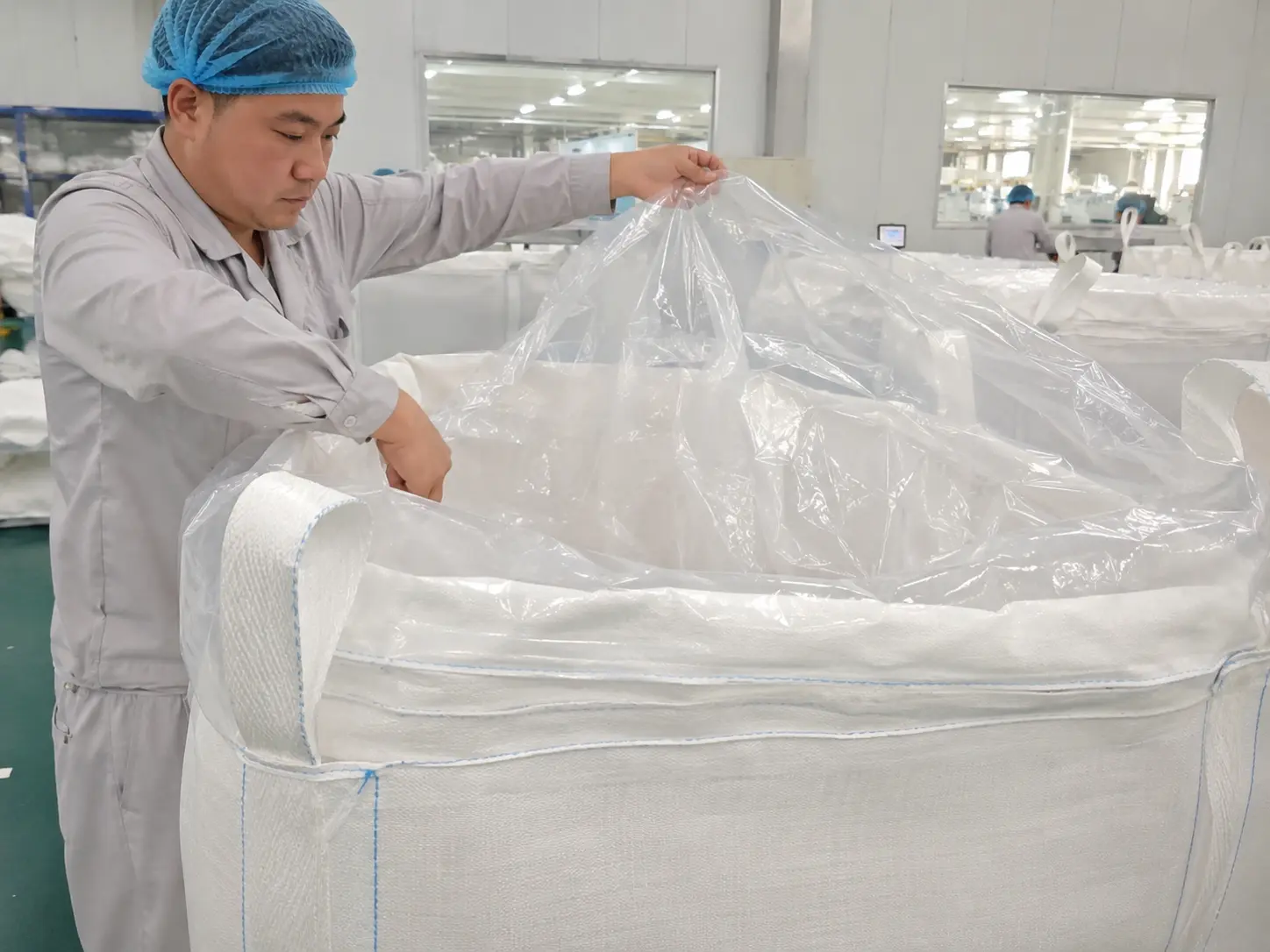
Why Fertilizer Cakes Inside a Sealed Bag
Caking starts when a hygroscopic product absorbs water vapour from the air around it, dissolving slightly at the granule surface and then recrystallising as conditions change — welding neighbouring granules into a solid mass. The trigger is ambient humidity crossing the product’s critical relative humidity, the threshold above which it pulls moisture from the air rather than sitting in equilibrium with it.
This reframes what packaging is doing. The bag is not keeping moisture away from a dry product; it is holding a fixed parcel of air around the product for the length of the journey. Fill a bag on a humid morning and seal it, and that humid air travels with the load. A perfect moisture barrier locks the problem in as effectively as it locks the weather out.
It is worth separating this from the other moisture problem in bulk bags. Cement and dry mortar react with water chemically and set hard — the damage is irreversible and a small amount of water ruins the load. Fertilizer caking is physical: the granules dissolve slightly and recrystallise into a mass that can often be broken up and used. That difference changes the target. With cement you are excluding water absolutely; with fertilizer you are managing a humidity threshold, and the acceptable level depends on a number you can look up.
Critical Relative Humidity: The Number That Picks Your Liner
CRH values are published chemistry, measured at a reference temperature — commonly 30°C. Widely cited industry reference figures:
| Product | Approximate CRH at 30°C |
|---|---|
| Urea | ~72% |
| Ammonium nitrate | ~59% |
| Ammonium sulphate | ~79% |
| DAP | ~78% |
| Urea + ammonium nitrate blend | ~18% |
Read the last row again. A blend of two products sitting at 72% and 59% behaves as though its threshold were 18% — meaning it absorbs moisture in almost any ambient air it will ever meet.
Blending Drops CRH Below Either Ingredient
Mixing two soluble salts produces a mixture whose CRH is lower than that of either component alone. Each salt’s dissolved ions increase the total solute concentration available at the granule surface, and the mixture holds a saturated solution at a humidity where neither pure component would.
The practical consequences run against intuition:
- A warehouse humidity level that is safe for straight urea can be well above a urea-based blend’s threshold
- Two products that each ship without incident can cake severely once blended
- Adding a third component usually lowers the threshold further, not partway back
This is why “we’ve shipped fertilizer in these bags for years” is not evidence that the spec fits a new blended grade. The bag did not change. The chemistry did.
Coating, Liner, or Both
| Coated fabric only | Liner only | Coated + form-fit liner | |
|---|---|---|---|
| Fabric moisture path | Blocked | Open | Blocked |
| Seam moisture path | Open | Blocked | Blocked |
| Closure integrity | Depends on top type | Sealed if tied | Sealed |
| Suits CRH above ~70% | Often adequate | Adequate | Adequate |
| Suits CRH below ~40% | No | Marginal | Required |
| Adds discharge complexity | No | Slight | Slight |
Coating alone leaves the seams open, which is the detail that catches buyers out — a coated bag is not a sealed bag. The full comparison of coated vs uncoated FIBC fabric covers what the coating does and does not do, and FIBC liner types covers form-fit versus loose liners for products that need a genuine barrier.
Two operational points matter more than the specification itself. Close the bag at the filling head, not at the end of the shift — an open bag in a humid plant is absorbing moisture the whole time it waits. And where the route involves temperature cycling, expect condensation inside the liner as warm air cools against the fabric overnight, which is a separate mechanism from ambient absorption and is worse on ocean freight than in static storage.
When a Fertilizer Becomes Dangerous Goods
Dangerous goods classification follows the formulation, not the product category. Many ammonium nitrate based fertilizers are regulated under IMDG and ADR, with the threshold depending on nitrogen content and what else is in the blend; urea and most straight NPK grades are not regulated at all. Some jurisdictions add national controls on top of the international codes, and those vary widely.
The practical rule: get the classification for your exact formulation from your shipper or a dangerous goods consultant before a bag is specified. If the product is regulated, it needs a UN certified bulk bag with the correct marking, and no amount of moisture protection substitutes for that. The UN 13H1–13H4 marking codes explain what the certification covers once you know you need it.
Do not take this article, or any supplier, as the source of that determination. Formulations that look similar on a spec sheet fall on different sides of the line.
Your Decision Checklist
- Do you know the CRH of the exact grade you are shipping, not the category? For a blend, ask the formulator — it will not be the average of the components.
- What is the ambient humidity at your filling point, not your warehouse? Whatever the air holds at the moment of closure travels with the load for the whole journey.
- Does your route cross temperature zones or involve ocean freight? Cycling drives condensation inside the bag independently of the humidity you sealed in.
- Is the bag closed at the filling head or later? A form-fit liner and a coated fabric are wasted on a bag that stood open for two hours in a humid plant.
- Has anyone confirmed whether your formulation is regulated for transport? Settle this before the bag spec, because a positive answer overrides every other decision here.
Final Thoughts
The useful question is not whether your fertilizer needs a good bag. It is what number your product’s critical relative humidity actually is, and whether the air you seal in sits above or below it. Get that figure for the grade you are shipping, tell us the route and the filling conditions, and the coating and liner specification follows from it directly — including the cases where a plain coated bag is genuinely enough.
Send the formulation, its CRH if the formulator has published one, your filling location and destination port, and whether the product is classified for transport. That is what we need to specify the barrier and confirm whether baffle construction earns its place on your container loading.
Common Questions
How do you keep fertilizer from caking in bulk bags?
Keep the air around the product below its critical relative humidity. In practice that means a sealed barrier — a coated fabric plus a form-fit polyethylene liner — closed immediately after filling, not at the end of the shift. Once ambient air has been sealed in above the product's CRH, the bag holds the problem inside rather than keeping it out.
Why do blended fertilizers cake faster than single-nutrient products?
Because mixing two soluble salts lowers the critical relative humidity of the mixture below either ingredient on its own. Urea sits near 72% and ammonium nitrate near 59%, but a blend of the two can fall to roughly 18%. The blend absorbs moisture in air where both original components would have stayed dry.
Do fertilizer bulk bags need UN certification?
Some do. Classification follows the shipping regulations for your specific formulation, not the word fertilizer. Several ammonium nitrate based blends are regulated under IMDG and ADR, while urea and most NPK grades are not. Confirm the classification for your exact formulation with your shipper before specifying a bag.
Is a coated bag enough, or do I need a liner as well?
Coating alone slows moisture ingress through the fabric but does nothing about the seams and the closure. For a hygroscopic product with a low CRH, a form-fit polyethylene liner plus coated fabric is the working combination. For a stable product in a dry climate on a short route, coating alone is often sufficient.
Does temperature change how fast fertilizer cakes?
Yes, in two ways. Critical relative humidity itself falls as temperature rises, so a product that is stable at 20°C may not be at 35°C. Temperature cycling also drives condensation inside a sealed bag as warm humid air cools against the fabric at night, which is why ocean freight is harder on fertilizer than static storage.
Can I ship fertilizer in ventilated bulk bags?
No. Ventilated construction is designed for products that need airflow, such as firewood and root vegetables. Fertilizer needs the opposite: a sealed barrier against ambient humidity. Specifying a ventilated bag for a hygroscopic product guarantees the failure you are trying to prevent.
Why does caked fertilizer damage the bag and not just the product?
A caked load stops behaving like a granular solid. It bridges instead of flowing at discharge, so operators cut, drop or beat the bag to release it, and the loops take shock loads they were never rated for. The product damage is recoverable by crushing; a bag that has been dropped to break a bridge is not reusable.
More in Applications
All Applications guides- Hemp Super Sacks: You're Buying Volume, Not StrengthDried hemp biomass is so light a super sack fills at under a fifth of its rating. Size the bag for volume, and seal it only once drying has finished.
- Super Sack Cofferdams: The Bag Holds Weight, Not WaterA super sack cofferdam is a mass structure, not a seal. Woven polypropylene seeps, so the bag supplies ballast and a separate membrane has to stop the water.
- Bulk Bags for Coffee Beans: The 12% Moisture ProblemGreen coffee is not a dry cargo. It ships in a narrow moisture band, and the real threat in a container is condensation putting water back into the bean.
- Dewatering Bulk Bags: The One FIBC Built to Let Water OutEvery other bulk bag keeps moisture away from the product. A dewatering bag does the opposite — and specifying it with coated fabric guarantees it will fail.