Sandbags for Flooding: Why Most Barriers Fail and How to Build One That Holds
Sandbags slow floodwater, they do not stop it. See why barriers fail, how full to fill the bags, how to stack them and where the agency guidance disagrees.
PackTonne Sourcing Desk · · 9 min read
Sandbags slow floodwater and redirect it. They do not stop it. The US Army Corps of Engineers says sandbags do not guarantee a watertight seal, and the UK Environment Agency says they seep even when well stacked. The agency guidance puts most of its attention on how the bags are filled and stacked, and that is where barriers go wrong. Get those two things right and a sandbag line can buy real time.
What Sandbags Can and Cannot Do
Sandbags are a short-term tool for slowing, diverting and weighing down, not a permanent flood wall. The US Army Corps of Engineers’ Sandbagging Techniques pamphlet lists uses such as preventing overtopping of levees, directing a river’s current, building ring dikes around boils and weighing down plastic sheeting or straw bales.
| Sandbags can | Sandbags cannot |
|---|---|
| Slow water and keep it out for short periods | Guarantee a watertight seal |
| Divert flow and weigh down sheeting | Be placed easily in running water |
| Filter out some muddy sediment | Last indefinitely if left in place |
| Be stockpiled empty for years if kept dry | Match purpose-made flood products |
The UK Environment Agency’s guidance is blunter: sandbags are relatively ineffective compared with purpose-designed flood protection products, and it takes about an hour to fill 12 of them.
Why Sandbag Barriers Fail
The guidance warns against five mistakes, and all five are about handling.
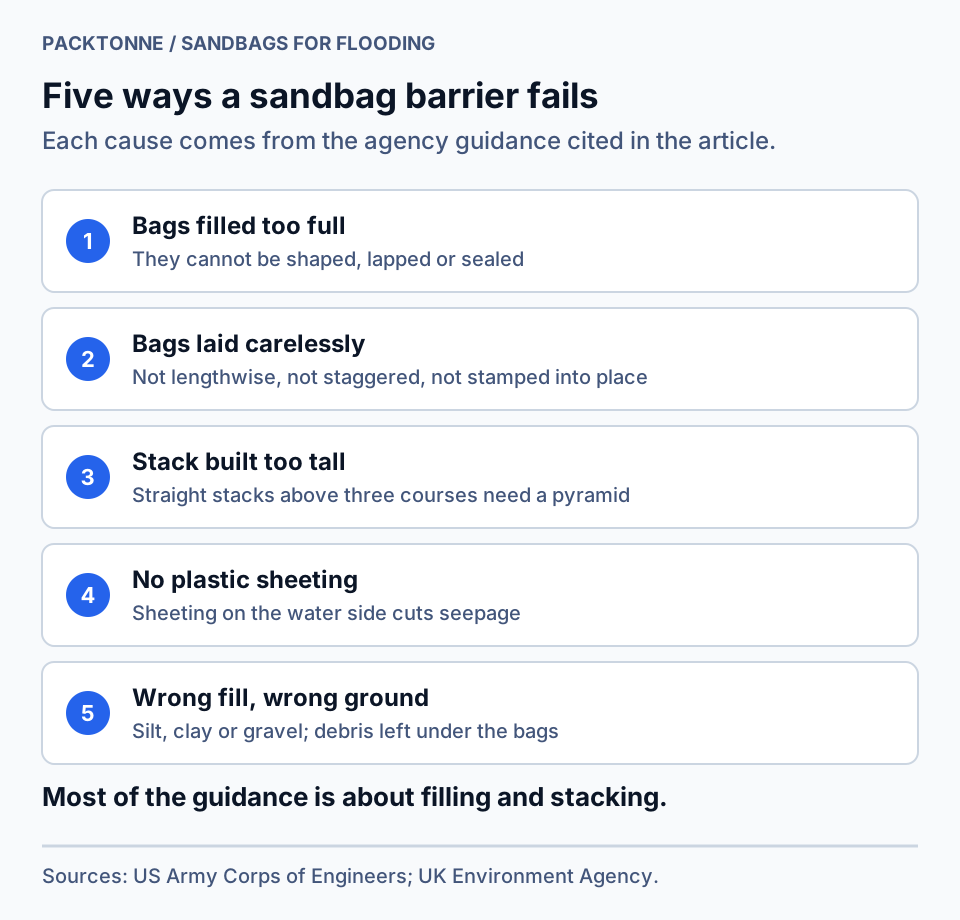
- Bags filled too full. They cannot be shaped, lapped or sealed. The Corps says untied bags should be filled one-half to two-thirds full.
- Bags laid carelessly. Lay them lengthwise, parallel to the flow, with joints staggered and each bag compacted by walking on it.
- Stack built too tall. The Corps says a straight stack is generally not recommended above three courses. Go higher with a pyramid.
- No plastic sheeting. The Environment Agency says sheeting on the water side improves how long a wall keeps water out.
- Wrong fill or ground. Clear debris first. Sand works best; silt, clay and gravel each cause problems.
How Full to Fill the Bags
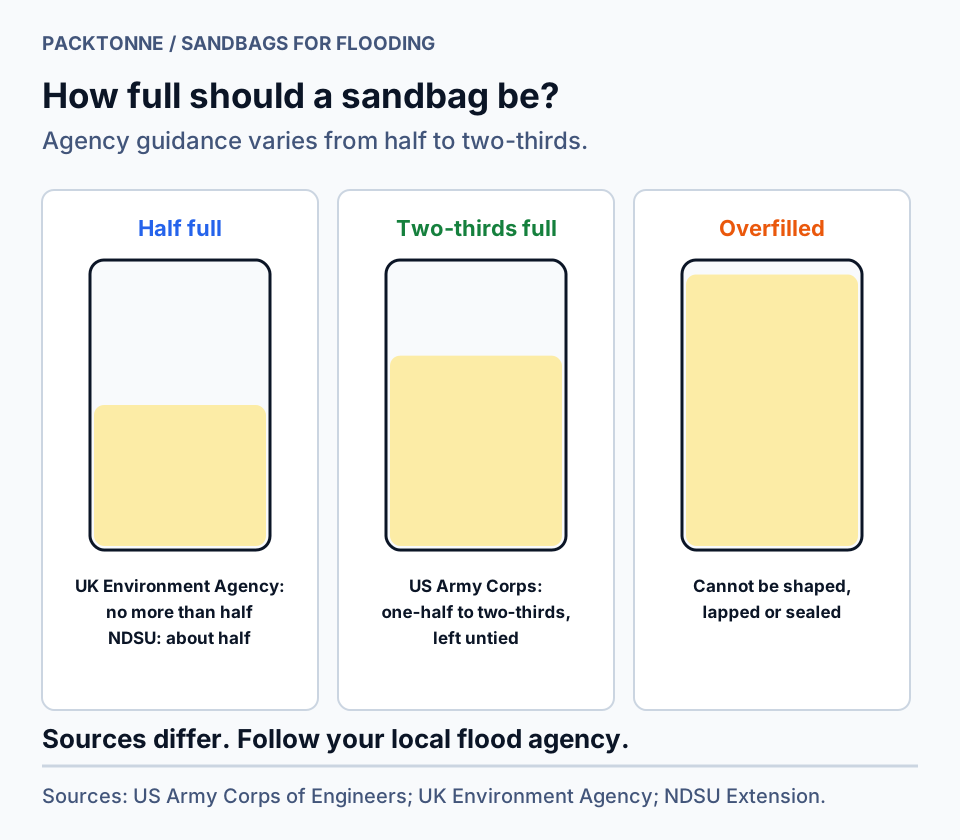
Agencies give different fill levels, so follow your local flood agency’s handout. The sources agree that an overfilled bag is the problem, but not on the exact fraction.
| Source | Fill level |
|---|---|
| UK Environment Agency | No more than half full; no need to tie |
| NDSU Extension | About half full; tie near the top only if needed |
| US Army Corps of Engineers | One-half to two-thirds full, left untied |
How to Fill and Stack
Filling is a two- or three-person job, and the steps below come from the Corps pamphlet and the Environment Agency.
- Fold the bag opening outward about 1–1½ inches to form a collar, so it stays open while it is filled.
- Clear debris from the placement area. Fill the low spots first.
- Lay bags lengthwise, parallel to the direction of flow, starting about 1 foot landward of the water’s edge, with the folded ends facing upstream.
- Overlap each bag with the previous one, and offset each row by half a bag length to avoid continuous joints.
- Compact each bag by walking on it, so voids close and the top flattens.
- Add plastic sheeting on the water side if the wall will stand for long, weighed down with extra bags.
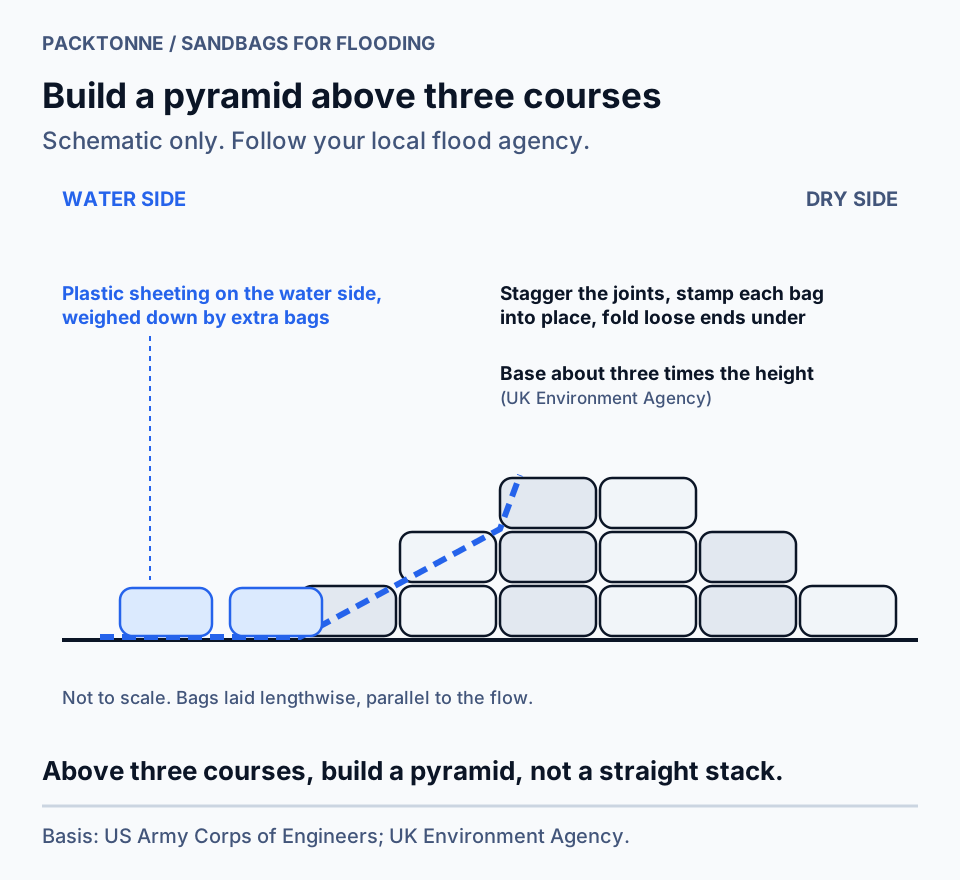
For height, build a pyramid. The Corps gives a rule of thumb: three bags in height equals about 1 foot, and three bags in width equals about 2.5 feet. The Environment Agency says to make the wall three times as wide as it is high. It also says a wall about 60 cm high and 1 m long takes roughly 80 filled bags, which is a useful planning figure.
The Bag and the Fill
Sand is the best fill, and the bag matters less than how it is filled. The Corps pamphlet describes bags of treated burlap or plastic measuring about 14 inches wide and 24 inches long, and says sand is by far the easiest material to fill and shape. Silty soils get soft when wet and leak fines, clay is hard to shape, and gravel is pervious.
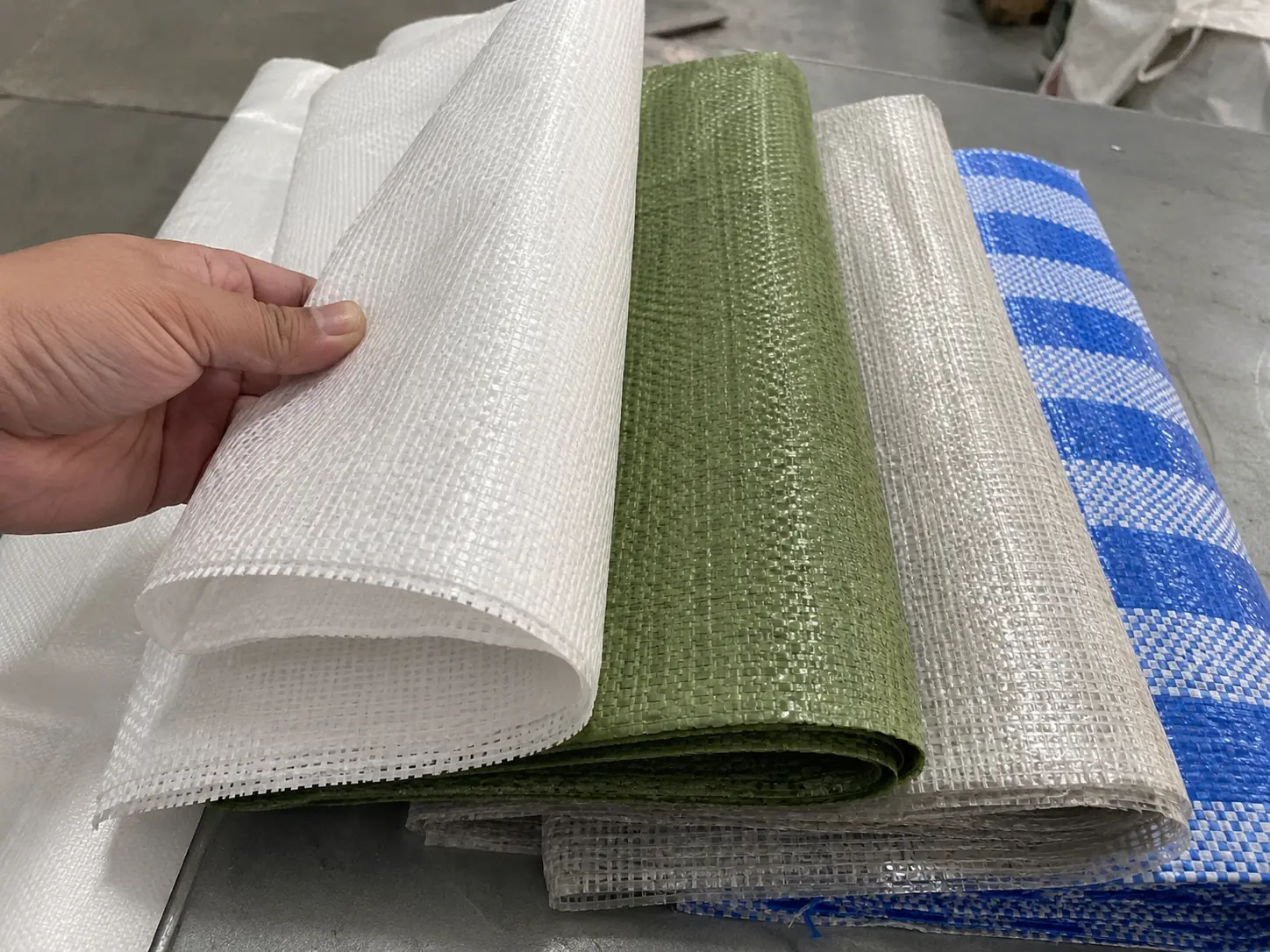
Sacking material is biodegradable and perishes if left in place, according to the Environment Agency. Woven polypropylene bags do not rot, but polypropylene degrades in sunlight unless it is UV-stabilized, so a bag left outdoors for months is a different case from one used for a week. Our guides to what woven polypropylene is and UV resistance in FIBC bags explain the difference.
What to Check Before You Buy
If you buy sandbags for a municipality, an emergency stockpile or resale, check these before you order.
- Bag size. Sources describe about 14 × 24 inches. Confirm the size you receive.
- Material and treatment. Burlap, plastic or woven polypropylene each behave differently in storage and in use.
- UV exposure. Stored outdoors or deployed for weeks, an unstabilized bag will weaken.
- Closure. Many programs leave bags untied. If you need tied bags, say so.
- Quantity per wall. Use the Environment Agency figure of about 80 bags per 60 cm × 1 m as a starting estimate and add a margin.
- Storage. Keep empty bags dry and out of the sun.
When to Use Something Else
For larger or longer jobs, sandbags are not the best tool. The Corps lists straw bales, concrete barriers and plastic sheeting as alternatives, and the Environment Agency encourages purpose-made flood protection products. For temporary water control with larger bags, see our guide to a super sack cofferdam, which explains why a bulk bag barrier needs a membrane.
Your Sandbag Checklist
- If you are unsure of the right fill level, you should follow your local flood agency’s handout.
- If the wall will be more than three courses high, you should build a pyramid, not a straight stack.
- If the wall will stand for days, you should add plastic sheeting on the water side.
- If you are stockpiling bags, you should keep them dry and out of the sun.
- If the water is deep or fast, you should not rely on sandbags alone.
Final Thoughts
Sandbags work when they are filled to a sensible level, laid lengthwise and staggered, compacted, and kept within the height a straight stack can take. They do not make a watertight wall, and no guidance claims they do. If you are specifying sandbags for stock or resale, send us the use, the quantity and the storage conditions.
Before You Request a Quote
If you are sourcing sandbags, send us these details:
- The use: emergency stock, municipal supply or resale
- Quantity and delivery destination
- Bag size, closure and outdoor storage needs
- Whether UV protection matters
We will confirm what the partner factory can supply for that specification and what to verify.
Common Questions
Do sandbags stop flooding?
No. Sandbags slow and redirect water, and they do not guarantee a watertight seal. The US Army Corps of Engineers calls them a proven deterrent that does not guarantee a watertight seal, and the UK Environment Agency says they seep water even when well stacked. Use them to buy time, not as a permanent flood wall.
How full should a sandbag be?
Agencies differ. The UK Environment Agency says no more than half full. NDSU Extension says about half full. The US Army Corps of Engineers says one-half to two-thirds full for untied bags. All agree on one point: an overfilled bag cannot be shaped or lapped. Follow your local flood agency's handout.
How many sandbags do I need?
As a planning figure, the UK Environment Agency says a wall about 60 cm high and 1 m long takes roughly 80 filled sandbags. The US Army Corps of Engineers gives pyramid dimensions as a rule of thumb: three bags in width equals about 2.5 feet and three bags in height about 1 foot. Add a margin and check with your local agency.
How high can sandbags be stacked?
The US Army Corps of Engineers says a straight stack is generally not recommended above three courses, about 1 foot, unless there is no flow, debris or wave action. For more height, build a pyramid. The UK Environment Agency says to use a base three times as wide as the wall is high.
Should I put plastic sheeting under or over sandbags?
Sheeting improves a sandbag barrier. The UK Environment Agency advises laying heavy plastic on the water side of the wall and weighing it down with extra bags, and says sandbags can keep water out for short periods, which sheeting improves. The Corps also describes plastic sheeting as an effective addition.
What should I fill sandbags with?
Sand. The US Army Corps of Engineers calls sand by far the easiest material to fill and shape, and notes it gets heavier when saturated. Silty soils get soft and leak fines through the weave, clay is hard to shape and bag, and coarse gravel lets water seep through. Use other materials only when sand is not available.
How long do empty sandbags keep in storage?
The US Army Corps of Engineers says unused empty bags can be stockpiled and stay serviceable for years if kept dry and properly stored. The UK Environment Agency warns that sacking material is biodegradable and will perish if left in place for a long time. Polypropylene bags degrade in sunlight unless stabilized, so store them out of the sun.
More in Applications
All Applications guides- Hemp Super Sacks: You're Buying Volume, Not StrengthDried hemp biomass is so light a super sack fills at under a fifth of its rating. Size the bag for volume, and seal it only once drying has finished.
- Super Sack Cofferdams: The Bag Holds Weight, Not WaterA super sack cofferdam is a mass structure, not a seal. Woven polypropylene seeps, so the bag supplies ballast and a separate membrane has to stop the water.
- Bulk Bags for Coffee Beans: The 12% Moisture ProblemGreen coffee is not a dry cargo. It ships in a narrow moisture band, and the real threat in a container is condensation putting water back into the bean.
- Dewatering Bulk Bags: The One FIBC Built to Let Water OutEvery other bulk bag keeps moisture away from the product. A dewatering bag does the opposite — and specifying it with coated fabric guarantees it will fail.