How Much Does a Sandbag Weigh? Typical Filled Weights and Why Fill Level Changes the Answer
Flood agencies plan around about 30 lb (14–15 kg) per filled sandbag; about 40 lb is what most people can carry. See what changes the weight and how to plan.
PackTonne Sourcing Desk · · 6 min read
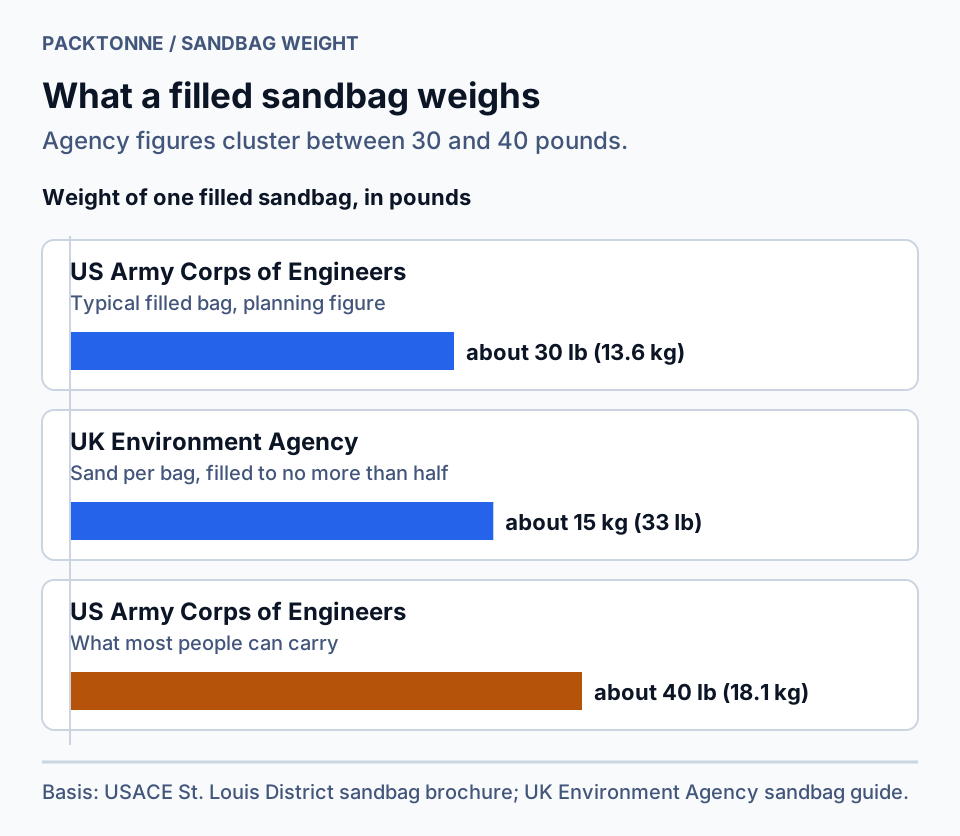
Flood agencies plan around about 30 lb (about 14 kg) per filled sandbag. The US Army Corps of Engineers says most people can carry a bag of about 40 lb, and the UK Environment Agency says each bag needs about 15 kg of sand. The real weight depends on the bag, how full it is, what is in it and whether it is wet.
What the Agencies Say
Two flood agencies give the numbers most often used for planning.
| Source | Weight or fill | Fill level |
|---|---|---|
| US Army Corps of Engineers, St. Louis District | About 30 lb per bag; most people can carry about 40 lb | Untied bags about two-thirds full; bags 55–60% full give the best engineering properties |
| UK Environment Agency | About 15 kg of sand per bag (about 33 lb) | No more than half full |
The two sit close together. They differ on fill level, a disagreement covered in our guide to sandbags for flooding.
What Changes the Weight
Four things move the weight of one bag.
- Fill level. A bag filled to half holds less than one filled to two-thirds. Both agencies say not to overfill.
- Bag size. The Corps describes the most common bags as treated burlap sacks of about 24 by 14 inches. Larger or smaller bags change what a given fill level holds.
- Fill material. The Corps says sandy soil is the most desirable fill. Clay is hard to fill and shape, and gravel is too pervious and hard to shape.
- Moisture. The Corps says sand adds weight when it becomes saturated. A planning figure for dry bags does not cover wet ones.
Why Not Fill It to the Limit
Both agencies point away from heavier bags. The Environment Agency says bags get heavy quickly and warns against overfilling them or filling them far from where they will be placed. The Corps notes that most people can carry about 40 lb. An overfilled bag is also harder to shape and lap, which is why guidance caps the fill level.
Planning Numbers
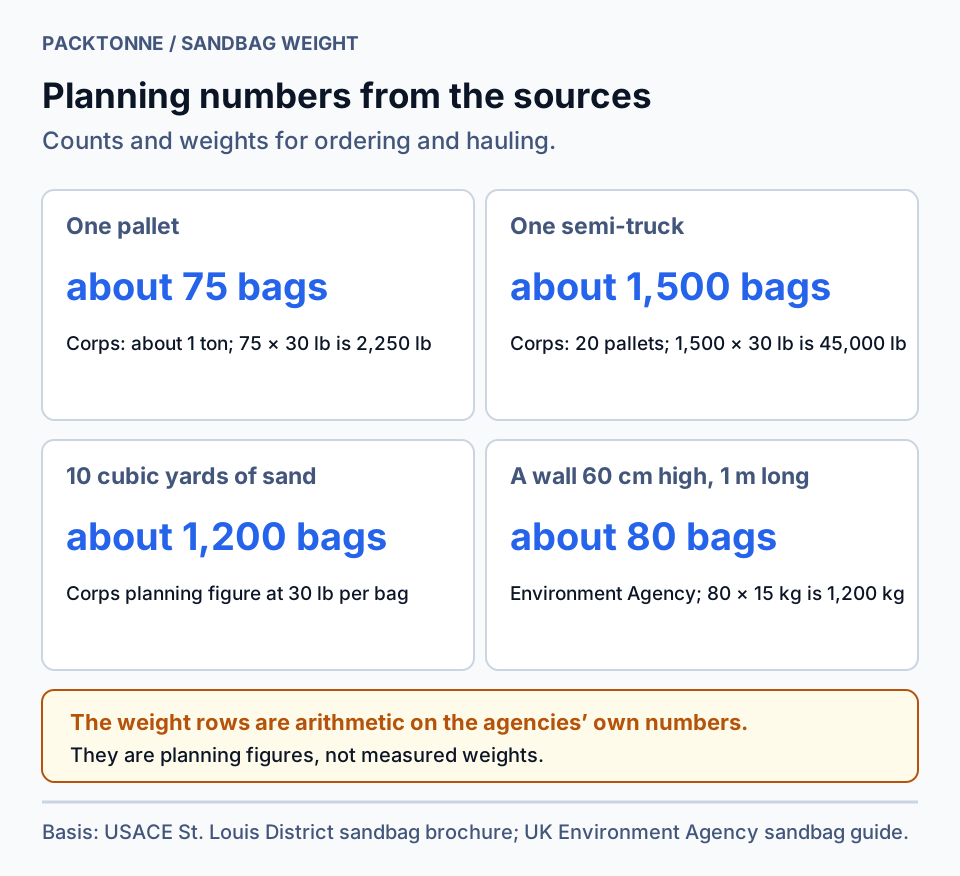
The Corps gives counts for ordering and hauling. These are planning figures, not measured weights.
| Quantity | Figure | Source |
|---|---|---|
| One pallet | About 75 bags, about 1 ton | Corps |
| One semi-truck | About 1,500 bags, 20 pallets | Corps |
| 10 cubic yards of sand | About 1,200 bags at 30 lb per bag | Corps |
| A wall 60 cm high and 1 m long | About 80 filled bags | Environment Agency |
Arithmetic on those numbers gives a few totals. 75 bags at 30 lb is 2,250 lb, which the Corps rounds to about 1 ton. 1,500 bags at 30 lb is 45,000 lb, close to the working payload range in our guide to how many bulk bags fit on a truck. 80 bags at 15 kg is 1,200 kg of sand for one short wall.
How to Find the Weight of Your Own Bags
Do not rely on a table for a purchase or a haul.
- Fill a sample bag to the fill line you plan to use, with the material you plan to use.
- Weigh it, dry and, if the bags may get wet, after soaking.
- Check the units in any figure you read. Pounds and kilograms, cubic yards and cubic meters are easy to mix up.
- Multiply by the number of bags, then check the total against your truck or your lifting limit.
When a Bulk Bag Is Easier
For a large fill, a bulk bag holds the sand of many sandbags. A 1,000 kg bag holds about as much as 67 bags at the Environment Agency’s 15 kg, and a 2,200 lb bag about as much as 73 bags at the Corps’ 30 lb, before counting the weight of the bags themselves. Bulk bags are lifted by machine, not by hand, and our guide to a bulk bag cofferdam shows how they are used as a temporary barrier. Our 1 ton bag guide explains the ratings.
Your Sandbag Weight Checklist
- If you need a planning figure, you should use about 30 lb (14–15 kg) per filled bag and confirm it with a sample.
- If bags may get wet, you should weigh a soaked sample.
- If people will carry the bags, you should stay under the 40 lb the Corps says most people can carry.
- If you are ordering for a wall, you should start from the Environment Agency’s 80 bags per 60 cm by 1 m wall and add a margin.
- If you are hauling, you should convert the bag count to weight and check it against the truck.
Final Thoughts
A filled sandbag weighs about 30 lb on an agency planning figure, and the 40 lb mark is where most people stop being able to carry it. The rest depends on how full it is, what it holds and whether it is wet. Weigh a sample, check the units and plan the total.
Before You Request a Quote
If you are moving large quantities of fill and are considering bulk bags, send us these details:
- What you are filling and its bulk density, if known
- The weight you need per bag and how the bags will be lifted
- Quantity and destination
We will check them against a 1 ton bulk bag construction and tell you what to confirm.
Common Questions
How much does a sandbag weigh?
A filled sandbag is usually planned at about 30 lb (about 14 kg). The US Army Corps of Engineers uses 30 lb in its planning figures and says most people can carry a bag of about 40 lb. The UK Environment Agency says each bag needs about 15 kg of sand. The actual weight depends on bag size, fill level, the fill material and moisture.
How much does an empty sandbag weigh?
The agency guides used for this article give no figure for an empty bag. An empty bag weighs very little next to its fill, so the fill sets the weight. If you need the figure for shipping or tare weight, ask the bag maker for it in writing.
How much does a wet sandbag weigh?
More than a dry one. The Corps says sand adds weight when it becomes saturated. It gives no figure for a wet bag, so weigh a sample if you need one. Do not assume the planning figure of 30 lb still holds once the bags are soaked.
How much sand goes into a sandbag?
The Environment Agency says about 15 kg per bag, filled to no more than half. The Corps says to fill untied bags about two-thirds full. Agencies differ on fill level, so follow the guidance from your own flood authority and stop well short of a bag too heavy to lift and lap.
How many sandbags are in a ton?
The Corps describes one pallet of about 75 bags as about 1 ton. At its own planning figure of 30 lb per bag, 75 bags weigh 2,250 lb, and a plain 2,000 lb divided by 30 lb gives about 67 bags. Treat it as roughly 65 to 75 bags, depending on the bag weight you actually use.
How many sandbags do I need for a wall?
The Environment Agency says a wall up to 60 cm high and 1 m long takes about 80 filled bags. At its figure of 15 kg per bag, that is about 1,200 kg of sand. The Corps' pamphlet gives other planning figures for longer dikes. See our flood guide for how to stack and place them.
How heavy is too heavy for a sandbag?
The Corps says most people can carry a bag of about 40 lb. The Environment Agency warns that bags get heavy quickly and says not to overfill them or fill them far from where they will be placed. An overfilled bag is also harder to shape and lap, so it works worse.
More in Applications
All Applications guides- Military Sandbags: What the Spec Actually Requires“Military grade” on a sandbag is not a certification. See what A-A-52142 requires, what the cancelled MIL spec added and how to check a listing against both.
- Sandless Sandbags: Where Water-Activated Bags Work, and the 4 Places They Don'tSandless sandbags store light and swell in minutes, but not in salt water, deep water or a second flood. See where they work and where sandbags still win.
- UV Resistant Sandbags: What “1,600 Hours” on the Label Actually MeansSandbag listings quote 1,600, 2,000 or 4,000 UV hours with no test method. See what a real UV test measures, why black differs from white and what to ask.
- Sandbags for Flooding: Why Most Barriers Fail and How to Build One That HoldsSandbags slow floodwater, they do not stop it. See why barriers fail, how full to fill the bags, how to stack them and where the agency guidance disagrees.