Bulk Bags for Resin: The Static Risk Pneumatic Fill Adds
Pneumatic conveying builds far more static than gravity fill, and molding-grade resin needs cleanliness a standard bag doesn't give. Spec for both.
PackTonne Sourcing Desk · · 6 min read
Plastic resin and pellets combine two risks most bulk products don’t share at the same time: static charge generated by pneumatic conveying systems, and contamination sensitivity for resin feeding directly into molding processes. Getting the FIBC spec right means addressing both, not just picking a bag rated for the resin’s basic combustibility. A resin that looks harmless under gravity fill can behave very differently through a conveying line.
Resin-Specific Spec Considerations
| Factor | Why it matters for resin | Typical approach |
|---|---|---|
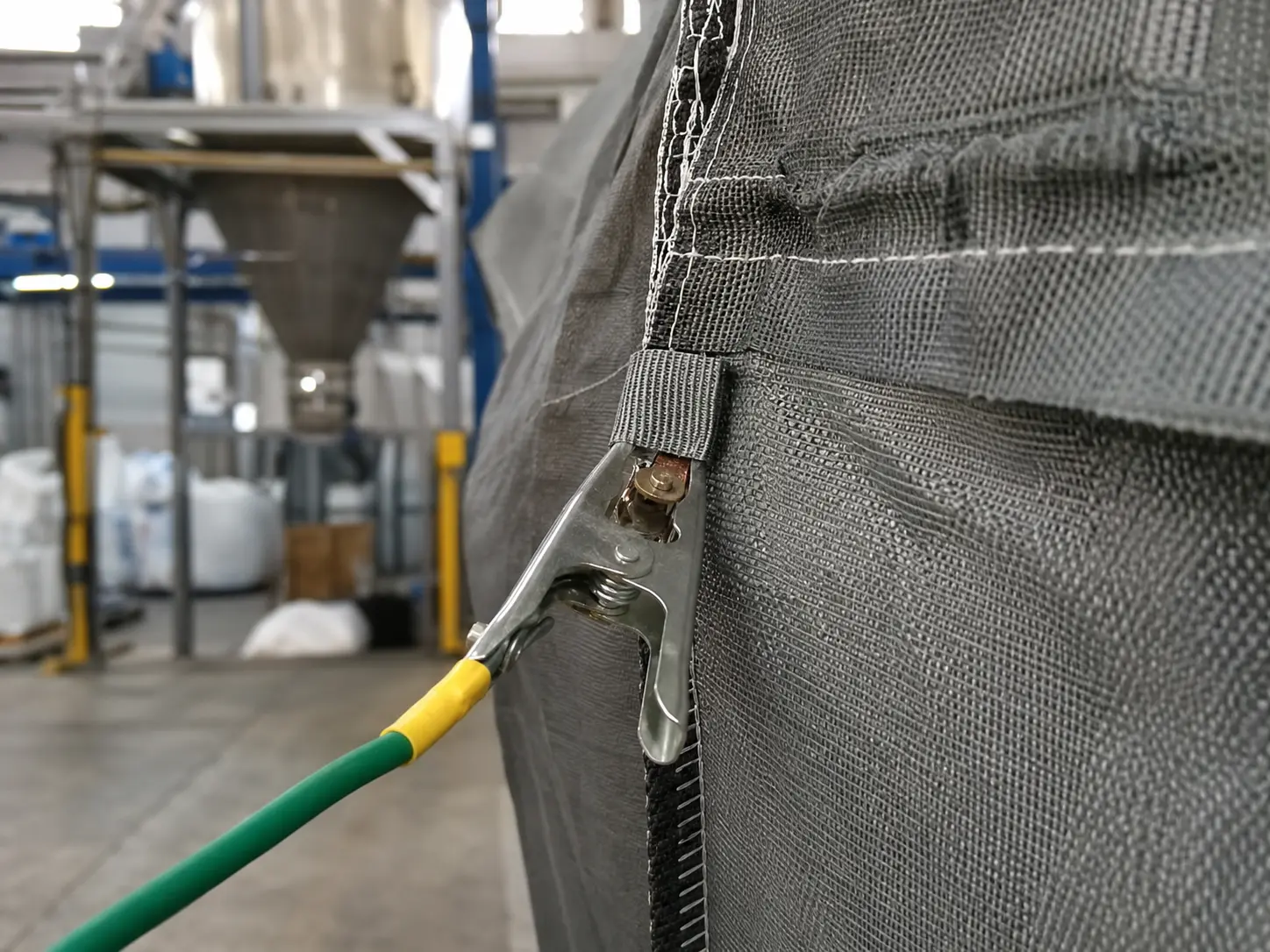
| Static from pneumatic conveying | High-velocity pipe transfer generates more charge than gravity fill | Confirm static class even for resins that seem non-hazardous |
| Contamination for molding | Fabric/dust contact can cause visible defects in finished parts | Liner for cleanliness, not just moisture |
| Hygroscopic engineering resins | Nylon, PET absorb moisture and cause processing defects | Liner with moisture barrier, sealed closure |
| Fill/discharge style | Automated pneumatic-fed lines need tight control | Spout top with spout or flat bottom |
| Container utilization | Export programs care about freight efficiency | Baffle construction for shape retention |
Why Pneumatic Conveying Changes the Static Calculation
Pellets moved through pneumatic conveying systems generate meaningfully more static charge than gravity-filled products, since high-velocity friction between pellets and pipe walls during transfer builds charge in a way slower, gravity-driven filling doesn’t. This matters because a resin that doesn’t seem obviously combustible on its own can still warrant static protection consideration specifically because of how it’s being filled, not because of the resin’s inherent properties alone. Check your product’s minimum ignition energy and confirm whether your filling process is pneumatic before assuming a standard bag is sufficient.
Contamination Control for Molding-Grade Resin
Resin feeding directly into injection molding, extrusion, or other processing equipment is often sensitive to contamination in ways many other bulk products aren’t — dust, fabric fiber contact, or handling residue can show up as visible defects or structural weak points in finished plastic parts. A liner protects against this contamination risk specifically, which is a different justification than the moisture-protection reasoning that drives liner decisions for many other products. Even resins that aren’t particularly moisture-sensitive often still warrant a liner purely for cleanliness.
Moisture-Sensitive Engineering Resins
Not all plastic resins behave the same way with moisture — commodity resins like standard polyethylene are relatively moisture-tolerant, but engineering resins like nylon and PET are hygroscopic and absorb ambient moisture readily, which causes visible defects and processing problems if the resin isn’t dried immediately before molding. If you’re packaging a hygroscopic engineering resin, a sealed liner with genuine moisture barrier properties matters considerably more than it would for a commodity resin, and the sealing method (heat seal versus tie) is worth the extra step for keeping moisture out during transit and storage.
Fill and Discharge Style for Resin Operations
Spout top paired with either spout bottom or flat bottom is common for resin and pellets, with the specific choice depending on how tightly your line controls both ends of the process. Automated, pneumatically-fed operations generally benefit from tighter control on both filling and discharge than manual handling setups — see our filling and discharge guide for the full tradeoff between styles. A resin operation feeding pellets directly into a hopper benefits from spout bottom’s controlled release in a way a manually-dumped operation doesn’t need.
Baffle Construction for Export Resin Programs
For resin shipped internationally in volume, container utilization directly affects freight cost, making baffle construction’s shape retention worth considering the same way it would be for any high-volume export product. This isn’t resin-specific reasoning so much as general freight economics applying to a product category that’s frequently shipped internationally in bulk — run the container math the same way you would for any high-volume export decision.
Common Mistakes When Packaging Resin and Pellets
- Skipping static protection because the resin “doesn’t seem flammable.” Pneumatic conveying can raise real static risk regardless of the resin’s inherent properties — check the actual process, not just the material.
- Choosing a liner purely for moisture without considering contamination. Molding-grade resin often needs cleanliness protection even when moisture isn’t the primary concern.
- Assuming all plastic resins share the same moisture sensitivity. Commodity and engineering resins behave very differently — verify your specific material.
- Using a general-purpose bag spec without checking your actual fill/discharge equipment. Pneumatic-fed automated lines have different requirements than manual handling operations.
- Overlooking freight economics for high-volume export resin. Baffle construction’s cost is easy to dismiss without running the actual container math for your volume.
Resin Handling Ties Multiple Site Topics Together
Resin and pellet packaging is a good example of how several independent spec decisions — static protection, liner, fill/discharge style, and construction type — combine around one product category’s actual handling process, rather than any single spec dominating the decision. Working through each factor separately, as covered in this guide, gives a more complete spec than defaulting to whatever a generic granular-product bag happens to offer.
Decision Checklist
- Is your filling process pneumatic or gravity-fed? Pneumatic conveying raises static risk consideration even for resins that don’t seem obviously combustible.
- Does your resin feed directly into a molding or processing line? Contamination control may justify a liner even without significant moisture sensitivity.
- Is your specific resin hygroscopic (nylon, PET, other engineering resins)? Confirm moisture sensitivity rather than assuming all plastics behave alike.
- Does your line need tight control on both fill and discharge? Automated pneumatic operations generally benefit from spout construction on both ends.
- Are you shipping export volume where container utilization matters? Baffle construction may pay back through freight savings.
Final Thoughts
Resin packaging goes wrong in two quiet ways: static risk assessed against the material instead of the conveying method, and contamination treated as a moisture question when it’s really a cleanliness one. Both are easy to get right if they’re raised before the order. Send us your resin grade and how it gets conveyed, and we’ll spec against the process rather than the datasheet alone.
Before You Request a Quote
Send us your resin type and process details, and we’ll confirm the right spec:
- Resin type and whether it’s an engineering or commodity grade
- Pneumatic or gravity filling
- Whether the resin feeds directly into molding equipment
- Target capacity and export volume, if applicable
Request a quote and we’ll confirm static protection, liner, and construction against your actual resin handling process.
Common Questions
Why do resin pellets carry a different static risk than other granular products?
Pellets are commonly moved through pneumatic conveying systems that generate significantly more static charge than gravity filling — friction between pellets and pipe walls during high-velocity transfer builds charge in a way slower manual filling doesn't. This makes static protection worth checking even for resins that don't seem obviously combustible.
Does plastic resin need a liner even though it's already plastic?
Often yes, for a different reason than moisture — many resins feed directly into molding processes where contamination from the outer fabric, dust, or handling residue can cause visible or structural defects in finished parts. A liner protects product cleanliness, not just against moisture.
Are all plastic resins moisture-sensitive?
No — commodity resins like standard polyethylene are relatively moisture-tolerant, but engineering resins like nylon and PET are hygroscopic and need to stay dry before molding, since absorbed moisture causes processing defects. Check your specific resin's moisture sensitivity rather than assuming all plastics behave the same way.
What fill and discharge style works best for pellet handling?
Spout top paired with either spout bottom or flat bottom is common, chosen based on how tightly your specific line needs to control both filling and discharge — automated pneumatic-fed lines generally benefit from tighter control on both ends than manual handling operations.
Does baffle construction matter for resin shipments?
It can, particularly for export programs where container utilization affects freight cost meaningfully — baffle construction's shape retention helps resin bags stack and load more efficiently, similar to the case for baffle bags generally.
Do recycled or regrind resins need a different spec than virgin pellets?
Often yes. Regrind tends to carry more fines and irregular particle shapes than uniform virgin pellets, which raises both dust generation and abrasion on the liner. Check the fines content and particle profile rather than assuming the spec that works for virgin material transfers.
Does colour or additive masterbatch affect bag choice?
Not directly, but heavily pigmented or additive-loaded material sometimes has different flow and dust characteristics than base resin. If your material carries significant masterbatch loading, mention it — it can change liner and discharge decisions even when the base polymer is unchanged.
More in Applications
All Applications guides- Hemp Super Sacks: You're Buying Volume, Not StrengthDried hemp biomass is so light a super sack fills at under a fifth of its rating. Size the bag for volume, and seal it only once drying has finished.
- Super Sack Cofferdams: The Bag Holds Weight, Not WaterA super sack cofferdam is a mass structure, not a seal. Woven polypropylene seeps, so the bag supplies ballast and a separate membrane has to stop the water.
- Bulk Bags for Coffee Beans: The 12% Moisture ProblemGreen coffee is not a dry cargo. It ships in a narrow moisture band, and the real threat in a container is condensation putting water back into the bean.
- Dewatering Bulk Bags: The One FIBC Built to Let Water OutEvery other bulk bag keeps moisture away from the product. A dewatering bag does the opposite — and specifying it with coated fabric guarantees it will fail.