Type C vs Type D FIBC: When Grounding Discipline Fails
Type C needs grounding every cycle; Type D doesn't. Here's which holds up once real operators, turnover and time pressure enter the picture.
PackTonne Sourcing Desk · · 7 min read
Type C and Type D solve the same static ignition risk through different mechanisms. Type C creates a low-resistance discharge path through interconnected conductive threads, but only works if the bag is actually grounded — a real dependency on human compliance. Type D uses a denser, static-dissipative weave that bleeds off charge gradually without a physical ground connection. The difference matters most where the static class basics stop: real sites with real staff turnover.
The Core Mechanism Difference
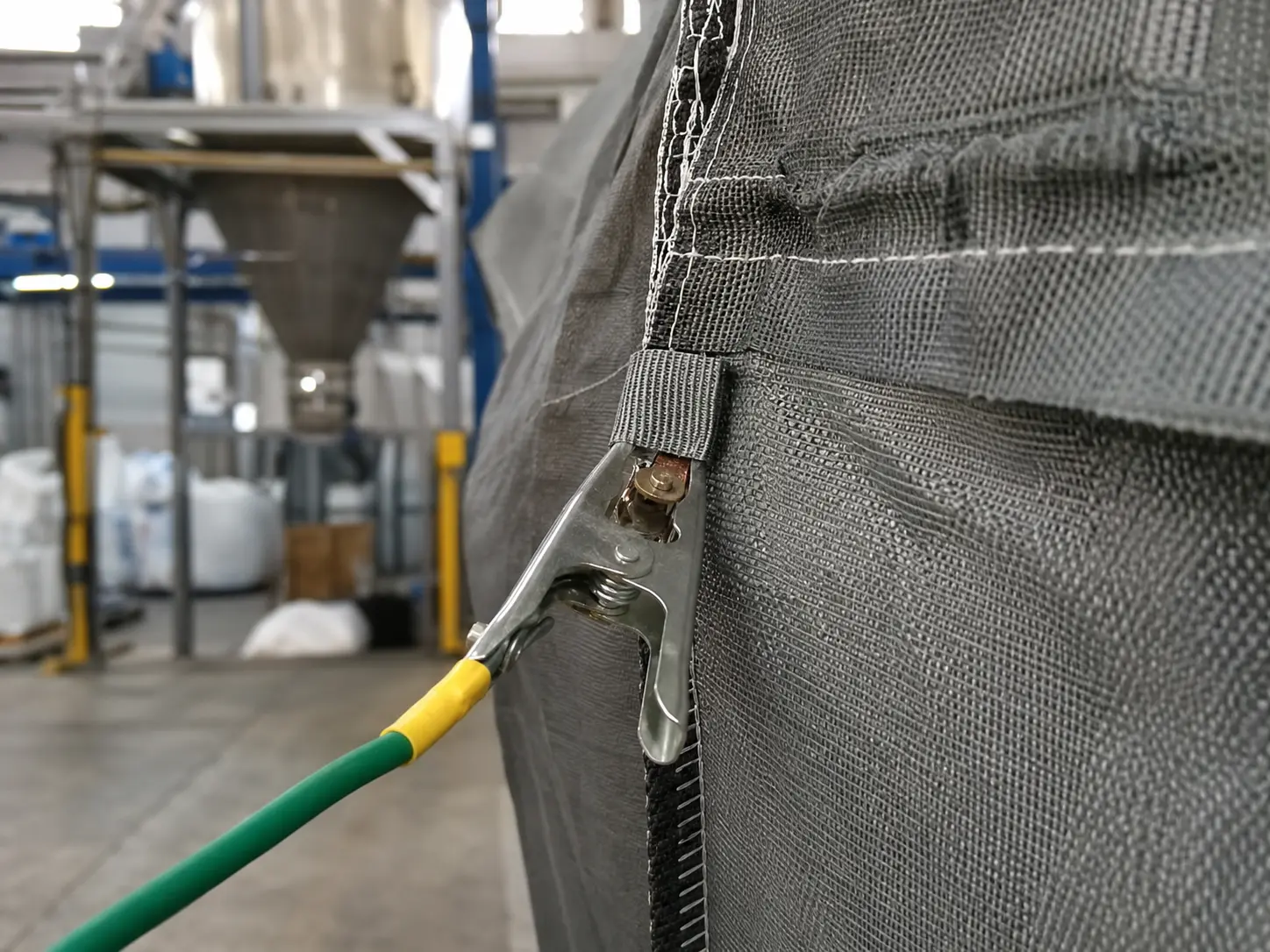
Type C’s conductive threads form an interconnected network across the fabric that channels static charge to a single grounding point — an active discharge path that requires a completed circuit to ground to function at all. Type D’s dissipative weave doesn’t create a discharge path to any single point; instead it bleeds accumulated charge across the fabric surface gradually, keeping charge density low enough to avoid a propagating discharge without needing a connection to anything external. This is why Type C is described as requiring grounding and Type D as not — they’re not variations on the same mechanism, they’re two different approaches to the same underlying risk.
Why Grounding Compliance Fails in Practice
Type C’s protection is only as reliable as the operator connecting the ground clamp correctly, every single filling cycle, indefinitely. In practice, this breaks down in predictable ways: new hires who weren’t trained on the specific procedure, contract packing operations where the packaging company doesn’t own the grounding discipline the way the product owner might, seasonal staffing surges, or simple time pressure on a fast-moving line where a clamp gets skipped to save thirty seconds. None of these failure modes show up in a bag’s test certification — they’re operational risks layered on top of a correctly-constructed bag.
Where Type C Still Makes Sense
Fixed industrial sites with established grounding infrastructure, trained permanent staff, and supervisory quality control around the filling process are where Type C’s protection scope — including flammable vapor and gas environments — remains the more appropriate choice, since the grounding compliance risk is genuinely lower in a stable, well-supervised environment. Some regulatory or insurance requirements also specifically call for grounded systems in certain solvent-handling contexts, making Type C not just a choice but sometimes a requirement independent of Type D’s operational advantages elsewhere.
Where Type D Wins in Practice
Mobile filling stations, remote locations without reliable grounding infrastructure, contract packaging arrangements with rotating staff, and multi-site operations where grounding discipline can’t be centrally enforced are all scenarios where Type D’s independence from a grounding connection removes the single biggest real-world failure mode. This isn’t about Type D being universally “safer” — it’s about matching construction to the actual operational reliability of your specific site, not a generic best-practice assumption.
The Real Cost Comparison Goes Beyond the Bag Price
Type D typically costs more per bag than Type C, but Type C carries its own less visible costs: grounding infrastructure installation and maintenance, ongoing operator training, and the compliance monitoring needed to actually verify grounding happens every cycle. A full cost comparison between the two isn’t just the per-bag price difference — it includes what a site spends maintaining the grounding system Type C depends on, and the risk cost of a compliance gap that a single skipped clamp represents. Sites without existing grounding infrastructure may find Type D’s higher per-bag cost is offset by not needing to build and maintain that infrastructure at all.
Using Both Across a Facility
Many operations aren’t purely Type C or Type D sites — a facility might run Type C at a fixed, well-supervised filling station with mature grounding infrastructure, while specifying Type D for a mobile unit, a satellite location, or an outsourced contract packing arrangement where grounding discipline can’t be guaranteed to the same standard. This isn’t inconsistency; it’s matching each specific filling point’s actual reliability conditions rather than forcing one construction across every scenario in the operation.
Common Mistakes When Choosing Between Them
- Treating Type D as a universal upgrade over Type C. It removes a specific failure mode but doesn’t extend into flammable vapor and gas coverage the way a properly grounded Type C does.
- Assuming existing grounding infrastructure will stay maintained indefinitely. Infrastructure that’s well-kept today can degrade without ongoing investment — factor maintenance into a long-term Type C decision, not just the initial installation.
- Standardizing on one type across a multi-site operation without checking each site’s actual conditions. A fixed headquarters site and a remote satellite location can have very different grounding reliability, warranting different constructions.
- Underestimating training cost and turnover risk when choosing Type C. The bag’s protection is only as good as the operator behavior behind it — that’s a real, ongoing cost, not a one-time setup.
- Ignoring insurance or regulatory requirements that specifically mandate a grounded system. Confirm this before treating Type D as a default substitute in every context.
A Practical Way to Decide
If you’re unsure which fits your situation, ask one question first: can you guarantee, with confidence, that a ground clamp gets connected correctly on every single fill cycle indefinitely, across every shift and every operator? If the honest answer is yes — a stable site, trained staff, active supervision — Type C’s broader protection scope in vapor and gas environments makes it the stronger choice. If the honest answer is “probably, but not always” or “it depends who’s working that day,” Type D’s independence from that dependency is the more reliable real-world choice, even at a higher per-bag cost.
Decision Checklist
- Is your grounding infrastructure permanent and well-maintained, or ad hoc? Permanent, mature infrastructure favors Type C; ad hoc or absent infrastructure favors Type D.
- How much staff turnover does your filling operation see? High turnover increases the real-world risk of Type C’s compliance dependency.
- Is your product’s environment flammable vapor or gas, not just combustible dust? Type C, properly grounded, has broader coverage here than Type D.
- Are you filling at multiple sites with inconsistent conditions? Type D’s independence from grounding infrastructure simplifies multi-site consistency.
- Does a regulatory or insurance requirement specifically call for a grounded system? Confirm this before assuming Type D is a drop-in substitute for Type C in every context.
Final Thoughts
Ask one question honestly: can you guarantee a ground clamp gets connected correctly on every fill cycle, across every shift, indefinitely? If yes, Type C’s broader coverage in vapor environments makes it the stronger choice. If the honest answer is closer to “most of the time,” Type D removes the dependency that gap creates. Tell us about your site and staffing and we’ll recommend against the reality, not the ideal.
Before You Request a Quote
Tell us about your actual filling operation and we’ll confirm the right construction:
- Fixed site or mobile/multi-site filling operation
- Staff turnover and training consistency
- Presence of flammable vapor or gas, not just combustible dust
- Any specific regulatory or insurance requirements
Request a quote and we’ll confirm Type C or Type D against your actual operating conditions, not just the product’s static risk alone.
Common Questions
What's the fundamental mechanical difference between Type C and Type D?
Type C weaves interconnected conductive threads that create a low-resistance path to ground, requiring an actual grounding connection to work. Type D uses a denser, static-dissipative weave that bleeds off charge gradually across a higher resistance range, without needing a physical ground connection.
Why do Type C grounding failures happen so often in practice?
Grounding compliance depends on consistent operator behavior — connecting a clamp every single cycle — which breaks down under staff turnover, contract packing arrangements, seasonal labor, or simple time pressure. The bag's protection is only as reliable as the weakest link in that human process.
Is Type D always the safer choice given Type C's grounding dependency?
Not universally — Type C, properly and consistently grounded, handles flammable vapor and gas environments that Type D has more limited coverage for. Type D removes a failure mode but doesn't fully replace Type C's protection scope in every environment.
Does humidity affect Type C grounding reliability?
Indirectly — inconsistent ambient conditions across sites or seasons can affect how reliably a grounding connection performs, adding another variable to a system that already depends on consistent human compliance. This is one more reason some operations favor Type D where grounding conditions can't be tightly controlled.
Can a single facility use both Type C and Type D bags?
Yes, and it's common — a facility might use Type C at a fixed station with reliable grounding infrastructure and established operator training, while using Type D for mobile filling, remote locations, or contract packaging arrangements where grounding discipline is harder to guarantee.
Does Type D cost more than Type C?
Usually yes on a per-bag basis. But the comparison isn't complete without grounding infrastructure — installation, maintenance, operator training and compliance monitoring are ongoing costs Type C carries and Type D doesn't. Sites without existing grounding often find Type D cheaper overall.
How do I audit whether grounding is actually happening?
Documented per-cycle checks, not verbal confirmation. A continuity check logged at each fill is the only reliable evidence; supervision alone tends to degrade under time pressure. If you can't sustain that documentation, that's a strong argument for Type D construction instead.
More in Static Protection
All Static Protection guides- Type B Bulk Bags: The Anti-Static Bag That Isn't Anti-StaticType B bulk bags cap breakdown voltage below 6 kV, which stops propagating brush discharges but not brush discharges — the reason they fail near solvent vapour.
- IEC 61340-4-4: The Tests Behind Type B, C and D BagsEach static class has its own test and its own threshold. Here's what IEC 61340-4-4 actually measures for Type B, C and D construction.
- Type A vs B vs C vs D FIBC: Which Static Class Do You Need?Static protection depends on what's near the bag during filling — flammable dust, solvent vapor, or nothing at all. Here's how to match the class to real risk.