UN Certified FIBC Bags: 13H1–13H4 Marking Codes Explained
13H1 through 13H4 each describe a specific FIBC construction — coated or not, lined or not. Picking the wrong code means shipping packaging that doesn't match what's actually in the bag.
PackTonne Sourcing Desk · · 6 min read
13H1 through 13H4 each identify a specific FIBC construction, not interchangeable variations of the same “UN certified” claim. The number after H specifies coating and liner combination — 13H1 has neither, 13H2 is coated only, 13H3 is lined only, 13H4 has both. Shipping a hazardous product in the wrong construction code means the packaging doesn’t actually match what’s inside, certification label or not.
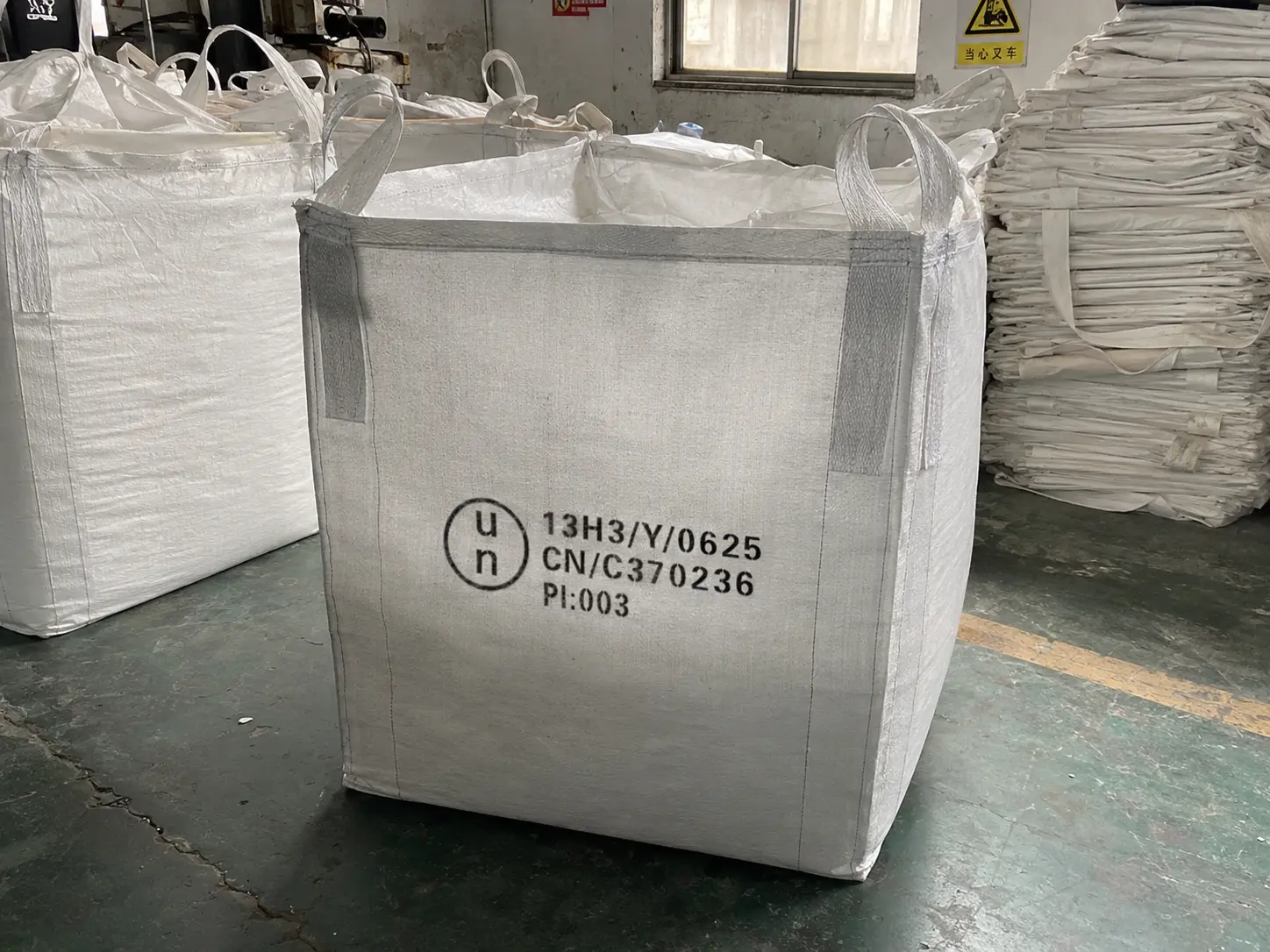
The 13H Codes at a Glance
| Code | Construction | Handles | Typical fit |
|---|---|---|---|
| 13H1 | Woven plastic, no coating, no liner | Coarse solids, no fine sifting risk | Non-sifting granular hazardous solids |
| 13H2 | Woven plastic, coated | Surface sealing against moisture or fine dust | Products sensitive to external moisture |
| 13H3 | Woven plastic, liner, no coating | Internal containment against sifting | Fine powders prone to leaking through the weave |
| 13H4 | Woven plastic, coated and lined | Both surface sealing and internal containment | Products needing full barrier protection both ways |
Reading the Full UN Marking String
The 13H code is only one part of a longer marking string required on a certified bag: the UN packaging symbol, the 13H construction code, the packing group letter, gross mass or specific gravity, the year of manufacture, and codes identifying the manufacturer and certifying body. Every element matters — a bag showing only “13H3” without the rest of the string isn’t presenting a complete or verifiable certification. If you’re auditing a supplier’s certification claim, ask to see the full marking, not just the construction code in isolation.
This full-string requirement exists because each element traces back to a specific tested condition. The gross mass or specific gravity figure, for example, confirms the bag was tested at a weight relevant to your actual shipment — a bag certified at a lower mass than your product’s actual density isn’t valid for your shipment even if the 13H code matches. Treat the marking as a set of linked facts, not a single pass/fail label.
13H1 vs 13H2 vs 13H3 vs 13H4: Matching Code to Product
The right code depends on two independent questions about your product: does it need protection from external moisture or contamination (coating), and does it risk sifting through the weave or need an internal barrier (liner)? A coarse, non-sifting solid with no moisture sensitivity fits 13H1 — no added construction needed. A fine powder prone to sifting through open weave needs at minimum 13H3’s liner. A product sensitive to both external moisture and internal sifting needs 13H4’s full combination. Getting this wrong in either direction either under-protects the product or adds unnecessary construction cost.
Packing Groups Address Hazard Severity, Separately from Construction
Packing group — I, II, or III — reflects how hazardous your specific product is under UN classification rules, independent of which 13H construction code applies. Group I covers the highest danger level, Group III the lowest. A bag has to be certified for the packing group your product falls under, not just carry a matching 13H construction code — the two classifications work together, and a supplier needs both pieces of information from you to certify the right combination. This is different from the static protection classes covered elsewhere on this site — packing group is about chemical hazard severity, not ignition risk.
A single 13H code can be certified across more than one packing group, but the certification has to explicitly cover the group you need — a bag certified only for Group III shouldn’t be assumed to work for a Group I or II shipment just because the construction code matches. If your product’s classification changes, or you’re shipping a new product for the first time, re-verify the packing group against your current certification rather than carrying over an assumption from a previous order.
The Marking Locks the Entire Design
Once a specific fabric, coating, liner, and stitching combination is tested and certified under a 13H code, none of those elements can change without recertifying the bag — a locked-spec requirement covered in more detail in our types of FIBC bags overview. This is why UN certified sourcing is a different conversation than sourcing a standard bag: you’re buying a fixed, tested design, and any change — even one that seems minor, like a different liner thickness — breaks the certification’s validity.
Common Mistakes with UN Certified Claims
- Treating “UN certified” as one uniform claim. The specific 13H code and packing group both need to match your actual product.
- Assuming a supplier’s general certification covers your packing group. Confirm the specific group your product requires is included in their certification.
- Changing a liner or coating spec after certification without recertifying. Any construction change invalidates the original certification.
- Accepting a partial marking string as proof of certification. Ask for the complete string — construction code, packing group, mass, manufacturer and certifying body codes.
- Confusing packing group with static protection class. They address entirely different risks and aren’t interchangeable specifications.
We work directly with partner factories capable of producing to 13H1–13H4 specifications; send us your product’s classification and we’ll confirm the exact code and packing group combination you need rather than a general certification claim.
Decision Checklist
- Does your product risk sifting through an open weave? If yes, you need at minimum a lined construction (13H3 or 13H4).
- Does your product need protection from external moisture or contamination? If yes, you need a coated construction (13H2 or 13H4).
- What packing group does your product’s UN classification require? Confirm this from your product’s safety data sheet, not a guess.
- Have you seen the full marking string, not just the 13H code? A complete claim includes packing group, mass, and manufacturer codes.
- Are you changing any spec after initial certification? Any change requires recertification — don’t assume otherwise.
Before You Request a Quote
Send us these details so we can confirm the right code:
- Product name and UN classification, if known
- Whether the product sifts through open weave or needs moisture protection
- Target capacity and dimensions
- Destination country’s specific import requirements
Request a quote with your product’s classification and we’ll confirm the right 13H code and packing group before production.
Common Questions
What does the 13H code on an FIBC bag mean?
13 identifies the packaging as a flexible intermediate bulk container (FIBC) in the UN Model Regulations code system; H identifies the material as plastic. The final digit (1 through 5) specifies the exact construction — coated, lined, both, or plastic film.
What's the difference between 13H1 and 13H3?
13H1 is woven plastic with no coating and no liner. 13H3 is woven plastic fitted with a liner but no coating. The liner in 13H3 addresses sifting or fine-particle containment that 13H1's open weave doesn't control.
What does 13H4 mean specifically?
13H4 is woven plastic with both a coating and a liner — the most contained construction in the woven plastic FIBC category, typically specified for products needing both surface sealing and an internal barrier.
Do I need to know the packing group for my shipment?
Yes — packing group (I, II, or III) reflects the hazard severity of your specific product and is a separate part of the full marking string from the construction code. Your product's UN classification determines the packing group; the FIBC has to be certified for that group, not just carry a 13H code.
Can I change the liner or coating after a bag is UN certified?
No. UN certification is tied to the exact tested construction — fabric, coating, liner, and stitching all locked together. Changing any of those elements after certification means the bag no longer matches its certified design and needs to be recertified.