1 Ton Bags Explained: Capacity, SWL and Safety Factors
A 1 ton bag's rated capacity is its safe working load (SWL) — the operating limit, not the breaking point. Here's how SWL, safety factor and breaking strength actually relate.
PackTonne Sourcing Desk · · 6 min read
A “1 ton bag” is rated for a safe working load (SWL) of 1000 kg — the operating limit you’re meant to load it to, not the point where it fails. That failure point is set by the safety factor: 5:1 for single-trip bags, 6:1 for multi-trip, meaning the bag is tested to withstand roughly five or six times its SWL before breaking. The “1 ton” in the name describes normal use, not the bag’s actual strength ceiling.
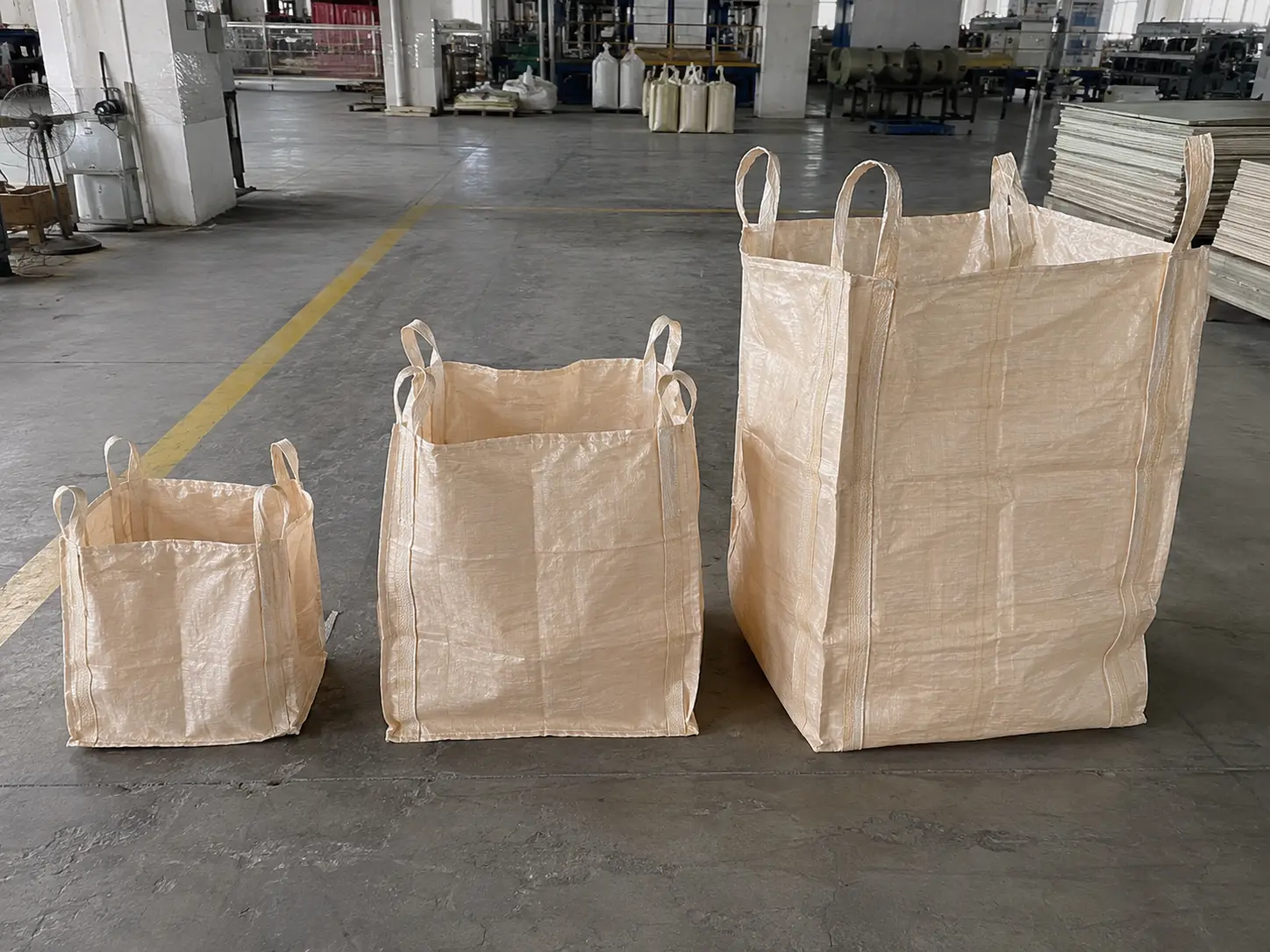
Key Terms at a Glance
| Term | What it means |
|---|---|
| SWL (Safe Working Load) | The rated operating capacity — 1000 kg for a “1 ton” bag |
| Safety factor | Ratio of tested breaking strength to SWL — 5:1 single-trip, 6:1 multi-trip |
| Breaking strength | The load at which the bag is tested to fail — SWL × safety factor |
| Rated capacity | Another term for SWL, used interchangeably on most spec sheets |
What “1 Ton” Actually Refers To
The “1 ton” label refers to SWL — the load the bag is designed and rated to carry during normal filling, lifting, transport, and discharge. It’s the number you load the bag to, not a description of how much weight it can survive under worst-case stress. Confusing SWL with a bag’s ultimate strength is a common misreading of a spec sheet, and it matters because loading meaningfully above SWL isn’t “using the safety margin” — it’s operating outside the bag’s tested and rated conditions.
Safety Factor Is the Real Strength Number
Safety factor multiplies against SWL to give the tested breaking strength: a 1000 kg SWL bag at 5:1 safety factor is tested to survive roughly 5000 kg before failure. That large gap between SWL and breaking strength exists because lifting and handling introduce dynamic stress — sudden jerks, uneven lifting, swinging during a crane move — that a static weight number doesn’t capture. The safety factor is what covers that gap, not padding for careless overloading.
Why Multi-Trip Bags Need a Higher Safety Factor
Single-trip bags are tested to survive one full load cycle — fill, lift, transport, discharge — with a 5:1 margin. Multi-trip bags need to survive that same cycle repeated many times without the fabric or stitching accumulating enough fatigue to fail on a later trip, which is why they’re built and tested to a 6:1 margin instead. The extra margin isn’t arbitrary — it accounts for cumulative wear that a single-use bag never has to withstand.
Is 1 Ton the Right Size for Your Product?
1 ton is the most common FIBC capacity because it balances forklift and crane handling limits against minimizing the number of bags per shipment — a genuinely practical middle ground, not a default that fits every product. Very dense products may need a smaller footprint to stay at 1000 kg SWL; very light products may need a larger bag to reach the same weight. See our dimensions guide for how bulk density changes the actual size calculation, and confirm your site’s lifting equipment can handle 1000 kg before assuming 1 ton is the right default.
How SWL Connects to Fabric Weight and Stitching
A bag’s actual ability to hold its rated SWL — and survive to its safety factor — depends on fabric weight (GSM) and stitching quality at the loops and seams working together, not fabric alone. Two bags rated for the same 1 ton SWL can use different GSM specs depending on safety factor and reinforcement technique; see our woven polypropylene guide for how fabric weight is chosen against a target load.
How Safety Factor Gets Verified
ISO 21898:2024 tests multi-trip bags with a cyclic top-lift protocol: 30 lift cycles at twice the SWL, followed by one final cycle at five times the SWL, with no seam splitting, loop failure, fabric tearing, or damage that would compromise future use. This cyclic approach exists because a single static pull test doesn’t reveal how a bag holds up under the repeated stress of actual multi-trip handling — a bag can pass one hard pull and still fail on the twentieth lift cycle if construction quality is inconsistent.
Common Misreadings of a Spec Sheet
- Treating SWL as the bag’s maximum survivable load. SWL is the operating limit; breaking strength (SWL × safety factor) is a separate, higher number.
- Assuming a higher safety factor always means a “stronger” bag overall. Safety factor reflects trip count design, not general build quality — check GSM and stitching separately.
- Loading consistently near or above SWL to “use the margin.” The safety factor exists for dynamic handling stress, not as headroom for routine overloading.
- Assuming 1 ton is the default answer without checking bulk density. A product far from typical bulk density can need a different capacity at the same physical bag size.
- Skipping confirmation of single-trip vs multi-trip rating. A 5:1 bag reused as if it were 6:1-rated is operating outside its tested margin.
Decision Checklist
- Is your product’s bulk density close to standard, or unusually light/dense? That changes whether 1 ton at standard dimensions actually fits your target weight.
- Can your site’s lifting equipment handle a 1000 kg SWL bag safely? Confirm before assuming 1 ton by default.
- Is this single-trip or multi-trip use? That determines whether you need 5:1 or 6:1 safety factor construction.
- Have you confirmed SWL and safety factor as separate spec fields? Don’t assume one implies the other on a spec sheet.
- Do you need documentation of cyclic top-lift testing? Ask for it explicitly if you’re planning multi-trip use.
Before You Request a Quote
Send these details so we can confirm the right spec for your load:
- Target weight per bag and product bulk density
- Single-trip or multi-trip use
- Site lifting equipment capacity
- Any static protection, food grade, or certification requirements
Request a quote and we’ll confirm SWL, safety factor and dimensions against your actual product.
Common Questions
What does '1 ton bag' actually mean?
It means the bag's safe working load (SWL) is rated at 1000 kg — the maximum load it's designed to carry in normal operation. It's not the load the bag will fail at; that's a separate, higher number defined by the safety factor.
What is the difference between SWL and safety factor?
SWL is the operating limit — the weight you're meant to load the bag to. Safety factor is the ratio between the bag's tested breaking strength and its SWL. A 1000 kg SWL bag with a 5:1 safety factor is tested to withstand roughly 5000 kg before failure, giving a large margin above normal use.
Why is the safety factor for single-trip bags lower than multi-trip?
Single-trip bags (5:1) only need to survive one load cycle, while multi-trip bags (6:1) need to withstand repeated lifting, filling and discharge cycles without accumulating enough fatigue to fail. The extra margin accounts for wear across multiple uses, not just one.
Is a 1 ton bag the right size for my product?
1 ton is the most common capacity because it balances handling equipment limits against fewer bags per shipment, but the right size depends on your product's bulk density and your site's lifting capacity — not on 1 ton being a default answer for every product.
How is a bag's safety factor actually tested?
Under ISO 21898:2024, multi-trip bags go through a cyclic top-lift test — 30 lift cycles at twice the SWL, then a final cycle at five times the SWL — without seam splitting, loop failure, or fabric tearing. This simulates repeated real-world handling rather than a single static pull test.