Bulk Bag Dimensions & Sizes Guide
The industry-standard FIBC runs about 90×90×110 cm and holds 500–3000 kg — but bulk density, not a fixed chart, is what actually determines the right size for your product.
PackTonne Sourcing Desk · · 7 min read
The industry-standard FIBC runs about 90×90×110 cm and holds 500–3000 kg, with 1 ton and 1.5 ton the most common ratings. But there’s no single fixed size chart — the right dimensions depend on your product’s bulk density, not a lookup table. A dense mineral and a light powder at the same target weight need different bag volumes. This guide explains what actually drives bag size, so you can size a bag instead of guessing from a generic chart.
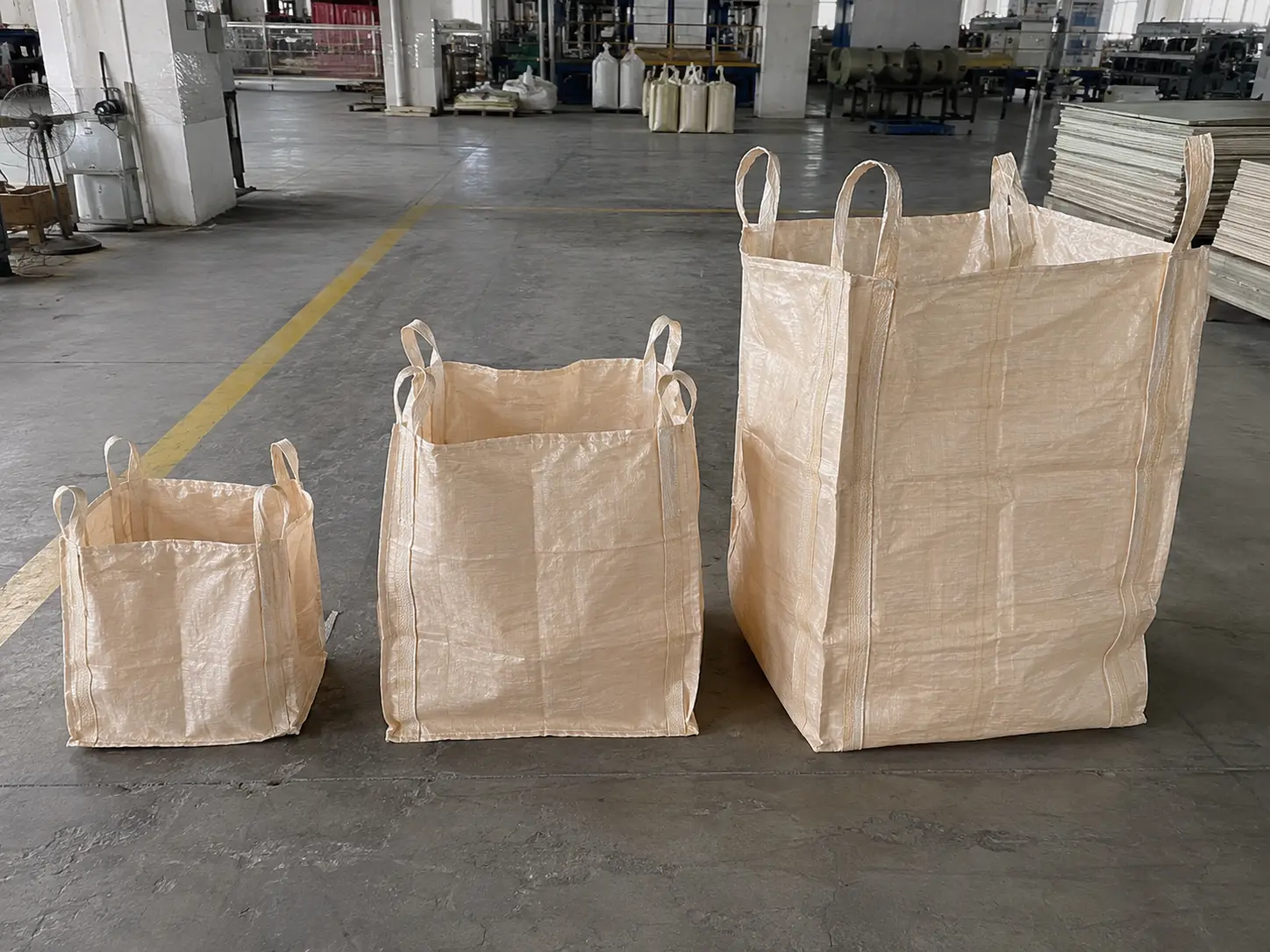
Typical Size Ranges by Capacity
| Target capacity | Approximate volume needed* | Typical footprint | Typical height |
|---|---|---|---|
| 500 kg | ~0.5–0.6 m³ | 85×85–90×90 cm | 80–100 cm |
| 1000 kg (1 ton) | ~1.0–1.1 m³ | 90×90–95×95 cm | 100–120 cm |
| 1500 kg | ~1.4–1.6 m³ | 100×100–105×105 cm | 120–140 cm |
| 2000 kg | ~1.8–2.0 m³ | 105×105–110×110 cm | 140–160 cm |
| 3000 kg | ~2.6–2.9 m³ | 110×110–120×120 cm | 160–190 cm |
*Assumes a mid-range bulk density around 900–1000 kg/m³. Lighter or denser products shift these numbers — see the calculation section below for the actual formula.
“Super Sack” Dimensions Are the Same Dimensions
Super sack, FIBC, and bulk bag are three names for the same product, so a search for “super sack dimensions” or “super sack size” turns up exactly the same size ranges as this guide. The term “super sack” is a genericized trademark, similar to how some buyers say “jumbo bag” — regional habit, not a different product line or spec sheet. If a supplier quotes different numbers for a “super sack” versus a “bulk bag” at the same capacity, ask why; there’s no technical reason the terminology should change the size.
What Actually Determines Bag Size
Bag volume, not bag weight rating, is the real constraint — you’re sizing a container for a given volume of product, and weight is just volume times bulk density. Two products rated for the same 1000 kg can need very different bag sizes: a dense mineral powder at 1400 kg/m³ needs less volume than a light plastic pellet at 500 kg/m³. Always start from bulk density, not from a generic “1 ton bag” assumption.
The 90×90×110 cm Bag Is Common, Not Universal
This footprint became the de facto industry default because it fits standard pallet dimensions (roughly 1m × 1m) and stacks efficiently in a container, and because 1 ton is the most frequently ordered capacity. But “standard” here means common, not fixed — suppliers vary the exact centimeters, and plenty of products need something else entirely. Treat this size as a starting reference point, not a spec you have to match.
Loop Type Changes the Usable Height
The four lifting loops attach at the top corners or sides, and loop height adds to the bag’s overall dimension without adding usable fill volume. A bag with tall, four-corner loops has a larger overall height on a spec sheet than a bag with short side-seam loops at the same fill capacity — when comparing dimensions across suppliers, check whether the quoted height includes loops or measures the body only.
This matters more than it looks like on paper. Two quotes listing “120 cm height” for the same rated capacity can describe bags with a 10–15 cm difference in actual body height once loop style is accounted for, which changes how many bags fit per layer on a pallet. Ask suppliers to specify body height and loop height separately rather than a single combined number.
Fabric Weight Doesn’t Change Size — It Changes What Size Can Safely Hold
Two bags with identical dimensions can carry different rated loads depending on fabric weight (GSM) and safety factor. A 90×90×110 cm bag in 140 g/m² fabric and the same footprint in 210 g/m² fabric aren’t interchangeable even though they measure the same — the heavier fabric carries more weight and tolerates rougher handling. This is also why “dimensions” alone is never a complete spec: two suppliers can quote the identical footprint at very different prices because one is proposing lighter fabric for a single-trip use case and the other heavier fabric for repeated handling. Read our Type A vs B vs C vs D static protection guide if fabric spec beyond size matters for your product’s flammability profile too.
Filling and Discharge Style Affects Usable Space
Duffle top (gathered and tied closed), spout top (a discharge spout for pouring), and flat bottom all use the same base dimensions differently. A spout adds height at the top or bottom without adding storage volume, and a flat-bottom bag trades some corner volume for stacking stability. When comparing two bags with the same headline dimensions, check the fill/discharge style — it changes how much of that stated volume is actually usable.
1 Ton vs 1.5 Ton: The Two Most-Ordered Sizes
1 ton (1000 kg) and 1.5 ton (1500 kg) cover most general bulk shipments — construction aggregates, agricultural inputs, industrial minerals — because they balance forklift handling limits against fewer bags per shipment. Beyond 2 tons, handling equipment and site logistics become the limiting factor more often than the bag design itself; confirm your site’s lifting capacity before ordering above 2000 kg.
Ordering a size outside these two common ratings isn’t a problem, but it changes the sourcing conversation. Standard 1-ton and 1.5-ton footprints are already tooled at most factories, so lead time is typically shorter. A less common capacity or an unusual footprint may need new tooling or adjusted stitching patterns, which is worth flagging early rather than discovering at the quote stage.
How to Calculate the Right Size for Your Product
- Find your product’s bulk density (kg/m³) — check the product datasheet or measure it directly (weight of a known volume).
- Divide target weight by bulk density to get required volume in cubic meters. Example: 1000 kg ÷ 800 kg/m³ = 1.25 m³.
- Add 10–15% headspace so the bag doesn’t need to be packed to its absolute limit, which strains seams and makes tying off harder.
- Convert volume to a footprint and height that fits your pallet and container plan — a supplier can do this step for you once you send the volume figure.
- Confirm safe working load and safety factor separately from the size — dimensions and rated capacity are two different checks, not one.
A worked example: a fine mineral powder at 650 kg/m³ bulk density, target weight 1000 kg. Required volume is 1000 ÷ 650 = 1.54 m³, noticeably more than the 1.0–1.1 m³ a denser product needs at the same weight. Sizing this bag off a generic “1 ton bag” chart without checking density would produce a bag too small to hold the actual load without overfilling past the safe fill line.
Common Sizing Mistakes
- Sizing off a generic chart instead of actual bulk density. The chart above is a starting reference, not a substitute for the calculation.
- Comparing quoted heights without checking loop style. A 10–15 cm gap in body height can hide inside two quotes that both say the same overall number.
- Packing to the bag’s absolute volume limit. Skipping headspace strains seams and makes the top harder to close, especially on duffle-top bags.
- Treating dimensions as the whole spec. Fabric weight and safety factor determine what a given footprint can safely carry — get both before ordering.
- Assuming a custom size costs proportionally more. Custom footprints mainly affect lead time from new tooling, not necessarily per-bag price at volume — ask for a quote rather than assuming.
Decision Checklist
- Do you know your product’s bulk density, or only its target weight? Get the density figure before requesting a size.
- Does your pallet or racking system constrain the footprint? State that limit upfront.
- Are you comparing quotes with different reported heights? Confirm whether loop height is included.
- Does your container loading plan favor a squarer profile? Ask about baffle construction to hold shape at your target size.
- Is your target capacity outside the common 1–1.5 ton range? Flag it early — larger custom sizes usually need a longer lead time to tool.
Before You Request a Quote
Send these details so a size can be quoted accurately:
- Target weight per bag
- Product bulk density, or enough detail for us to estimate it
- Pallet or container constraints, if any
- Fill and discharge style preference (duffle, spout, flat bottom)
- Whether you need Type A standard construction or a different static/certification class
Request a quote with these specs and we’ll confirm dimensions against your actual product, not a generic chart.
Common Questions
What is the standard size of a bulk bag?
The most common FIBC runs around 90×90×110 cm and holds 1000 kg (1 ton), though the exact footprint varies by supplier and by the bulk density of the product it's built to hold. There's no single fixed industry dimension — capacity and volume together determine size.
How do I calculate what size bulk bag I need?
Divide your target weight by the product's bulk density in kg per cubic meter to get the volume you need, then work backward to a footprint and height. A 1000 kg load of a product with 1000 kg/m³ bulk density needs 1 cubic meter of bag volume; a lighter product needs a larger bag for the same weight.
What's the difference between a bulk bag and a super sack in terms of size?
None — super sack, FIBC, and bulk bag describe the same product, so dimensions are identical across the terms. The naming difference is regional and industry habit, not a size or spec distinction.
Does a bigger bulk bag always mean a heavier rated capacity?
No. Rated capacity depends on fabric weight and safety factor as much as size. A larger bag built with lighter fabric can carry less than a smaller bag built with heavier fabric and a higher safety factor — always check the safe working load, not just the dimensions.
Can I get a custom size bulk bag instead of a standard one?
Yes. Custom dimensions are common when a product's bulk density, packing line, or container loading plan doesn't fit a standard footprint. Send your target weight, bulk density, and any line clearance constraints, and a supplier can quote a size built around your product.