Ventilated Bulk Bags for Firewood & Agriculture
Firewood, onions, and potatoes need airflow more than sealing — open-weave ventilated bags prevent the rot and mold that a solid-fabric bag would trap in. Here's how to spec one right.
PackTonne Sourcing Desk · · 6 min read
Firewood, onions, and potatoes need airflow more than sealing — open-weave ventilated fabric lets moisture and humidity escape instead of trapping it against the product, which is exactly what accelerates rot and mold in a solid-fabric bag. This guide covers what makes ventilated construction the right call for these products, and where it clearly isn’t.
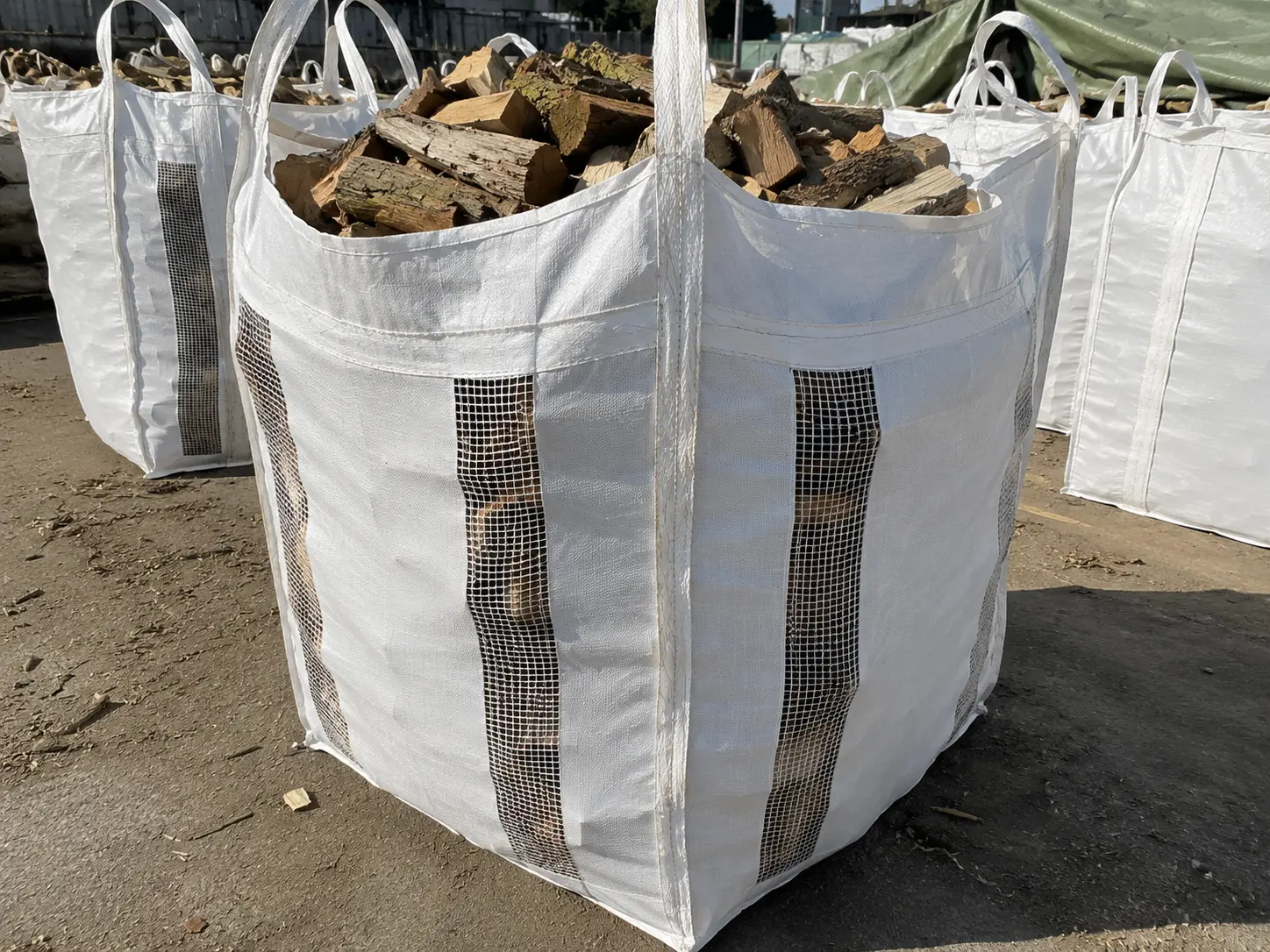
Ventilated Bag Applications at a Glance
| Product | Key need | Why ventilation matters |
|---|---|---|
| Firewood | Continued drying after bagging | Trapped moisture slows drying and promotes mold on stacked logs |
| Onions | Curing and humidity control | Onions release moisture post-harvest; trapped humidity causes rot |
| Potatoes | Airflow to prevent sprouting and rot | Excess humidity and heat buildup accelerate spoilage |
| Other produce | Varies by crop respiration rate | General principle: living produce needs airflow, not a sealed environment |
Why Airflow Matters More Than Sealing for These Products
Firewood isn’t fully dry when it’s bagged — it continues losing moisture, and a sealed bag traps that moisture against the wood, slowing drying and creating conditions for mold. Onions and potatoes are still biologically active after harvest, respiring and releasing moisture and heat; a sealed environment concentrates that humidity and accelerates rot far faster than open storage would. Open-weave fabric solves both problems by letting the bag breathe continuously rather than sealing the product into a static, increasingly humid environment.
Firewood-Specific Considerations
Firewood bags need dimensions matched to typical log lengths, since oversized empty space wastes bag volume while undersized bags force awkward stacking that can strain the fabric unevenly. Fill weight for firewood also varies more than for uniform granular products, since log density and moisture content differ batch to batch — confirm your bag’s rated capacity accounts for wetter, heavier wood rather than assuming a single weight figure covers all moisture conditions.
Agricultural Produce Considerations
Onions and potatoes both benefit from ventilated bags during curing — the period after harvest when the crop needs controlled airflow to develop proper skin and reduce moisture content before storage. Bag size for produce is typically driven more by handling logistics (forklift capacity, truck loading) than by a fixed industry standard, so confirm dimensions against your packhouse equipment rather than assuming a default size. Ventilation needs also don’t stop at the bag: stacking pattern and warehouse airflow around the bags affect curing outcomes as much as the bag’s own fabric.
Weave Density: Enough Airflow Without Losing Product
The open weave in a ventilated bag is calibrated to the product it’s built for — tight enough to contain firewood logs or produce, loose enough to let meaningful air through. This is different from a standard bag’s weave, which is woven for tensile strength and dust control rather than airflow. Product size dictates how open the weave can safely be: coarse, large items like firewood tolerate a more open weave than smaller produce like onions, where the weave needs to stay tighter while still allowing airflow.
What Ventilated Bags Can’t Do
Ventilated construction is specifically the wrong choice for fine powders, granules, or any moisture-sensitive product that needs sealing rather than airflow — the open weave that helps firewood and produce breathe would let fine material sift straight through, and it can’t be paired with a liner without defeating its own purpose. If your product needs both containment against fine particles and airflow, that combination doesn’t exist in ventilated construction; you’re likely looking at a different bag type or a different packaging approach entirely.
Common Mistakes When Specifying Ventilated Bags
- Assuming a tighter weave is always safer. Too tight a weave defeats the airflow purpose; match weave density to your specific product size, not a general instinct toward “more contained.”
- Using ventilated construction for a moisture-sensitive product that actually needs sealing. If the product needs protection from humidity rather than release of its own moisture, ventilated is the wrong direction entirely.
- Ignoring warehouse or curing environment airflow. The bag is one part of the system — stacking pattern and ambient ventilation matter for curing outcomes too.
- Sizing the bag off a generic standard rather than actual log length or produce handling needs. Firewood and produce logistics vary enough that a default size often doesn’t fit well.
- Requesting a liner “just in case.” A liner defeats ventilated construction’s purpose — if you think you need one, you likely need a different bag type, not an add-on to this one.
Ventilated Bags Combine With Other Specs, With Limits
Static protection and certification categories can technically apply to ventilated bags, but in practice firewood and produce rarely need either — these products aren’t combustible dust risks or UN-classified hazardous goods. Food grade status is the one combination worth considering for produce destined for retail packaging chains with traceability requirements, though the liner conflict above still applies: food grade’s PE liner and ventilated construction’s open weave don’t work together, so “food grade ventilated” isn’t a combination you can actually order. If your produce needs food-contact documentation, that’s a conversation about labeling and handling practices outside the bag’s construction, not a liner spec.
Decision Checklist
- Does your product continue releasing moisture or heat after bagging? That’s the core signal ventilated construction is the right fit.
- Is your product large enough to stay contained by an open weave? Fine powders and small granules aren’t suited to this construction.
- Do you need a liner for contamination or moisture-sealing? That contradicts ventilated construction’s purpose — reconsider bag type.
- Have you sized the bag to your specific product handling — log length, produce volume? Don’t assume a generic standard size fits your case.
- Does your storage or curing process rely on airflow beyond the bag itself? Factor stacking and warehouse ventilation into the full picture, not just the bag.
Before You Request a Quote
Send these details so we can confirm the right ventilated bag spec:
- Product — firewood, onions, potatoes, or other produce
- Typical fill weight and moisture content range
- Target dimensions based on your handling equipment
- Storage or curing duration before use
Request a quote and we’ll confirm weave density and dimensions against your actual product.
Common Questions
Why do firewood and produce need ventilated bags instead of standard ones?
Firewood needs to keep drying after bagging, and onions and potatoes continue respiring and releasing moisture after harvest — a solid-fabric bag traps that moisture and humidity, accelerating rot and mold. Open-weave ventilated fabric lets that moisture escape instead.
Will an open-weave bag let firewood or produce fall through the gaps?
No — the weave is sized to let air pass while still containing the product; it's a tighter weave than it might look, calibrated to the product size. Very small or fine materials aren't a good fit for ventilated construction regardless of weave tightness.
Can ventilated bags be used for onions and potatoes in the same construction?
Yes, the same open-weave fabric works for both, though bag size and typical fill weight often differ between the two based on each product's density and how it's handled in the field or packhouse.
Are ventilated bags suitable for any powder or fine granular product?
No. Ventilated construction is specifically wrong for fine powders and granules, which would sift through the open weave. It's suited only to products large enough to be contained by an open-weave fabric while needing airflow through it.
Do ventilated bags come with a liner?
No, adding a liner would defeat the purpose of ventilated construction by blocking the airflow the open weave is designed to allow. If your product needs both containment against fine sifting and airflow, that's a contradiction ventilated construction can't solve — it's the wrong bag type for that combination.