New vs Used Bulk Bags: Risks and Real Savings
Used FIBC bags cost less upfront but carry unknown load history and contamination risk. The real savings usually come from buying new multi-trip bags, not secondhand ones.
PackTonne Sourcing Desk · · 6 min read
Used FIBC bags cost less upfront, but carry unknown load history and, for food or hazardous products, real contamination risk. The bigger savings opportunity usually isn’t buying secondhand — it’s buying new bags designed and tested for multiple trips from the start. This guide breaks down when used bags make sense, when they don’t, and where the actual savings come from.
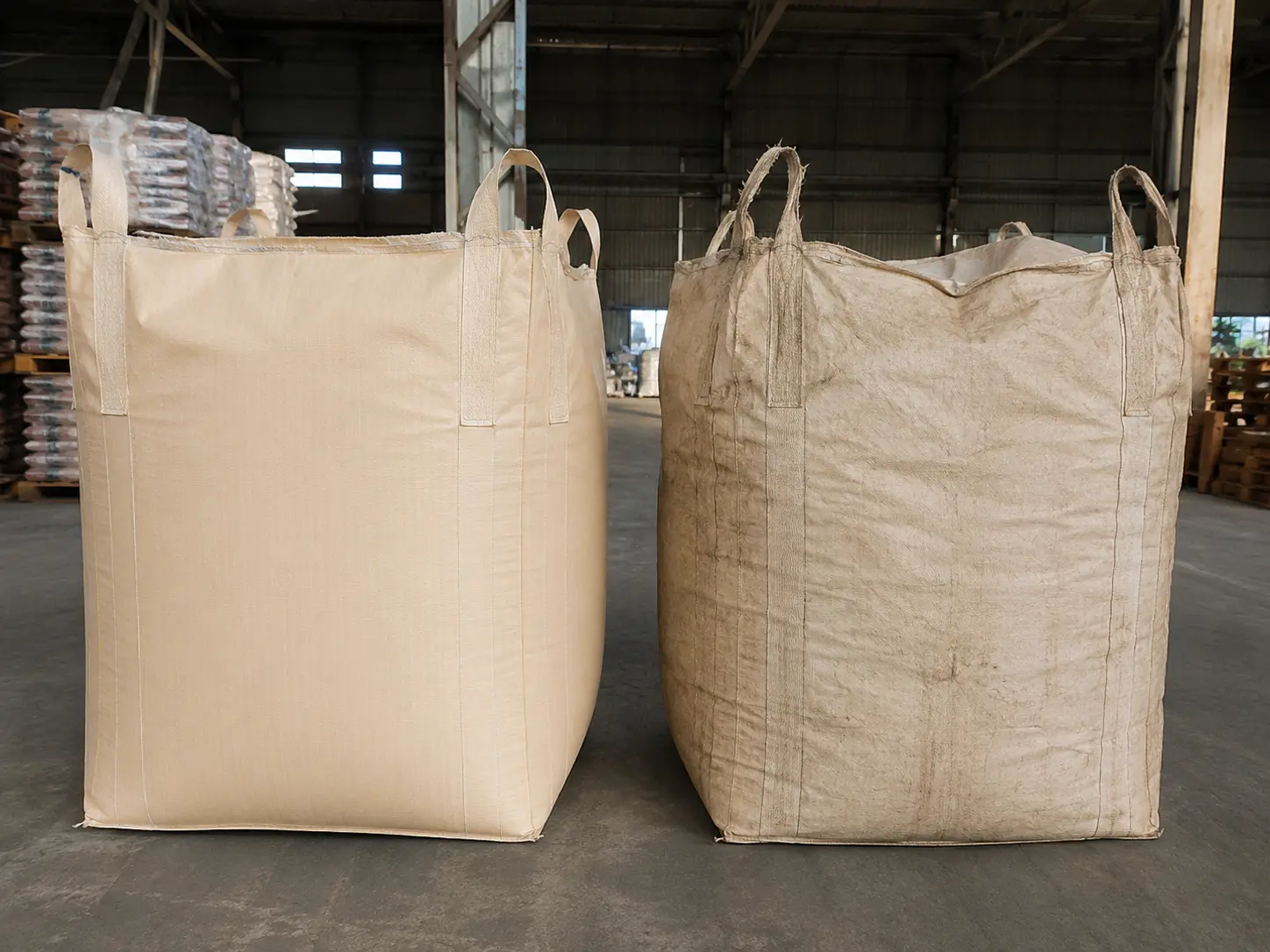
New vs Used at a Glance
| New (single-trip) | New (multi-trip) | Used | |
|---|---|---|---|
| Upfront cost | Lowest | Higher | Lowest |
| Safety factor | 5:1, verified | 6:1, verified | Unknown remaining margin |
| Load history | None — first use | None — first use | Unverifiable |
| Contamination risk | None | None | Depends on prior contents |
| Suitable for food/hazardous goods | Yes, if spec matches | Yes, if spec matches | No |
| Best fit | One-time, non-reuse loads | Recurring internal reuse | Low-risk, non-critical loads only |
What “Used” Actually Means
A used bag is one that’s already been filled and emptied at least once, sold on rather than discarded after its original use. Condition varies enormously — a bag from a single careful use looks and performs very differently from one that’s been through multiple rough handling cycles, and there’s usually no way to tell which you’re getting just by looking at it.
The Real Risk: Unknown Load History
Every FIBC bag has a rated safety factor — 5:1 for single-trip, 6:1 for multi-trip — based on tested performance under a known number of load cycles. A used bag’s remaining safety margin depends entirely on how it was actually used before you got it, information that’s almost never available unless the original seller kept batch-tracked records tied to that specific bag. A bag that looks fine can still have consumed most of its rated safety margin in ways that aren’t visible on inspection — stitching fatigue and fabric stress don’t always show as visible damage before they show as failure.
This is the same reasoning behind ISO 21898:2024’s cyclic top-lift test for multi-trip bags: 30 lift cycles at 2x safe working load, then a final cycle at 5x, all without seam splitting or loop failure. That standard exists precisely because repeated loading stresses a bag in ways a single visual check can’t catch. A used bag bought without that testing history is, in effect, skipping the verification step the standard was designed to provide.
Contamination Risk Rules Out Food and Hazardous Use
A used bag’s prior contents are rarely fully known, which makes reuse a genuine compliance problem for food grade or UN certified applications — there’s no way to verify a used bag meets the contamination controls those categories require. This isn’t a gray area: used bags simply aren’t an option for food, feed, pharmaceutical, or hazardous goods regardless of how good the price looks.
Certification and Safety Ratings Don’t Carry Over Cleanly
UN certification is locked to a specific tested design — fabric weight, coating, and liner all fixed together for that certification to hold. A used UN certified bag’s certification doesn’t reliably transfer with resale, since there’s no way to confirm the specific bag still matches its originally tested condition. Treat any “UN certified” claim on a used bag with skepticism unless there’s specific documentation tying it to that individual bag’s history.
When Buying Used Actually Makes Sense
Used bags fit a narrow but real use case: low-risk, non-critical, non-food products where the load is well below the bag’s original rating and a visual inspection can reasonably catch obvious wear — construction debris, some agricultural byproducts, internal material handling where a bag failure means inconvenience rather than a safety incident. Even here, inspect for visible fabric damage, stitching integrity at the loops, and liner condition before use.
Loading well under the original rated capacity matters more than it might seem — if a used bag was rated for 1000 kg new, filling it to 600–700 kg gives some margin for whatever safety factor has already been consumed, rather than testing what’s left of its rating at full load. This isn’t a substitute for knowing the bag’s real history, but it reduces the consequence if that unknown history turns out worse than assumed.
“Empty Bulk Bags” Searches Usually Mean Something Specific
Buyers searching for “empty bulk bags” are typically looking for unfilled bags to use as containers for their own material handling — storage, waste collection, internal transfer — not necessarily secondhand ones. If that’s your use case, the new-vs-used decision still applies: a new bag gives you a known safety rating from the start, while a used one carries the same unverifiable history problem regardless of what you’re calling the search.
Common Mistakes When Considering Used Bags
- Judging condition by appearance alone. Fabric stress and stitching fatigue don’t always show as visible damage before they show as failure under load.
- Assuming a “UN certified” label on a used bag still applies. Certification is tied to a specific tested design and condition — resale doesn’t carry a reliable guarantee that condition still holds.
- Using a used bag for food or hazardous product to save money. The compliance risk isn’t worth the savings — this is a hard no regardless of price.
- Not asking the seller about prior contents. Even for non-food use, knowing what a bag previously held helps you judge contamination and residue risk for your own product.
- Comparing only the sticker price against a new bag. Factor in the unknown remaining safety margin and inspection time before assuming used is actually cheaper for your use case.
The Better Savings Play: Buy New Multi-Trip Bags
If your actual goal is lowering cost per use rather than lowering upfront price, a new multi-trip bag — built and tested from the start for repeated use, meeting ISO 21898:2024’s cyclic top-lift test of 30 cycles at 2x safe working load plus a final cycle at 5x — usually delivers better real savings than buying secondhand. You get a known, tested safety margin across every trip instead of an unknown, degrading one. This is also where the industry is heading: the multi-trip woven PP bag market is projected to grow from roughly $6.6 billion in 2025 to $10.4 billion by 2036, as buyers shift from single-use toward reusable logistics.
Decision Checklist
- Is the product food, feed, pharmaceutical, or hazardous? Used bags are off the table — buy new.
- Do you know the bag’s prior load history? If not, treat its remaining safety margin as unknown.
- Is the application low-risk and non-critical? Used bags can be a reasonable cost-saving option here.
- Are you trying to lower cost per use over time, not just upfront price? A new multi-trip bag likely beats a used bag on that measure.
- Can you visually inspect before use? Check stitching at the loops, fabric condition, and liner integrity every time, regardless of source.
Before You Request a Quote
If you’re weighing new multi-trip bags against used ones, send us:
- Product type and whether it’s food, feed, or hazardous
- How many reuse cycles you’re planning for
- Target capacity and current single-use cost, if you have a comparison point
- Any certification requirements
Request a quote for multi-trip bags built for your reuse cycle, not a secondhand bag with an unknown history.
Common Questions
Is it safe to buy used bulk bags?
It depends on what you're packing. For non-critical, non-food, low-risk products, a visually sound used bag can work. For hazardous goods, food, or anything requiring UN or FDA compliance, used bags carry real risk because their load history and contamination exposure aren't verifiable.
How do I know how many times a used bulk bag has been filled?
In most cases, you can't. Unless the seller kept batch-level records tied to that specific bag, there's no reliable way to know how much of its safety factor has already been consumed by prior use — a real risk for any load-bearing application.
Can a single-trip bag be reused as a used bag?
It shouldn't be. Single-trip bags are tested and rated to a 5:1 safety factor for one use; reusing one beyond its rated trip count means operating outside its tested safety margin, which isn't something you can verify just by looking at it.
What's the difference between a used bag and a multi-trip bag?
A multi-trip bag is manufactured and tested from the start for repeated use — 6:1 safety factor, heavier fabric, reinforced stitching, tested against cyclic lift standards. A used bag is simply a single-trip or multi-trip bag that's already been filled at least once, with no guarantee of remaining safety margin.
Are used bulk bags a good way to save money?
Sometimes, for low-risk, non-critical applications where upfront cost matters more than long-term reliability. For anything load-bearing, hazardous, or food-contact, buying new multi-trip-rated bags usually delivers better real savings — lower cost per use over the bag's life, with a known and tested safety margin.